Browse by Category
Fiction
- Action & Adventure
- African American
- Anthologies
- Children's Fiction
- Classics
- Comics & Graphic Novels
- Coming of Age
- Contemporary
- Cultural & Regional
- Drama
- Erotica
- Fantasy
- General
- Historical Fiction
- Horror
- Humor & Satire
- Literary Fiction
- Mystery, Thriller & Suspense
- Poetry
- Religious & Inspirational
- Romance
- Science Fiction
- Short Stories
- War & Military
- Westerns
- Women's Fiction
- Young Adult
Non-Fiction
- Antiques & Collectibles
- Arts & Photography
- Biographies & Memoirs
- Business & Money
- Children's Non-Fiction
-
Computers & Technology
- Artificial Intelligence
- Computer Science
- Cybersecurity & Cryptography
- Data Science & Analytics
- Databases & Big Data
- Game Development & Design
- General
- Hardware & DIY
- Mobile App Development
- Networking & Cloud Computing
- Operating Systems
- Programming
- Robotics
- Software
- Software Engineering
- User Experience (UX) & Design
- Web Development & Design
- Cooking, Food & Wine
- Crafts, Hobbies & Home
- Education & Teaching
- Engineering
- General
- Health, Fitness & Dieting
-
History
- African History
- African History - North Africa
- African History - Sub-Saharan Africa
- American History
- American History - 20th Century
- American History - Civil War
- American History - Colonial Period
- Ancient History
- Asian History
- Asian History - China
- Asian History - India
- Asian History - Japan
- Asian History - Southeast Asia
- European History
- European History - Ancient Greece
- European History - Ancient Rome
- European History - Medieval
- European History - Modern
- European History - Renaissance
- General
- Middle Eastern History
- Military History
- Military History - Aviation
- Military History - Naval
- Social & Cultural History
- World History
- Humor & Entertainment
- Industrial Technology
- Language Learning
- Law
- LGBTQ+ Non-Fiction
- Literary Criticism
- Medical Books
- Parenting & Relationships
- Philosophy
- Politics & Social Sciences
- Reference
- Religion & Spirituality
-
Science & Math
- Agricultural Sciences
- Astronomy & Space Science
- Behavioral Sciences
- Biological Sciences
- Botany & Plant Science
- Chemistry
- Earth Sciences
- Engineering - Chemical
- Engineering - Civil
- Engineering - Electrical
- Engineering - Mechanical
- Environment
- General
- Geology
- Mathematics
- Nature & Ecology
- Oceanography
- Paleontology
- Physics
- Statistics
- Self-Help
- Sports & Outdoors
- Study Aids
- Sustainability & Green Living
- Textbooks
- Transportation
- Travel
- True Crime
- Urban Planning & Development
- Veterinary Medicine
- Writing & Publishing
Jump to Section

Want unlimited access to all books published by MixCache.com (plus their audiobooks)? Try MixCache.com Total Access. Look for the MTA badge on book covers to identify included titles.
Access to infinite ebooks: Don't see the book you want? Suggest it and we'll create it (free!) for you from scratch with our powerful AI book writer. Then read it with MTA - besides profiting from any sales it makes!
A History of Geology
About this book:
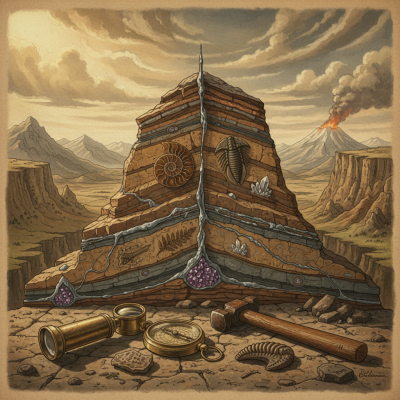
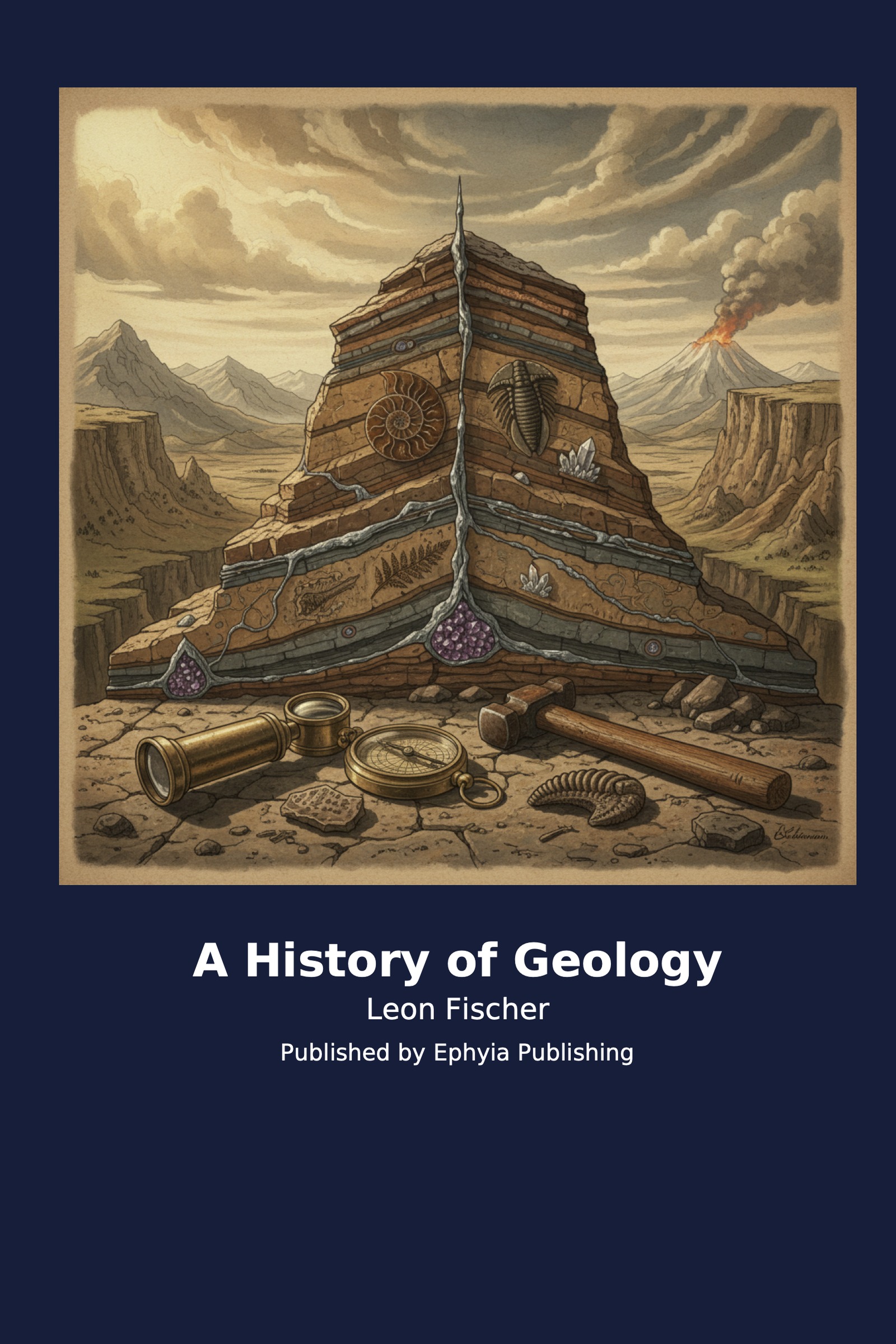
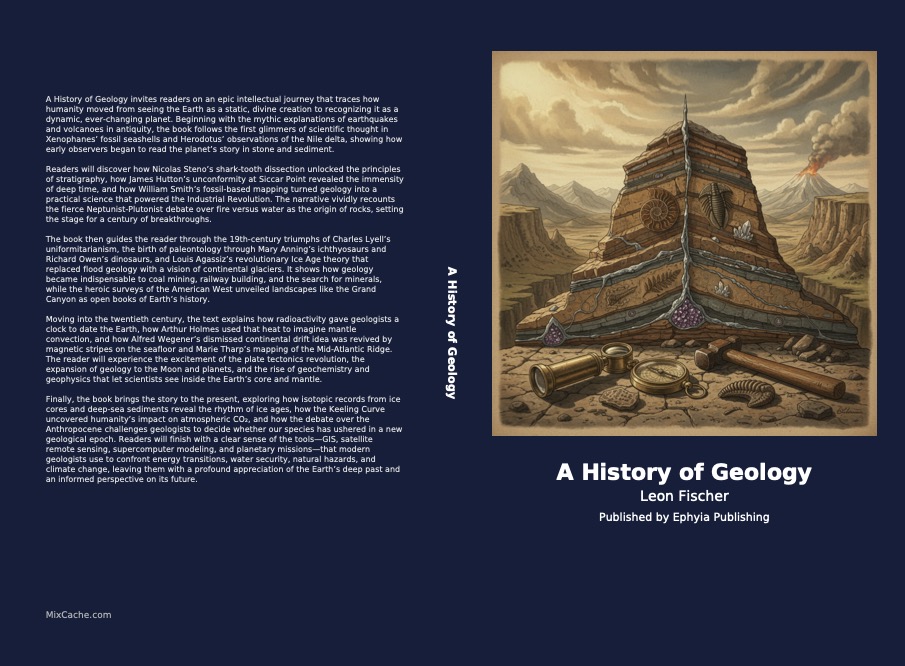
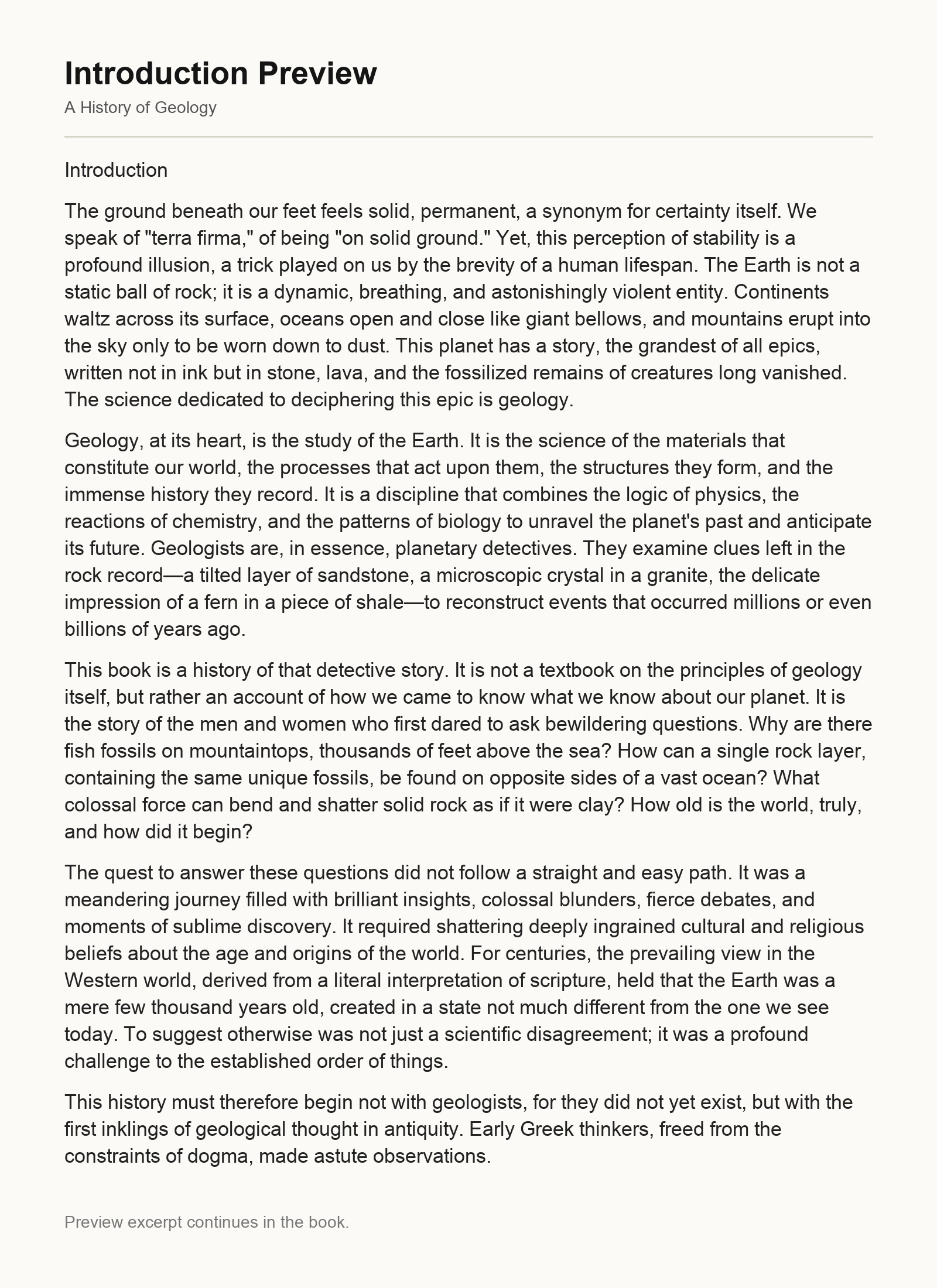
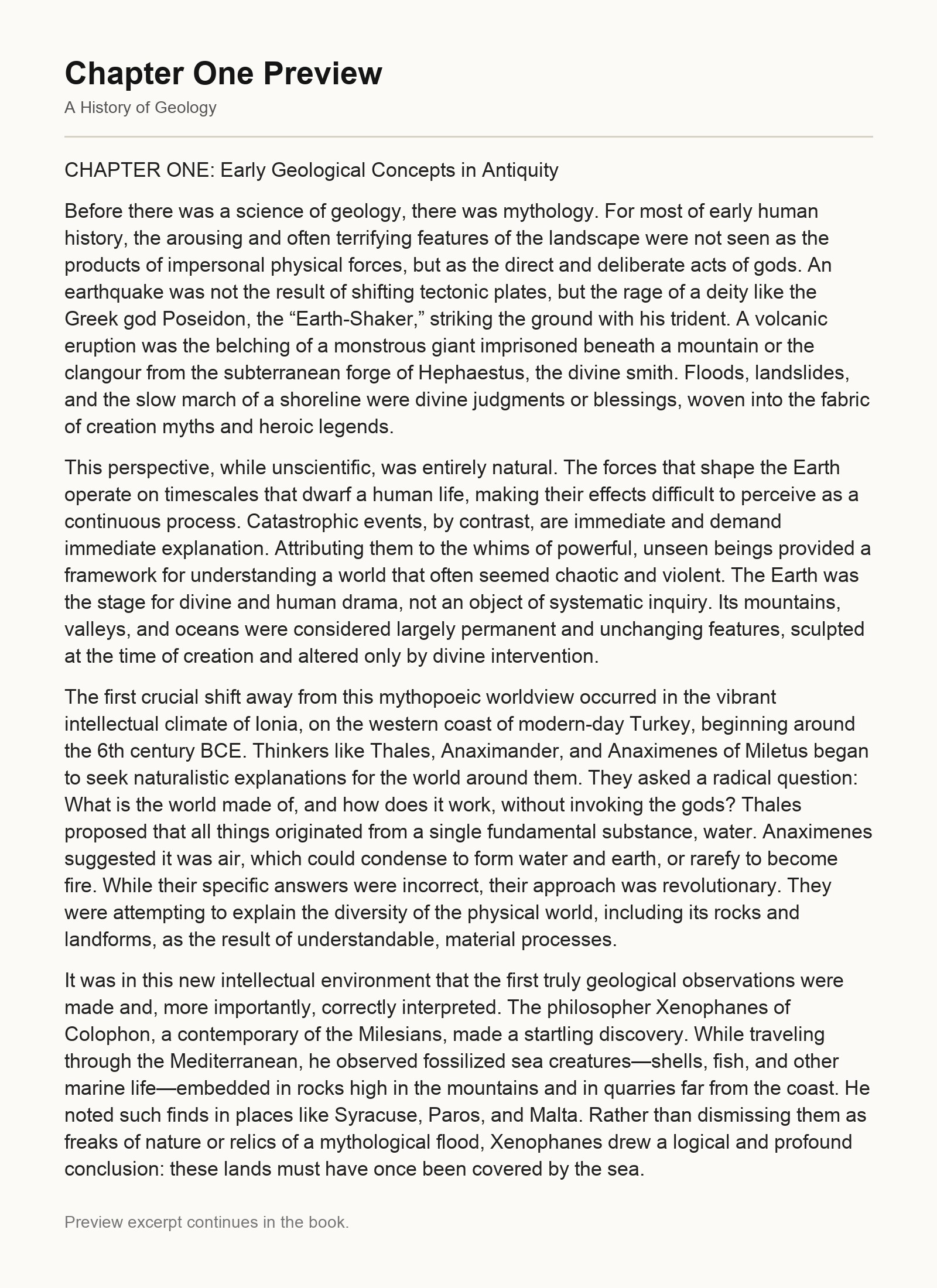
A History of Geology invites readers on an epic intellectual journey that traces how humanity moved from seeing the Earth as a static, divine creation to recognizing it as a dynamic, ever‑changing planet. Beginning with the mythic explanations of earthquakes and volcanoes in antiquity, the book follows the first glimmers of scientific thought in Xenophanes’ fossil seashells and Herodotus’ observations of the Nile delta, showing how early observers began to read the planet’s story in stone and sediment.
Readers will discover how Nicolas Steno’s shark‑tooth dissection unlocked the principles of stratigraphy, how James Hutton’s unconformity at Siccar Point revealed the immensity of deep time, and how William Smith’s fossil‑based mapping turned geology into a practical science that powered the Industrial Revolution. The narrative vividly recounts the fierce Neptunist‑Plutonist debate over fire versus water as the origin of rocks, setting the stage for a century of breakthroughs.
The book then guides the reader through the 19th‑century triumphs of Charles Lyell’s uniformitarianism, the birth of paleontology through Mary Anning’s ichthyosaurs and Richard Owen’s dinosaurs, and Louis Agassiz’s revolutionary Ice Age theory that replaced flood geology with a vision of continental glaciers. It shows how geology became indispensable to coal mining, railway building, and the search for minerals, while the heroic surveys of the American West unveiled landscapes like the Grand Canyon as open books of Earth’s history.
Moving into the twentieth century, the text explains how radioactivity gave geologists a clock to date the Earth, how Arthur Holmes used that heat to imagine mantle convection, and how Alfred Wegener’s dismissed continental drift idea was revived by magnetic stripes on the seafloor and Marie Tharp’s mapping of the Mid‑Atlantic Ridge. The reader will experience the excitement of the plate tectonics revolution, the expansion of geology to the Moon and planets, and the rise of geochemistry and geophysics that let scientists see inside the Earth’s core and mantle.
Finally, the book brings the story to the present, exploring how isotopic records from ice cores and deep‑sea sediments reveal the rhythm of ice ages, how the Keeling Curve uncovered humanity’s impact on atmospheric CO₂, and how the debate over the Anthropocene challenges geologists to decide whether our species has ushered in a new geological epoch. Readers will finish with a clear sense of the tools—GIS, satellite remote sensing, supercomputer modeling, and planetary missions—that modern geologists use to confront energy transitions, water security, natural hazards, and climate change, leaving them with a profound appreciation of the Earth’s deep past and an informed perspective on its future.
What You'll Find Inside:
- The book traces how geological thinking evolved from mythological explanations to a rigorous science grounded in observation and evidence.
- It highlights pivotal contributions—Steno’s stratigraphy, Hutton’s deep time, Smith’s faunal succession, and Wegener’s continental drift—that built the foundations of modern geology.
- Major scientific debates, such as Neptunism vs. Plutonism and Uniformitarianism vs. Catastrophism, are shown to have driven the discipline forward by testing and refining ideas.
- The integration of physics and chemistry through radiometric dating, seismology, and geochemistry provided absolute dates and revealed Earth’s internal dynamics.
- The text concludes with modern applications—resource exploration, hazard assessment, climate change research, and the ongoing debate over the Anthropocene epoch.
Who's It For:
This work is ideal for undergraduate geology students, earth‑science enthusiasts, and historians of science who want a clear, narrative‑driven account of how geological ideas developed over time. It also serves educators seeking a comprehensive yet accessible overview of the discipline’s evolution, and professionals looking to contextualize current challenges within the long history of geological thought.
Table of Contents:
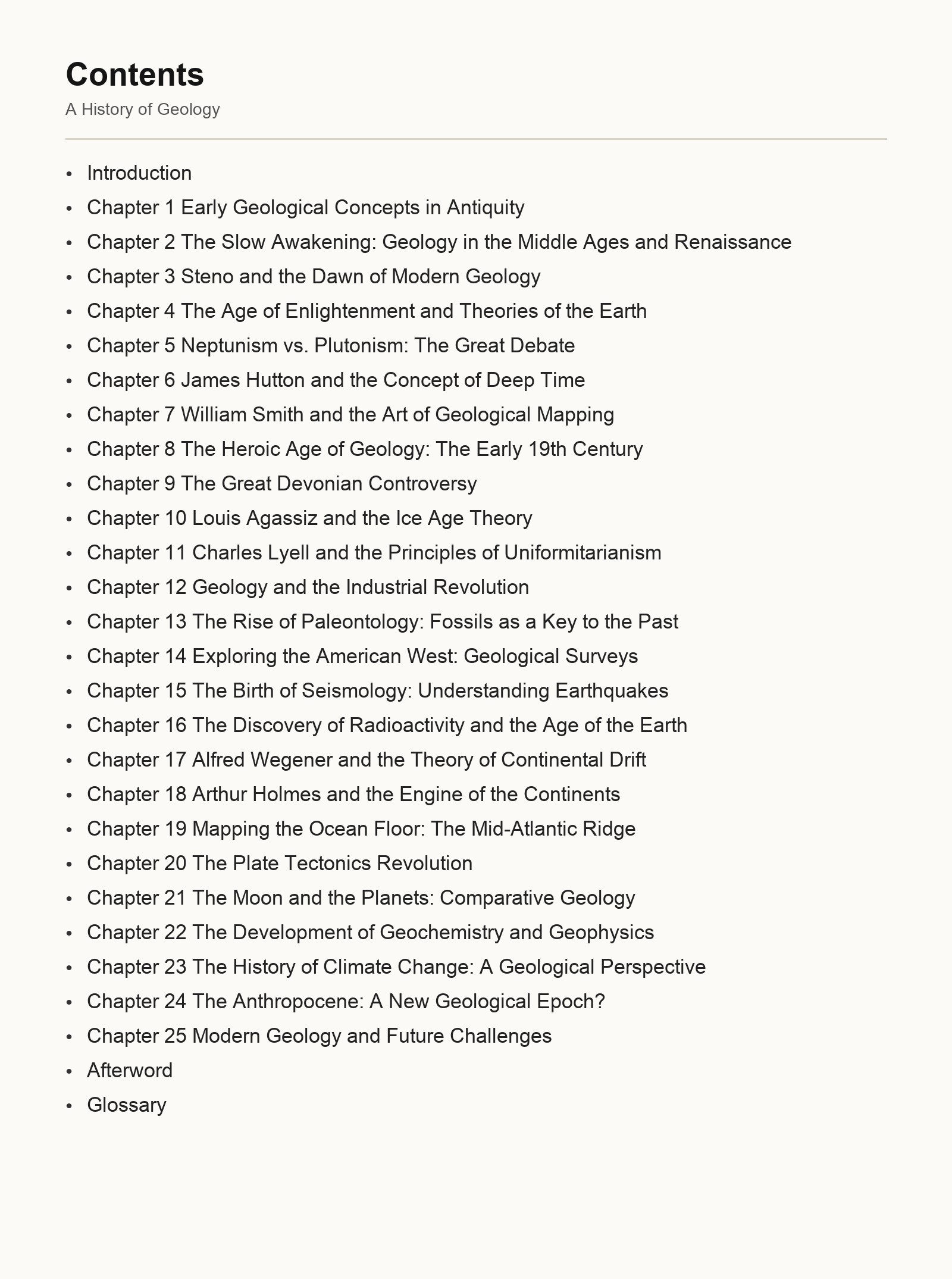
- Introduction
- Chapter 1 Early Geological Concepts in Antiquity
- Chapter 2 The Slow Awakening: Geology in the Middle Ages and Renaissance
- Chapter 3 Steno and the Dawn of Modern Geology
- Chapter 4 The Age of Enlightenment and Theories of the Earth
- Chapter 5 Neptunism vs. Plutonism: The Great Debate
- Chapter 6 James Hutton and the Concept of Deep Time
- Chapter 7 William Smith and the Art of Geological Mapping
- Chapter 8 The Heroic Age of Geology: The Early 19th Century
- Chapter 9 The Great Devonian Controversy
- Chapter 10 Louis Agassiz and the Ice Age Theory
- Chapter 11 Charles Lyell and the Principles of Uniformitarianism
- Chapter 12 Geology and the Industrial Revolution
- Chapter 13 The Rise of Paleontology: Fossils as a Key to the Past
- Chapter 14 Exploring the American West: Geological Surveys
- Chapter 15 The Birth of Seismology: Understanding Earthquakes
- Chapter 16 The Discovery of Radioactivity and the Age of the Earth
- Chapter 17 Alfred Wegener and the Theory of Continental Drift
- Chapter 18 Arthur Holmes and the Engine of the Continents
- Chapter 19 Mapping the Ocean Floor: The Mid-Atlantic Ridge
- Chapter 20 The Plate Tectonics Revolution
- Chapter 21 The Moon and the Planets: Comparative Geology
- Chapter 22 The Development of Geochemistry and Geophysics
- Chapter 23 The History of Climate Change: A Geological Perspective
- Chapter 24 The Anthropocene: A New Geological Epoch?
- Chapter 25 Modern Geology and Future Challenges
- Afterword
- Glossary
Author:
Published By:
Date Published:
May 16, 2026
Type:
Nonfiction
Language:
English
Also Available In:
Word Count:
52,699 words
Reading Time:
3 hours 41 minutes
Sample:
Order:
Order A History of Geology (Hardcover) on MixCache.com:
Buy NowPrint copy is made to order and ships worldwide. Includes the ebook free, ready to read instantly.
$5 account credit for all new MixCache.com accounts, usable toward any ebook purchase!*