Browse by Category
Fiction
- Action & Adventure
- African American
- Anthologies
- Children's Fiction
- Classics
- Comics & Graphic Novels
- Coming of Age
- Contemporary
- Cultural & Regional
- Drama
- Erotica
- Fantasy
- General
- Historical Fiction
- Horror
- Humor & Satire
- Literary Fiction
- Mystery, Thriller & Suspense
- Poetry
- Religious & Inspirational
- Romance
- Science Fiction
- Short Stories
- War & Military
- Westerns
- Women's Fiction
- Young Adult
Non-Fiction
- Antiques & Collectibles
- Arts & Photography
- Biographies & Memoirs
- Business & Money
- Children's Non-Fiction
-
Computers & Technology
- Artificial Intelligence
- Computer Science
- Cybersecurity & Cryptography
- Data Science & Analytics
- Databases & Big Data
- Game Development & Design
- General
- Hardware & DIY
- Mobile App Development
- Networking & Cloud Computing
- Operating Systems
- Programming
- Robotics
- Software
- Software Engineering
- User Experience (UX) & Design
- Web Development & Design
- Cooking, Food & Wine
- Crafts, Hobbies & Home
- Education & Teaching
- Engineering
- General
- Health, Fitness & Dieting
-
History
- African History
- African History - North Africa
- African History - Sub-Saharan Africa
- American History
- American History - 20th Century
- American History - Civil War
- American History - Colonial Period
- Ancient History
- Asian History
- Asian History - China
- Asian History - India
- Asian History - Japan
- Asian History - Southeast Asia
- European History
- European History - Ancient Greece
- European History - Ancient Rome
- European History - Medieval
- European History - Modern
- European History - Renaissance
- General
- Middle Eastern History
- Military History
- Military History - Aviation
- Military History - Naval
- Social & Cultural History
- World History
- Humor & Entertainment
- Industrial Technology
- Language Learning
- Law
- LGBTQ+ Non-Fiction
- Literary Criticism
- Medical Books
- Parenting & Relationships
- Philosophy
- Politics & Social Sciences
- Reference
- Religion & Spirituality
-
Science & Math
- Agricultural Sciences
- Astronomy & Space Science
- Behavioral Sciences
- Biological Sciences
- Botany & Plant Science
- Chemistry
- Earth Sciences
- Engineering - Chemical
- Engineering - Civil
- Engineering - Electrical
- Engineering - Mechanical
- Environment
- General
- Geology
- Mathematics
- Nature & Ecology
- Oceanography
- Paleontology
- Physics
- Statistics
- Self-Help
- Sports & Outdoors
- Study Aids
- Sustainability & Green Living
- Textbooks
- Transportation
- Travel
- True Crime
- Urban Planning & Development
- Veterinary Medicine
- Writing & Publishing
Jump to Section
MixCache.com Total Access
Unlimited reading and audiobooks for every book published by MixCache.com.
Included titles carry the MTA badge.
Learn more →
Paper Tigers and Iron Rice Bowls: Industrial Policy and Labor in 20th Century China
MTA
A study of industrial planning, worker life, and economic reforms from state socialism to market transition
About this book:
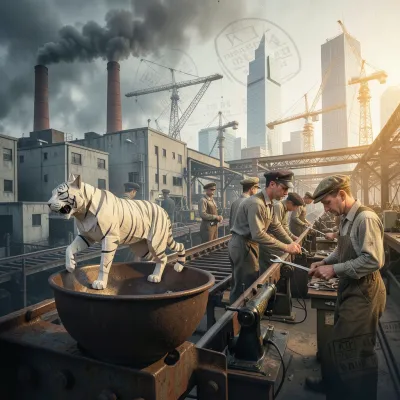
*Paper Tigers and Iron Rice Bowls* provides a comprehensive historical analysis of China’s industrial transformation throughout the 20th century, tracing the evolution from pre-1949 legacies to the command economy of the Maoist era and the eventual transition to market-oriented reforms. The book centers on the "work unit" (*danwei*) as a pivotal institution that fused production with social welfare, creating the "iron rice bowl"—a system of lifetime employment, housing, and healthcare that secured worker loyalty while imposing strict state control. This social compact was tested by tumultuous political campaigns like the Great Leap Forward and the Cultural Revolution, which prioritized ideological mobilization over technical efficiency, often with devastating human and economic consequences.
The narrative highlights the geographic and sectoral diversity of Chinese industry, contrasting the heavy-industry heartlands of the Northeast and Wuhan with the textile hubs of Tianjin and the sophisticated machinery plants of Shanghai. Through these case studies, the author illustrates how central planning relied on a "planner’s dilemma" of quotas and soft budget constraints, which encouraged report inflation and hidden inefficiencies. Meanwhile, rural industry under the commune system provided a precursor to the explosive growth of the reform era, demonstrating a persistent grassroots capacity for industrial improvisation outside of major urban centers.
With the onset of reforms under Deng Xiaoping, the book explores the deliberate dismantling of the *danwei* system and the "shattering" of the iron rice bowl. The 1990s restructuring of state-owned enterprises led to mass layoffs (*xiagang*) and privatization, shifting the burden of social risk onto individual workers. This transition gave rise to a two-tier labor regime: a struggling state sector and a dynamic, export-driven coastal economy powered by millions of migrant workers. These migrants, marginalized by the *hukou* (household registration) system, lived under "dormitory labor regimes" in places like Shenzhen, where they fueled China's rise as a global manufacturing power while being denied the social protections once afforded to the socialist proletariat.
Ultimately, the book examines the contemporary legacies of these policies, focusing on the emergence of labor activism, legal reforms, and the state’s obsessive focus on "stability maintenance." By documenting the physical and psychological toll on generations of workers—from occupational diseases to the precarity of the modern market—the study argues that China’s industrial success was built upon a profound human cost. The transition from socialist paternalism to global capitalism has left an unfinished legacy of inequality and social tension, where the state continues to negotiate its authority against the evolving aspirations and protests of its massive industrial workforce.
What You'll Find Inside:
- The danwei system functioned as a total institution integrating employment with comprehensive welfare (housing, healthcare, education, pensions), creating the 'iron rice bowl' of lifetime security while binding workers to state enterprises through material dependence.
- Industrial policy evolved from Soviet-inspired central planning (First Five-Year Plan) through mass mobilization campaigns (Great Leap Forward, Cultural Revolution) to market-oriented reforms including Special Economic Zones, enterprise autonomy, and state-owned enterprise restructuring in the 1980s-1990s.
- Political campaigns repeatedly subordinated technical rationality to ideological goals, resulting in initiatives like backyard furnaces that produced unusable steel while disrupting established industrial capacity and causing widespread human suffering.
- The reform era created dual labor regimes: privileged state-owned enterprise workers with eroding benefits versus migrant laborers in export factories facing precarious conditions without urban hukou protections or comprehensive welfare.
- Industrial policy's lasting legacies include regional inequalities (northeast rust belt vs. coastal boom), gendered labor expectations, evolving worker consciousness, and the ongoing tension between security assurances and market realities in China's economic transformation.
Who's It For:
This book is essential reading for students and scholars of modern Chinese history, labor economics, and political economy who seek to understand how industrial policy shaped workers' lives across the twentieth century. It will particularly benefit researchers interested in the social history of work, welfare systems, and the human consequences of economic transition, as well as policy analysts studying the challenges of industrial reform and labor market development in emerging economies.
Table of Contents:
- Introduction
- Chapter 1 Legacies of Industry before 1949: Empire, Republic, and War
- Chapter 2 Blueprints of Planning: The First Five-Year Plan and Soviet Influence
- Chapter 3 Building the Danwei: Work Units and the Iron Rice Bowl
- Chapter 4 Labor Discipline and Socialist Incentives on the Shop Floor
- Chapter 5 Welfare as Wage: Housing, Healthcare, and the Social Compact
- Chapter 6 Campaigns and Capacity: The Great Leap in the Factories
- Chapter 7 Politics in Production: Workers and the Cultural Revolution
- Chapter 8 Emulation and Exemplars: The Daqing and Anshan Models
- Chapter 9 Shanghai Machinery: Technology Transfer and Urban Labor
- Chapter 10 The Northeast Heavy-Industry Belt: Shenyang and Anshan
- Chapter 11 Steel and City: Wuhan’s Megaprojects and Municipal Power
- Chapter 12 Threads of Change: Tianjin Textiles and Women Workers
- Chapter 13 Counting, Quotas, and Soft Budgets: The Planner’s Dilemma
- Chapter 14 From Communes to Workshops: Rural Industry before Reform
- Chapter 15 Experiments at the Margin: Enterprise Autonomy, 1978–1984
- Chapter 16 Coastal Turn: Special Economic Zones and Shenzhen’s Rise
- Chapter 17 Township and Village Enterprises: Local Corporatism Ascendant
- Chapter 18 From Cadres to Managers: Corporate Governance in SOEs
- Chapter 19 Restructuring the State Sector: Privatization and Xiagang in the 1990s
- Chapter 20 Hukou and Mobility: Migrant Workers in a Changing Labor Regime
- Chapter 21 Dormitory Labor Regimes: The Pearl River Delta and Export Factories
- Chapter 22 Law, Unions, and Petitioning: The ACFTU and Legal Reform
- Chapter 23 After the Iron Rice Bowl: Social Insurance and Safety Nets
- Chapter 24 Risk, Precarity, and Protest: Stability Maintenance and Labor Politics
- Chapter 25 Legacies and Lessons: Industrial Policy’s Human Consequences
Author:
Published By:
Date Published:
May 15, 2026
Type:
Nonfiction
Language:
English
Word Count:
87,663 words
Reading Time:
6 hours 8 minutes
Sample:
Order:
Order Paper Tigers and Iron Rice Bowls: Industrial Policy and Labor in 20th Century China (Paperback) on MixCache.com:
Buy NowPrint copy is made to order and ships worldwide. Includes the ebook free, ready to read instantly.
$5 account credit for all new MixCache.com accounts, usable toward any ebook purchase!*