Browse by Category
Fiction
- Action & Adventure
- African American
- Anthologies
- Children's Fiction
- Classics
- Comics & Graphic Novels
- Coming of Age
- Contemporary
- Cultural & Regional
- Drama
- Erotica
- Fantasy
- General
- Historical Fiction
- Horror
- Humor & Satire
- Literary Fiction
- Mystery, Thriller & Suspense
- Poetry
- Religious & Inspirational
- Romance
- Science Fiction
- Short Stories
- War & Military
- Westerns
- Women's Fiction
- Young Adult
Non-Fiction
- Antiques & Collectibles
- Arts & Photography
- Biographies & Memoirs
- Business & Money
- Children's Non-Fiction
-
Computers & Technology
- Artificial Intelligence
- Computer Science
- Cybersecurity & Cryptography
- Data Science & Analytics
- Databases & Big Data
- Game Development & Design
- General
- Hardware & DIY
- Mobile App Development
- Networking & Cloud Computing
- Operating Systems
- Programming
- Robotics
- Software
- Software Engineering
- User Experience (UX) & Design
- Web Development & Design
- Cooking, Food & Wine
- Crafts, Hobbies & Home
- Education & Teaching
- Engineering
- General
- Health, Fitness & Dieting
-
History
- African History
- African History - North Africa
- African History - Sub-Saharan Africa
- American History
- American History - 20th Century
- American History - Civil War
- American History - Colonial Period
- Ancient History
- Asian History
- Asian History - China
- Asian History - India
- Asian History - Japan
- Asian History - Southeast Asia
- European History
- European History - Ancient Greece
- European History - Ancient Rome
- European History - Medieval
- European History - Modern
- European History - Renaissance
- General
- Middle Eastern History
- Military History
- Military History - Aviation
- Military History - Naval
- Social & Cultural History
- World History
- Humor & Entertainment
- Industrial Technology
- Language Learning
- Law
- LGBTQ+ Non-Fiction
- Literary Criticism
- Medical Books
- Parenting & Relationships
- Philosophy
- Politics & Social Sciences
- Reference
- Religion & Spirituality
-
Science & Math
- Agricultural Sciences
- Astronomy & Space Science
- Behavioral Sciences
- Biological Sciences
- Botany & Plant Science
- Chemistry
- Earth Sciences
- Engineering - Chemical
- Engineering - Civil
- Engineering - Electrical
- Engineering - Mechanical
- Environment
- General
- Geology
- Mathematics
- Nature & Ecology
- Oceanography
- Paleontology
- Physics
- Statistics
- Self-Help
- Sports & Outdoors
- Study Aids
- Sustainability & Green Living
- Textbooks
- Transportation
- Travel
- True Crime
- Urban Planning & Development
- Veterinary Medicine
- Writing & Publishing
Jump to Section

Want unlimited access to all books published by MixCache.com (plus their audiobooks)? Try MixCache.com Total Access. Look for the MTA badge on book covers to identify included titles.
Access to infinite ebooks: Don't see the book you want? Suggest it and we'll create it (free!) for you from scratch with our powerful AI book writer. Then read it with MTA - besides profiting from any sales it makes!
The Quiet Countryside: Agrarian Life and Rural Change in Europe
MTA
A social and economic history of European peasantries, land use, and rural reform
About this book:
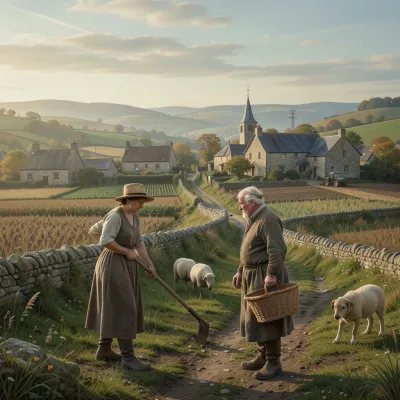
"The Quiet Countryside: Agrarian Life and Rural Change in Europe" provides a comprehensive social and economic history of European peasantries, land use, and rural reform from the medieval period to the present day. The book challenges the notion of the countryside as a static entity, instead presenting it as a dynamic arena shaped by power, knowledge, and ecological interactions. It traces four key processes: enclosure and the reconfiguration of common rights, the evolution of tenancy and property regimes, agricultural innovation, and rural migration, all framed within a nuanced environmental history.
The narrative begins by defining the diverse landscapes and lifeworlds of the European countryside, moving through the medieval manorial system, the significance of commons and open fields, and the complex relationships between lords, tenants, and serfs. It details the profound impacts of climate, famine, and environmental pressures, alongside the transformative influences of early modern markets and proto-industry on household strategies. The book then delves into the dramatic remaking of space through enclosure, the intricacies of tenure and taxation by the fiscal state, and the slow but significant adoption of agricultural innovations in rotations, tools, and knowledge networks, highlighting the crucial role of animals, soils, and nutrient cycling.
Later chapters explore the often-overlooked contributions of women's work to household economies and the extensive migration circuits—seasonal labor, emigration, and urbanization—that continuously reshaped rural demographics. The book also dedicates attention to peripheral countrysides, such as Mediterranean latifundia and mountain farms, demonstrating their unique adaptations and challenges. It then examines the accelerating impact of market integration through the development of roads, canals, and railways, and the profound political upheavals of revolutions and reforms between 1789 and 1848 on village life. The cooperative movement, from credit societies to dairies, is presented as a crucial strategy for mutual aid and economic resilience.
The twentieth century brought further radical changes: Europe's entanglement in a global food system driven by empire and grain, the increasing role of science and the state in addressing the "agrarian question," and the catastrophic impact of two world wars that led to scarcity and forced reconstruction. Collectivization in Eastern Europe is explored as a distinct and often violent path of rural transformation, contrasted with the rise of welfare states and the Common Agricultural Policy in postwar Western Europe, which spurred "green revolutions" through mechanization and chemicals, pushing yield frontiers but also creating new environmental dilemmas. Finally, the book addresses the cultural representations of rural life in literature, music, and film, and the continuous history of protest and environmentalism surrounding land and law, concluding with a reflection on contemporary depopulation, amenity migration, and the uncertain futures of Europe's villages.
What You'll Find Inside:
- The book traces how enclosure, technological innovation, and evolving land tenure systems continuously reshaped Europe's countryside from medieval times to the present
- It examines the sophisticated systems of commons and open-field management that structured rural life for centuries before gradual privatization
- Environmental history reveals how rural societies adapted to climate variability, soil exhaustion, and other ecological pressures through resilience strategies
- Rural migration patterns—seasonal, circular, and permanent—connected villages to cities and global markets, redistributing labor and ideas
- Gendered labor divisions reveal women's central role in household economies, food processing, and maintaining rural livelihoods
Who's It For:
This book is written for environmental historians, agricultural historians, and readers seeking to understand how today's European food systems and land policies are rooted in historical processes. It will particularly benefit students and scholars of rural history, policymakers working on agricultural sustainability, and anyone interested in the long-term dynamics of peasantries, land use, and rural reform across Europe.
Author:
Published By:
Date Published:
May 14, 2026
Type:
Nonfiction
Language:
English
Word Count:
79,232 words
Reading Time:
5 hours 33 minutes
Sample:
Order:
Order The Quiet Countryside: Agrarian Life and Rural Change in Europe (Hardcover) on MixCache.com:
Buy NowPrint copy is made to order and ships worldwide. Includes the ebook free, ready to read instantly.
$5 account credit for all new MixCache.com accounts, usable toward any ebook purchase!*