
Browse by Category
Fiction
- Action & Adventure
- African American
- Anthologies
- Children's Fiction
- Classics
- Comics & Graphic Novels
- Coming of Age
- Contemporary
- Cultural & Regional
- Drama
- Erotica
- Fantasy
- General
- Historical Fiction
- Horror
- Humor & Satire
- Literary Fiction
- Mystery, Thriller & Suspense
- Poetry
- Religious & Inspirational
- Romance
- Science Fiction
- Short Stories
- War & Military
- Westerns
- Women's Fiction
- Young Adult
Non-Fiction
- Antiques & Collectibles
- Arts & Photography
- Biographies & Memoirs
- Business & Money
- Children's Non-Fiction
-
Computers & Technology
- Artificial Intelligence
- Computer Science
- Cybersecurity & Cryptography
- Data Science & Analytics
- Databases & Big Data
- Game Development & Design
- General
- Hardware & DIY
- Mobile App Development
- Networking & Cloud Computing
- Operating Systems
- Programming
- Robotics
- Software
- Software Engineering
- User Experience (UX) & Design
- Web Development & Design
- Cooking, Food & Wine
- Crafts, Hobbies & Home
- Education & Teaching
- Engineering
- General
- Health, Fitness & Dieting
-
History
- African History
- African History - North Africa
- African History - Sub-Saharan Africa
- American History
- American History - 20th Century
- American History - Civil War
- American History - Colonial Period
- Ancient History
- Asian History
- Asian History - China
- Asian History - India
- Asian History - Japan
- Asian History - Southeast Asia
- European History
- European History - Ancient Greece
- European History - Ancient Rome
- European History - Medieval
- European History - Modern
- European History - Renaissance
- General
- Middle Eastern History
- Military History
- Military History - Aviation
- Military History - Naval
- Social & Cultural History
- World History
- Humor & Entertainment
- Industrial Technology
- Language Learning
- Law
- LGBTQ+ Non-Fiction
- Literary Criticism
- Medical Books
- Parenting & Relationships
- Philosophy
- Politics & Social Sciences
- Reference
- Religion & Spirituality
-
Science & Math
- Agricultural Sciences
- Astronomy & Space Science
- Behavioral Sciences
- Biological Sciences
- Botany & Plant Science
- Chemistry
- Earth Sciences
- Engineering - Chemical
- Engineering - Civil
- Engineering - Electrical
- Engineering - Mechanical
- Environment
- General
- Geology
- Mathematics
- Nature & Ecology
- Oceanography
- Paleontology
- Physics
- Statistics
- Self-Help
- Sports & Outdoors
- Study Aids
- Sustainability & Green Living
- Textbooks
- Transportation
- Travel
- True Crime
- Urban Planning & Development
- Veterinary Medicine
- Writing & Publishing
Jump to Section
MixCache.com Total Access
Unlimited reading and audiobooks for every book published by MixCache.com.
Included titles carry the MTA badge.
Learn more →
Faith and Power: Religion's Role in European Politics
MTA
How Christianity, the Reformation, and secularization influenced European governance and conflict
About this book:
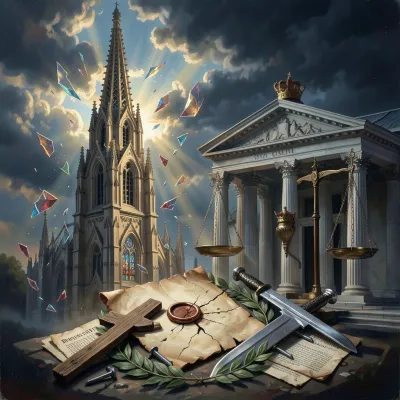
*Faith and Power: Religion's Role in European Politics* examines the enduring influence of Christianity on European governance from late antiquity to the contemporary era. The book begins by tracing the transformation of the Roman Empire into Christendom, highlighting how the fusion of imperial authority and church doctrine under figures like Constantine and Theodosius I created a template for medieval political legitimacy. It explores the tension between "throne and altar" through the Investiture Struggle and the development of canon law, which provided an administrative and legal framework that shaped the architecture of modern statecraft and judicial procedure.
The narrative shifts to the fragmentation of Western religious unity during the Reformation. It analyzes how Martin Luther’s "two kingdoms" doctrine and John Calvin’s model of moral discipline in Geneva transformed theology into a tool for state-building and social control. This period of "confessionalization" saw European rulers use religious identity to consolidate territorial sovereignty, a process that eventually culminated in the catastrophic Thirty Years’ War. The resulting Peace of Westphalia in 1648 is presented as a pivotal moment that established the sovereign state system, successfully re-containing religious conflict by prioritizing *raison d'état* over confessional solidarity.
The book then follows the trajectory of religion through the Enlightenment and the French Revolution, illustrating how the rise of secular rationalism and republicanism stripped churches of their traditional land and legal privileges. It traces the 19th-century emergence of Social Catholicism and Christian Democracy as the Church’s response to industrialization and liberalism, followed by the harrowing challenges posed by 20th-century totalitarianism. While communism sought the eradication of faith, fascist regimes often attempted to co-opt it, forcing churches into difficult positions of collaboration, quiet endurance, or principled resistance.
In its final chapters, the text addresses the post-war landscape, from the reforms of Vatican II to the institutionalization of European integration. It concludes with a modern analysis of secularization and pluralism, noting that while institutional religious practice has declined in Western Europe, faith remains a potent political force. The arrival of Islam as a significant European religion and the rise of right-wing populists who invoke "Christian heritage" as a civilizational boundary demonstrate that the historical dialogue between faith and power continues to be a central, contested feature of European identity and governance.
What You'll Find Inside:
- How Christianity transformed late Roman governance through imperial patronage, ecclesiastical courts, and the migration of spiritual authority from emperor to pope
- The Reformation's creation of confessional politics where rulers gained authority to determine their subjects' religion, reshaping European state-building
- How confessionalization synchronized catechisms, courts, and coercion to forge disciplined communities and bureaucratic capacities in early modern states
- The Enlightenment's secularizing impact that reallocated spiritual authority into rights-based discourse while enabling state control of churches through concordats and cultural campaigns
- Contemporary Europe's religious pluralism challenges from migration, Islam, and populist movements that renew debates about identity, law, and neutrality
Who's It For:
This book is intended for students, scholars, and educated readers interested in European history, religious studies, and political science. It will particularly benefit those seeking to understand the historical foundations of contemporary European debates about secularism, religious identity, migration, and the relationship between faith and state power. Readers will gain insight into how theological developments and social realities have co-produced European governance patterns over two millennia, from the late antique transformation of the Roman Empire to modern challenges of pluralism and populism.
Table of Contents:
- Introduction
- Chapter 1 From Empire to Christendom: The Late Antique Transformation
- Chapter 2 The Papacy and Princes: Authority, Law, and the Investiture Struggle
- Chapter 3 Canon Law and the Architecture of Medieval Governance
- Chapter 4 Monastic Powerhouses: Orders, Learning, and Administrative Reach
- Chapter 5 Crusade, Heresy, and the Politics of Unity
- Chapter 6 Cities of God and Man: Urban Communes, Guilds, and Lay Piety
- Chapter 7 Print, Humanism, and Pre-Reformation Dissent
- Chapter 8 Luther and the Birth of Confessional Politics
- Chapter 9 Calvin’s Geneva and Reformed Models of Discipline
- Chapter 10 The Radical Reformation and Early Toleration Debates
- Chapter 11 Confessionalization: State-Building Through Faith
- Chapter 12 The Habsburgs, Rome, and Catholic Restoration
- Chapter 13 Wars of Religion in France, the Netherlands, and the Isles
- Chapter 14 The Thirty Years’ War and the Peace of Westphalia
- Chapter 15 Peripheries and Frontiers: Scandinavia, Poland-Lithuania, and Russia
- Chapter 16 Enlightenment, Skepticism, and the Secularizing State
- Chapter 17 Revolution and Church: 1789–1815
- Chapter 18 Concordats, Kulturkampf, and National Churches
- Chapter 19 Liberalism, Social Catholicism, and Christian Democracy
- Chapter 20 Faith under Authoritarianism: Fascism, Communism, and the Churches
- Chapter 21 Renewal and Reform: Vatican II and Ecumenical Currents
- Chapter 22 Building Europe: Integration, Memory, and Christian Thought
- Chapter 23 Secularization Revisited: Data, Debates, and Divergent Paths
- Chapter 24 Islam, Migration, and Plural Pluralism in Contemporary Europe
- Chapter 25 Populism, Identity, and the Future of Religion in European Politics
Author:
Published By:
Date Published:
May 14, 2026
Type:
Nonfiction
Language:
English
Word Count:
86,080 words
Reading Time:
6 hours 2 minutes
Sample:
Order:
Order Faith and Power: Religion's Role in European Politics (Paperback) on MixCache.com:
Buy NowPrint copy is made to order and ships worldwide. Includes the ebook free, ready to read instantly.
$5 account credit for all new MixCache.com accounts, usable toward any ebook purchase!*


