Browse by Category
Fiction
- Action & Adventure
- African American
- Anthologies
- Children's Fiction
- Classics
- Comics & Graphic Novels
- Coming of Age
- Contemporary
- Cultural & Regional
- Drama
- Erotica
- Fantasy
- General
- Historical Fiction
- Horror
- Humor & Satire
- Literary Fiction
- Mystery, Thriller & Suspense
- Poetry
- Religious & Inspirational
- Romance
- Science Fiction
- Short Stories
- War & Military
- Westerns
- Women's Fiction
- Young Adult
Non-Fiction
- Antiques & Collectibles
- Arts & Photography
- Biographies & Memoirs
- Business & Money
- Children's Non-Fiction
-
Computers & Technology
- Artificial Intelligence
- Computer Science
- Cybersecurity & Cryptography
- Data Science & Analytics
- Databases & Big Data
- Game Development & Design
- General
- Hardware & DIY
- Mobile App Development
- Networking & Cloud Computing
- Operating Systems
- Programming
- Robotics
- Software
- Software Engineering
- User Experience (UX) & Design
- Web Development & Design
- Cooking, Food & Wine
- Crafts, Hobbies & Home
- Education & Teaching
- Engineering
- General
- Health, Fitness & Dieting
-
History
- African History
- African History - North Africa
- African History - Sub-Saharan Africa
- American History
- American History - 20th Century
- American History - Civil War
- American History - Colonial Period
- Ancient History
- Asian History
- Asian History - China
- Asian History - India
- Asian History - Japan
- Asian History - Southeast Asia
- European History
- European History - Ancient Greece
- European History - Ancient Rome
- European History - Medieval
- European History - Modern
- European History - Renaissance
- General
- Middle Eastern History
- Military History
- Military History - Aviation
- Military History - Naval
- Social & Cultural History
- World History
- Humor & Entertainment
- Industrial Technology
- Language Learning
- Law
- LGBTQ+ Non-Fiction
- Literary Criticism
- Medical Books
- Parenting & Relationships
- Philosophy
- Politics & Social Sciences
- Reference
- Religion & Spirituality
-
Science & Math
- Agricultural Sciences
- Astronomy & Space Science
- Behavioral Sciences
- Biological Sciences
- Botany & Plant Science
- Chemistry
- Earth Sciences
- Engineering - Chemical
- Engineering - Civil
- Engineering - Electrical
- Engineering - Mechanical
- Environment
- General
- Geology
- Mathematics
- Nature & Ecology
- Oceanography
- Paleontology
- Physics
- Statistics
- Self-Help
- Sports & Outdoors
- Study Aids
- Sustainability & Green Living
- Textbooks
- Transportation
- Travel
- True Crime
- Urban Planning & Development
- Veterinary Medicine
- Writing & Publishing
Jump to Section
MixCache.com Total Access
Unlimited reading and audiobooks for every book published by MixCache.com.
Included titles carry the MTA badge.
Learn more →
Cultural Crossroads: Migration, Exchange, and Identity in Mediterranean Europe
MTA
A focused study of cultural hybridity, diasporas, and artistic exchange around the Mediterranean basin
About this book:
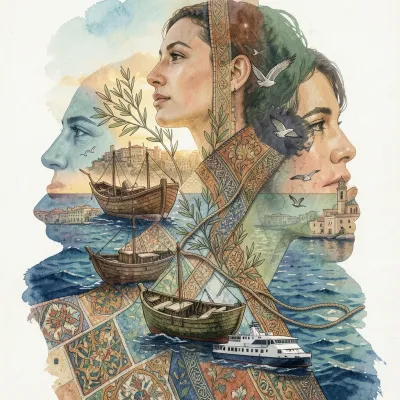
*Cultural Crossroads* presents the Mediterranean basin not as a static boundary between continents, but as a centuries-long "experiment in living with difference." Moving from antiquity to the modern era, the book employs the concepts of hybridity, diaspora, and connectivity to demonstrate how the sea has functioned as a conduit for the continuous remaking of identities. From the early maritime trade of the Phoenicians and the cosmopolitan citizenship of Rome to the intellectual efflorescence of the Islamic Mediterranean, the text traces how people, objects, and ideas—from silk and ceramics to algebra and Aristotelian philosophy—traveled across confessional and political lines, creating a shared cultural substratum.
Central to the narrative are specific "cities of hybridity" and historical "crossroads" such as Al-Andalus, Norman Sicily, and the Ottoman port cities of Thessaloniki, Izmir, and Alexandria. In these urban laboratories, the book explores how the legal frameworks of religious pluralism, such as the Ottoman *millet* system, allowed for a pragmatic, if often hierarchical, coexistence. The study moves beyond elite history to examine "port lives," detailing how gender roles, family-based merchant networks, and everyday rituals in marketplaces and bathhouses sustained a pervasive cosmopolitanism. This is further evidenced by the linguistic evolution of the region, including the development of the Mediterranean Lingua Franca and the persistence of Judeo-Spanish (Ladino) among the Sephardic diaspora.
The book also addresses the darker "archives of entanglement," acknowledging that mobility was often forced through slavery, piracy, and captivity. It highlights how the forced movement of people—whether through the Barbary corsair trade or the later nationalist-driven population exchanges—paradoxically served as a vehicle for cultural transfer, as captives and refugees carried their languages, music, and culinary techniques to new shores. The material culture of the Mediterranean, from the gold-ground icons of Byzantium to the lustreware of Islamic Spain, is analyzed as a record of these encounters, proving that artistic techniques migrated with the hands of mobile craftsmen regardless of political frontiers.
In its concluding chapters, the work examines the fracturing of this cosmopolitan world with the rise of the nation-state, colonial incursions, and rigid modern borders. It argues that the twentieth-century shift toward cultural homogeneity was a radical departure from the Mediterranean’s pluralistic past, resulting in the tragic displacement of ancient minorities. Finally, the book connects this history to contemporary debates on migration and heritage, suggesting that the Mediterranean’s deep time of entanglement provides a vital template for understanding modern identity. It insists that the region’s true character lies in its role as a bridge, where culture is not a bounded possession but a relation continually remade through contact.
What You'll Find Inside:
- The Mediterranean operates as a dynamic zone of connection where cultural hybridity emerges through sustained contact between peoples, objects, and ideas across millennia, challenging notions of fixed boundaries.
- Diaspora communities functioned as engines of cultural transfer through social technologies like kinship networks, credit systems, and shared rituals that built trust across linguistic and political divides.
- Artistic and architectural exchange reveals layered histories of influence, with objects and buildings serving as material evidence of cross-cultural encounter, adaptation, and the palimpsest nature of Mediterranean culture.
- Religious pluralism created zones of negotiation and exchange where translation, shared commercial interests, and proximate living fostered cultural transfer between Jews, Christians, and Muslims despite periods of tension.
- Historical patterns of Mediterranean entanglement illuminate contemporary debates on migration, heritage, and belonging, demonstrating that mixture is a continuing condition rather than a historical exception.
Who's It For:
This book is ideal for undergraduate and graduate students in history, anthropology, religious studies, and cultural studies focusing on the Mediterranean region. It will also benefit scholars of diaspora studies, world history, and postcolonial theory interested in interconnected historical approaches. General readers with an interest in cultural hybridity, trade networks, or the historical roots of contemporary Mediterranean migration and identity debates will find the accessible yet scholarly narrative particularly valuable.
Table of Contents:
- Introduction
- Chapter 1 Mapping the Sea of Connections: Concepts and Methods
- Chapter 2 Shores in Contact: Geographies of Passage from Iberia to the Levant
- Chapter 3 From Phoenicians to Hellenistic Worlds: Early Diasporas and Hybridities
- Chapter 4 Rome and the Cosmopolis: Citizenship, Mobility, and Multilingualism
- Chapter 5 Faiths in Proximity: Religious Pluralism from Late Antiquity to Byzantium
- Chapter 6 The Islamic Mediterranean: Conquest, Exchange, and Translation
- Chapter 7 Al-Andalus: Convivencia, Contestation, and Cultural Transfer
- Chapter 8 Sicily as Crossroads: Norman, Arab, and Byzantine Entanglements
- Chapter 9 Crusades and Commerce: The Latin East and Levantine Ports
- Chapter 10 Venice and Genoa: Merchant Republics and Maritime Empires
- Chapter 11 The Ottoman Sea: Governance, Port Cities, and Mixed Communities
- Chapter 12 Sephardic Migrations after 1492: Routes, Memory, and Reinvention
- Chapter 13 Maghrebi and Syrian Trade Diasporas: Letters, Credit, and Trust
- Chapter 14 Archives of Entanglement: The Cairo Geniza and Other Windows
- Chapter 15 Slavery, Captivity, and Redemption: Mobility under Constraint
- Chapter 16 Pilgrimage, Scholars, and Translators: Circulations of Knowledge
- Chapter 17 Art on the Move: Icons, Textiles, Ceramics, and Architecture
- Chapter 18 Languages in Contact: Lingua Franca, Judeo-Spanish, and Merchant Pidgins
- Chapter 19 Cities of Hybridity: Thessaloniki, Izmir, Alexandria, and Tunis
- Chapter 20 Port Lives: Gender, Family, and Everyday Cosmopolitanism
- Chapter 21 After Empire: Nation-States, Borders, and Minorities
- Chapter 22 Exile and Remigration: Greeks, Italians, and Iberians, 19th–20th Centuries
- Chapter 23 Colonial Encounters: North Africa, the Levant, and European Visions
- Chapter 24 Music, Food, and Popular Culture: Tastes of Entanglement
- Chapter 25 The Contemporary Mediterranean: Migration, Heritage, and Belonging
Author:
Published By:
Date Published:
May 14, 2026
Type:
Nonfiction
Language:
English
Word Count:
69,144 words
Reading Time:
4 hours 51 minutes
Sample:
Order:
Order Cultural Crossroads: Migration, Exchange, and Identity in Mediterranean Europe (Paperback) on MixCache.com:
Buy NowPrint copy is made to order and ships worldwide. Includes the ebook free, ready to read instantly.
$5 account credit for all new MixCache.com accounts, usable toward any ebook purchase!*