Browse by Category
Fiction
- Action & Adventure
- African American
- Anthologies
- Children's Fiction
- Classics
- Comics & Graphic Novels
- Coming of Age
- Contemporary
- Cultural & Regional
- Drama
- Erotica
- Fantasy
- General
- Historical Fiction
- Horror
- Humor & Satire
- Literary Fiction
- Mystery, Thriller & Suspense
- Poetry
- Religious & Inspirational
- Romance
- Science Fiction
- Short Stories
- War & Military
- Westerns
- Women's Fiction
- Young Adult
Non-Fiction
- Antiques & Collectibles
- Arts & Photography
- Biographies & Memoirs
- Business & Money
- Children's Non-Fiction
-
Computers & Technology
- Artificial Intelligence
- Computer Science
- Cybersecurity & Cryptography
- Data Science & Analytics
- Databases & Big Data
- Game Development & Design
- General
- Hardware & DIY
- Mobile App Development
- Networking & Cloud Computing
- Operating Systems
- Programming
- Robotics
- Software
- Software Engineering
- User Experience (UX) & Design
- Web Development & Design
- Cooking, Food & Wine
- Crafts, Hobbies & Home
- Education & Teaching
- Engineering
- General
- Health, Fitness & Dieting
-
History
- African History
- African History - North Africa
- African History - Sub-Saharan Africa
- American History
- American History - 20th Century
- American History - Civil War
- American History - Colonial Period
- Ancient History
- Asian History
- Asian History - China
- Asian History - India
- Asian History - Japan
- Asian History - Southeast Asia
- European History
- European History - Ancient Greece
- European History - Ancient Rome
- European History - Medieval
- European History - Modern
- European History - Renaissance
- General
- Middle Eastern History
- Military History
- Military History - Aviation
- Military History - Naval
- Social & Cultural History
- World History
- Humor & Entertainment
- Industrial Technology
- Language Learning
- Law
- LGBTQ+ Non-Fiction
- Literary Criticism
- Medical Books
- Parenting & Relationships
- Philosophy
- Politics & Social Sciences
- Reference
- Religion & Spirituality
-
Science & Math
- Agricultural Sciences
- Astronomy & Space Science
- Behavioral Sciences
- Biological Sciences
- Botany & Plant Science
- Chemistry
- Earth Sciences
- Engineering - Chemical
- Engineering - Civil
- Engineering - Electrical
- Engineering - Mechanical
- Environment
- General
- Geology
- Mathematics
- Nature & Ecology
- Oceanography
- Paleontology
- Physics
- Statistics
- Self-Help
- Sports & Outdoors
- Study Aids
- Sustainability & Green Living
- Textbooks
- Transportation
- Travel
- True Crime
- Urban Planning & Development
- Veterinary Medicine
- Writing & Publishing
Jump to Section
MixCache.com Total Access
Unlimited reading and audiobooks for every book published by MixCache.com.
Included titles carry the MTA badge.
Learn more →
The Napoleonic Campaign: Strategy, Maneuver, and the Art of War
MTA
Operational-Level Analysis of Napoleon's Greatest Battles and Failures
About this book:
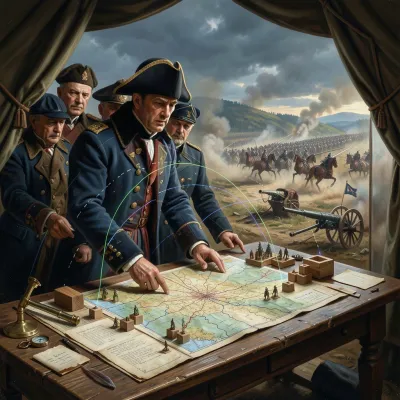
The book analyzes the military career of Napoleon Bonaparte through the lens of "operational art," the critical middle ground between grand strategy and battlefield tactics. It explores how Napoleon revolutionized warfare by utilizing the corps system—self-contained, modular armies that could march separately to ease logistical burdens but concentrate rapidly for decisive engagements. This organizational flexibility, combined with a relentless focus on tempo, deception, and the massing of artillery, allowed the Grande Armée to achieve historic victories at Ulm, Austerlitz, and Jena-Auerstedt. The text highlights how Napoleon’s ability to orchestrate movement, information, and reserves created a "decision cycle" that consistently outpaced and paralyzed his more rigid eighteenth-century opponents.
However, the book also meticulously documents the limitations and eventual collapse of this system. As Napoleon’s ambitions expanded into vast or hostile theaters like Spain and Russia, the fundamental pillars of his success began to erode. The logistical architecture that thrived in fertile Central Europe failed in the impoverished, scorched landscapes of the East, leading to the catastrophic 1812 retreat. Furthermore, the "Spanish ulcer" demonstrated the system’s inability to effectively counter unconventional guerrilla warfare. Over time, coalition enemies learned to adapt by adopting their own corps structures and implementing the Trachenberg Plan—a strategy designed to avoid Napoleon in person while defeating his less-capable marshals in detail.
The final chapters examine the desperate brilliance of the 1814 defense of France and the ultimate failure at Waterloo. These later campaigns underscore the high cost of operational friction, such as delayed communications and poor coordination between subordinates like Ney and Grouchy. The book concludes that while Napoleon’s personal genius remained sharp, he was ultimately overwhelmed by a world that had successfully absorbed his methods and weaponized them against him. His defeat is portrayed as the natural result of overreach, where the physical constraints of distance and the political resilience of a united coalition finally surpassed the capacity of his military system.
Ultimately, the work presents Napoleon’s campaigns as a laboratory for modern maneuver warfare. It distills timeless principles—such as the primacy of tempo, the necessity of a flexible reserve, and the critical role of logistics—into a framework relevant to contemporary military practitioners. By examining both the masterclasses in maneuver and the tragic failures of overextension, the book argues that operational art is a dynamic way of thinking that requires constant adaptation to geography, technology, and the human element. The Napoleonic legacy is thus characterized not just by tactical flair, but by the sophisticated orchestration of force, space, and time.
What You'll Find Inside:
- How Napoleon's corps system created modular armies capable of independent maneuver under centralized intent, enabling rapid concentration and dispersal
- The decisive role of march tempo, road management, and timing in achieving operational surprise before enemy reactions could develop
- How operational logistics (magazines, depots, forage systems) determined where mass could be sustained and when momentum would culminate
- The function of cavalry screens, reconnaissance and intelligence systems as the army's nervous system for maintaining situational awareness
- Case studies from Ulm to Waterloo demonstrating operational principles across success and failure, with forward-looking applications to modern maneuver warfare
Who's It For:
This book is for military professionals, historians, and students of military science who seek to understand operational art—the level connecting strategy to tactics—through Napoleon's campaigns. It will particularly benefit commanders, staff officers, and planners interested in how maneuver, logistics, timing, and command systems function at the operational level, as well as those studying the evolution of modern maneuver warfare doctrine.
Table of Contents:
- Introduction
- Chapter 1 The Operational Art and the Revolutionary Inheritance
- Chapter 2 The Corps System: Modular Armies and Mission Command
- Chapter 3 Roads, Marches, and Tempo: The Geometry of Movement
- Chapter 4 Screening, Reconnaissance, and the Cavalry Arm
- Chapter 5 Ulm 1805: The Operational Envelopment
- Chapter 6 Austerlitz 1805: Deception, Reserves, and the Decisive Blow
- Chapter 7 Jena–Auerstedt 1806: Pursuit, Exploitation, and Systemic Collapse
- Chapter 8 Eylau to Friedland 1807: Winter, Attrition, and Operational Persistence
- Chapter 9 Spain and Portugal: The Peninsular War and the Limits of Empire
- Chapter 10 Lines of Operation and Interior Lines: Theory into Practice
- Chapter 11 Bridging the Danube: Aspern–Essling to Wagram 1809
- Chapter 12 Operational Logistics: Magazines, Depots, and Forage
- Chapter 13 Artillery and Fire Support at the Operational Level
- Chapter 14 Staff Work, Communications, and Orders
- Chapter 15 Intelligence, Deception, and Operational Security
- Chapter 16 Russia 1812 I: Smolensk and the Road to Borodino
- Chapter 17 Russia 1812 II: Borodino, Moscow, and the Culminating Point
- Chapter 18 The Long Retreat: Logistics in Extremis and Command under Collapse
- Chapter 19 1813 in Germany: Coalition Learning and the Battle of Nations
- Chapter 20 1814 in France: The Six Days’ Campaign and the Last Operational Masterclass
- Chapter 21 Waterloo 1815: Friction, Coordination, and the Cost of Delay
- Chapter 22 Risk, Initiative, and Decision Cycles: Napoleon and His Marshals
- Chapter 23 Diplomacy, Sea Power, and the Wider Operational System
- Chapter 24 From Napoleon to Maneuver Warfare: Doctrinal Echoes into the 20th Century
- Chapter 25 Principles and Checklists: Applying Operational Lessons Today
Author:
Published By:
Date Published:
May 13, 2026
Type:
Nonfiction
Language:
English
Word Count:
83,469 words
Reading Time:
5 hours 51 minutes
Sample:
Order:
Order The Napoleonic Campaign: Strategy, Maneuver, and the Art of War (Paperback) on MixCache.com:
Buy NowPrint copy is made to order and ships worldwide. Includes the ebook free, ready to read instantly.
$5 account credit for all new MixCache.com accounts, usable toward any ebook purchase!*