
Browse by Category
Fiction
- Action & Adventure
- African American
- Anthologies
- Children's Fiction
- Classics
- Comics & Graphic Novels
- Coming of Age
- Contemporary
- Cultural & Regional
- Drama
- Erotica
- Fantasy
- General
- Historical Fiction
- Horror
- Humor & Satire
- Literary Fiction
- Mystery, Thriller & Suspense
- Poetry
- Religious & Inspirational
- Romance
- Science Fiction
- Short Stories
- War & Military
- Westerns
- Women's Fiction
- Young Adult
Non-Fiction
- Antiques & Collectibles
- Arts & Photography
- Biographies & Memoirs
- Business & Money
- Children's Non-Fiction
-
Computers & Technology
- Artificial Intelligence
- Computer Science
- Cybersecurity & Cryptography
- Data Science & Analytics
- Databases & Big Data
- Game Development & Design
- General
- Hardware & DIY
- Mobile App Development
- Networking & Cloud Computing
- Operating Systems
- Programming
- Robotics
- Software
- Software Engineering
- User Experience (UX) & Design
- Web Development & Design
- Cooking, Food & Wine
- Crafts, Hobbies & Home
- Education & Teaching
- Engineering
- General
- Health, Fitness & Dieting
-
History
- African History
- African History - North Africa
- African History - Sub-Saharan Africa
- American History
- American History - 20th Century
- American History - Civil War
- American History - Colonial Period
- Ancient History
- Asian History
- Asian History - China
- Asian History - India
- Asian History - Japan
- Asian History - Southeast Asia
- European History
- European History - Ancient Greece
- European History - Ancient Rome
- European History - Medieval
- European History - Modern
- European History - Renaissance
- General
- Middle Eastern History
- Military History
- Military History - Aviation
- Military History - Naval
- Social & Cultural History
- World History
- Humor & Entertainment
- Industrial Technology
- Language Learning
- Law
- LGBTQ+ Non-Fiction
- Literary Criticism
- Medical Books
- Parenting & Relationships
- Philosophy
- Politics & Social Sciences
- Reference
- Religion & Spirituality
-
Science & Math
- Agricultural Sciences
- Astronomy & Space Science
- Behavioral Sciences
- Biological Sciences
- Botany & Plant Science
- Chemistry
- Earth Sciences
- Engineering - Chemical
- Engineering - Civil
- Engineering - Electrical
- Engineering - Mechanical
- Environment
- General
- Geology
- Mathematics
- Nature & Ecology
- Oceanography
- Paleontology
- Physics
- Statistics
- Self-Help
- Sports & Outdoors
- Study Aids
- Sustainability & Green Living
- Textbooks
- Transportation
- Travel
- True Crime
- Urban Planning & Development
- Veterinary Medicine
- Writing & Publishing
Jump to Section

Want unlimited access to all books published by MixCache.com (plus their audiobooks)? Try MixCache.com Total Access. Look for the MTA badge on book covers to identify included titles.
Access to infinite ebooks: Don't see the book you want? Suggest it and we'll create it (free!) for you from scratch with our powerful AI book writer. Then read it with MTA - besides profiting from any sales it makes!
From Phalanx to Legion: The Evolution of Ancient Warfare
MTA
How tactics, organization, and technology shaped battle from the Bronze Age to Rome's rise
About this book:
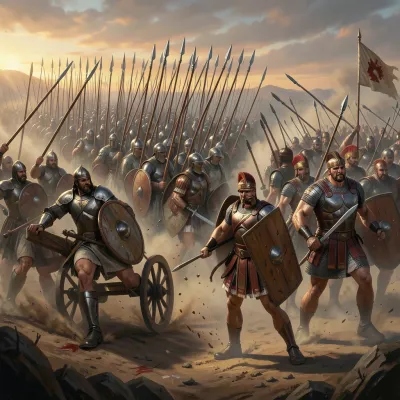
"From Phalanx to Legion: The Evolution of Ancient Warfare" traces the transformative journey of military organization, tactics, and technology from the Bronze Age to the Roman Republic's rise. The book posits that military innovation was primarily a response to necessity, with political, social, and economic structures dictating what was achievable on the battlefield. It highlights the shift from the dense, shock-focused phalanx formations prevalent in various forms from the Bronze Age to the Hellenistic period, to the Roman manipular legion's flexible, distributed system, designed for adaptability across diverse terrains and prolonged campaigns. The narrative explores how these changes, driven by factors like metal availability, political systems, and logistical demands, fundamentally reshaped the ancient world.
The book delves into specific eras and their defining military characteristics. It begins with Bronze Age palace armies and their expensive chariot corps, explaining their decline with the scarcity of resources and the subsequent "reset" to Iron Age militias, which relied on more accessible iron weaponry and broader communal participation. The emergence of the Greek hoplite phalanx is presented as a reflection of the polis's citizen-soldier ideal, emphasizing collective identity and discipline. This is contrasted with Persia's imperial war machine, which relied on multinational armies, extensive road networks, and complex logistics to project power over vast distances. The Peloponnesian War is analyzed as a strategic stalemate that pushed innovations in naval power, siegecraft, and attrition, revealing the limits of traditional hoplite warfare. The Theban hegemony, particularly through Epaminondas's innovations in depth and oblique order, marks a crucial pivot, demonstrating how clever tactical adjustments could overcome established military power. Philip of Macedon's revolution, synthesizing the sarissa phalanx with integrated combined arms (heavy cavalry, skirmishers), further professionalized warfare, paving the way for Alexander's operational art, which prioritized speed, intelligence, and decisive action across continents.
The latter half of the book focuses on the Italian peninsula and the Roman military. It first examines the diverse "Oscan ways of war" among Samnites and Etruscans, highlighting the need for adaptability in broken terrain, which contrasted with Greek phalanx traditions. This environment fostered the development of the manipular legion, a flexible, modular system designed for resilience and sustained engagement, particularly effective against the rigid phalanx. The Roman Republic's command structure, its reliance on citizen-soldiers and allies, and its systematic approach to logistics (roads, grain, pay) are explored as foundational to its military success. The Punic Wars, especially Hannibal's devastating victories at Cannae and the subsequent Roman recovery at Metaurus, underscore Rome's remarkable learning curve and institutional capacity to absorb losses and adapt. The clashes between the Roman legion and the Macedonian phalanx at Cynoscephalae and Pydna are presented as definitive demonstrations of the legion's superior flexibility. Finally, the book details the critical development of Roman sea power and maritime logistics, culminating in an analysis of how these military foundations transformed the Roman Republic into the dominant hegemon of the Mediterranean, marking the end of one era of warfare and the dawn of another.
What You'll Find Inside:
- The transformation from dense phalanx formations to flexible legion systems, showing how Roman manipular tactics overcame Macedonian sarissa phalanxes through adaptability rather than sheer force.
- The critical role of logistics and supply chains in determining campaign success, demonstrating how roads, granaries, and pay systems enabled sustained Roman military operations far from home.
- The evolution of combined arms warfare, from chariot archer teams to Macedonian cavalry-phalanx coordination to Roman legion integration of infantry, cavalry, and specialized troops.
- How political structures and social organizations directly shaped military capabilities, from Bronze Age palace armies to citizen hoplites to professional standing armies.
- The technological and tactical innovations that drove military change, including the composite bow, trireme warships, sarissa spears, pilum javelins, and Roman siege engineering.
Who's It For:
This book is ideal for students and academics of ancient or military history, as well as serious history enthusiasts interested in the evolution of warfare tactics and organization. It will particularly benefit readers seeking to understand Rome's rise to power through military innovation and institutional adaptation. Those who appreciate comparative analysis of different military systems across cultures and time periods will find valuable insights here. The work also appeals to anyone interested in how technology, logistics, and society interacted to shape ancient combat from the Bronze Age to Rome's hegemony.
Author:
Published By:
Date Published:
May 7, 2026
Type:
Nonfiction
Language:
English
Word Count:
71,436 words
Reading Time:
5 hours
Sample:
MixCache.com Total Access
Get unlimited access to this book + all books published by MixCache.com for $11.99/month
Subscribe to MTAOr purchase this book individually below
Order:
Buy the From Phalanx to Legion: The Evolution of Ancient Warfare ebook on MixCache.com:
Buy Now
Full ebook will be available immediately
- read online or download as a PDF file.
$5 account credit for all new MixCache.com accounts, usable toward any ebook purchase!*




Ratings & Reviews
Ask Questions About This Book
Have a question about the content? Ask our AI assistant!
Start by asking a question about "From Phalanx to Legion: The Evolution of Ancient Warfare"
Example: "Does this book mention William Shakespeare?"
Thinking...