Browse by Category
Fiction
- Action & Adventure
- African American
- Anthologies
- Children's Fiction
- Classics
- Comics & Graphic Novels
- Coming of Age
- Contemporary
- Cultural & Regional
- Drama
- Erotica
- Fantasy
- General
- Historical Fiction
- Horror
- Humor & Satire
- Literary Fiction
- Mystery, Thriller & Suspense
- Poetry
- Religious & Inspirational
- Romance
- Science Fiction
- Short Stories
- War & Military
- Westerns
- Women's Fiction
- Young Adult
Non-Fiction
- Antiques & Collectibles
- Arts & Photography
- Biographies & Memoirs
- Business & Money
- Children's Non-Fiction
-
Computers & Technology
- Artificial Intelligence
- Computer Science
- Cybersecurity & Cryptography
- Data Science & Analytics
- Databases & Big Data
- Game Development & Design
- General
- Hardware & DIY
- Mobile App Development
- Networking & Cloud Computing
- Operating Systems
- Programming
- Robotics
- Software
- Software Engineering
- User Experience (UX) & Design
- Web Development & Design
- Cooking, Food & Wine
- Crafts, Hobbies & Home
- Education & Teaching
- Engineering
- General
- Health, Fitness & Dieting
-
History
- African History
- African History - North Africa
- African History - Sub-Saharan Africa
- American History
- American History - 20th Century
- American History - Civil War
- American History - Colonial Period
- Ancient History
- Asian History
- Asian History - China
- Asian History - India
- Asian History - Japan
- Asian History - Southeast Asia
- European History
- European History - Ancient Greece
- European History - Ancient Rome
- European History - Medieval
- European History - Modern
- European History - Renaissance
- General
- Middle Eastern History
- Military History
- Military History - Aviation
- Military History - Naval
- Social & Cultural History
- World History
- Humor & Entertainment
- Industrial Technology
- Language Learning
- Law
- LGBTQ+ Non-Fiction
- Literary Criticism
- Medical Books
- Parenting & Relationships
- Philosophy
- Politics & Social Sciences
- Reference
- Religion & Spirituality
-
Science & Math
- Agricultural Sciences
- Astronomy & Space Science
- Behavioral Sciences
- Biological Sciences
- Botany & Plant Science
- Chemistry
- Earth Sciences
- Engineering - Chemical
- Engineering - Civil
- Engineering - Electrical
- Engineering - Mechanical
- Environment
- General
- Geology
- Mathematics
- Nature & Ecology
- Oceanography
- Paleontology
- Physics
- Statistics
- Self-Help
- Sports & Outdoors
- Study Aids
- Sustainability & Green Living
- Textbooks
- Transportation
- Travel
- True Crime
- Urban Planning & Development
- Veterinary Medicine
- Writing & Publishing
Jump to Section

Want unlimited access to all books published by MixCache.com (plus their audiobooks)? Try MixCache.com Total Access. Look for the MTA badge on book covers to identify included titles.
Access to infinite ebooks: Don't see the book you want? Suggest it and we'll create it (free!) for you from scratch with our powerful AI book writer. Then read it with MTA - besides profiting from any sales it makes!
Mass Armies and Maneuver: Warfare in the Age of Revolutions
MTA
Conscription, logistics, and campaign strategy from the French Revolution to 19th-century conflicts
About this book:
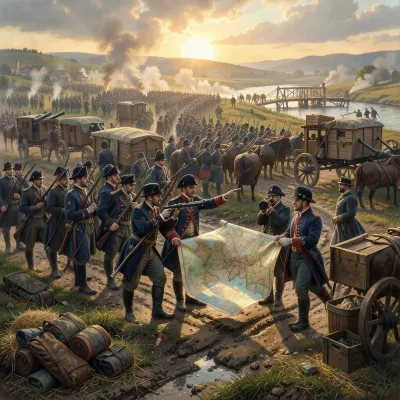
"Mass Armies and Maneuver: Warfare in the Age of Revolutions" examines the profound transformation of warfare from the French Revolution to the late 19th century, focusing on how states learned to mobilize, supply, and direct unprecedented numbers of soldiers. The book argues that the "Age of Revolutions" fundamentally changed military practice by linking political mobilization—the *levée en masse* and subsequent conscription systems—with sophisticated operational maneuver. It details how this shift from professional armies to citizen-soldiers required massive administrative and logistical innovation, including recruitment and reserve systems, extensive supply chains, and evolving command structures like the *corps d’armée*.
The narrative traces this evolution through key conflicts and reforms. The French revolutionary wars and Napoleon's campaigns illustrate the early adoption of mass mobilization and the development of operational art, showcasing both its potential for rapid, decisive victories and its limitations when facing logistical overstretch (e.g., the Peninsular War, 1812 in Russia) or popular resistance. The book then explores how other European powers—Britain, Austria, Prussia, and Russia—adapted these lessons, highlighting Prussia's systematic reforms under figures like Scharnhorst and Gneisenau, which laid the groundwork for a highly efficient, staff-driven military. The text emphasizes the critical, often unglamorous, role of finance, medicine, and administrative bureaucracy in sustaining these large forces.
Later chapters demonstrate how technological advancements, particularly railways and telegraphs, further revolutionized mobilization and command, accelerating the tempo of war and expanding logistical reach. Case studies like the Crimean War, the Wars of Italian Unification, and the American Civil War reveal the complex interplay of industrial capacity, mass armies, and campaign logistics, as well as the enduring challenges of occupation, resistance ("small wars"), and maintaining morale on both the front and the home front. The book culminates with the Austro-Prussian and Franco-Prussian Wars (1866 and 1870–71), presenting them as the "culmination of the nation in arms," where the systematic integration of conscription, railways, and sophisticated staff work demonstrated unprecedented military effectiveness.
Ultimately, the book argues that these developments created the infrastructure—material, organizational, and ideological—for the even more encompassing "total wars" of the 20th century. While celebrating the operational brilliance and organizational efficiency achieved, it consistently highlights the inherent limits imposed by logistics, morale, geography, and the political will of societies. The age of mass armies, while promising decisive maneuver and rapid victory, continuously wrestled with the immense human and material costs of scale, forever linking battlefield ambition to the mundane but unforgiving demands of sustenance and popular support.
What You'll Find Inside:
- How the levée en masse transformed conscription from a fiscal tool into a national sacrament, binding citizens to the state through political mobilization and creating the foundation for mass armies.
- The critical role of logistics as the 'decisive grammar of possibility' that determined where armies could concentrate, persist, and fight, often constraining operational ambition more than enemy forces did.
- The evolution of the corps d'armée system as a solution to maneuvering large forces, enabling semi-autonomous units to disperse for subsistence and concentrate rapidly for battle through precise timing and coordination.
- Case studies of operational limits, including the Peninsular War's guerrilla resistance and the 1812 Russian campaign, demonstrating how terrain, logistics, and popular will could unravel even sophisticated maneuver plans.
- How railways, telegraphs, professional staff systems, and refined conscription synthesized by 1870 to enable swift, decisive operational maneuver when logistics and morale held—as shown in the Austro-Prussian and Franco-Prussian Wars.
Who's It For:
This book is ideal for military historians, students of modern European history, and defense professionals seeking to understand how political mobilization, logistical innovation, and operational art transformed warfare from the French Revolution through the Franco-Prussian War. It offers deep insights into the interplay between conscription, supply systems, and battlefield maneuver that shaped the emergence of mass armies and informed later developments in military organization.
Author:
Published By:
Date Published:
May 7, 2026
Type:
Nonfiction
Language:
English
Word Count:
68,397 words
Reading Time:
4 hours 47 minutes
Sample:
Order:
Order Mass Armies and Maneuver: Warfare in the Age of Revolutions (Hardcover) on MixCache.com:
Buy NowPrint copy is made to order and ships worldwide. Includes the ebook free, ready to read instantly.
$5 account credit for all new MixCache.com accounts, usable toward any ebook purchase!*