Browse by Category
Fiction
- Action & Adventure
- African American
- Anthologies
- Children's Fiction
- Classics
- Comics & Graphic Novels
- Coming of Age
- Contemporary
- Cultural & Regional
- Drama
- Erotica
- Fantasy
- General
- Historical Fiction
- Horror
- Humor & Satire
- Literary Fiction
- Mystery, Thriller & Suspense
- Poetry
- Religious & Inspirational
- Romance
- Science Fiction
- Short Stories
- War & Military
- Westerns
- Women's Fiction
- Young Adult
Non-Fiction
- Antiques & Collectibles
- Arts & Photography
- Biographies & Memoirs
- Business & Money
- Children's Non-Fiction
-
Computers & Technology
- Artificial Intelligence
- Computer Science
- Cybersecurity & Cryptography
- Data Science & Analytics
- Databases & Big Data
- Game Development & Design
- General
- Hardware & DIY
- Mobile App Development
- Networking & Cloud Computing
- Operating Systems
- Programming
- Robotics
- Software
- Software Engineering
- User Experience (UX) & Design
- Web Development & Design
- Cooking, Food & Wine
- Crafts, Hobbies & Home
- Education & Teaching
- Engineering
- General
- Health, Fitness & Dieting
-
History
- African History
- African History - North Africa
- African History - Sub-Saharan Africa
- American History
- American History - 20th Century
- American History - Civil War
- American History - Colonial Period
- Ancient History
- Asian History
- Asian History - China
- Asian History - India
- Asian History - Japan
- Asian History - Southeast Asia
- European History
- European History - Ancient Greece
- European History - Ancient Rome
- European History - Medieval
- European History - Modern
- European History - Renaissance
- General
- Middle Eastern History
- Military History
- Military History - Aviation
- Military History - Naval
- Social & Cultural History
- World History
- Humor & Entertainment
- Industrial Technology
- Language Learning
- Law
- LGBTQ+ Non-Fiction
- Literary Criticism
- Medical Books
- Parenting & Relationships
- Philosophy
- Politics & Social Sciences
- Reference
- Religion & Spirituality
-
Science & Math
- Agricultural Sciences
- Astronomy & Space Science
- Behavioral Sciences
- Biological Sciences
- Botany & Plant Science
- Chemistry
- Earth Sciences
- Engineering - Chemical
- Engineering - Civil
- Engineering - Electrical
- Engineering - Mechanical
- Environment
- General
- Geology
- Mathematics
- Nature & Ecology
- Oceanography
- Paleontology
- Physics
- Statistics
- Self-Help
- Sports & Outdoors
- Study Aids
- Sustainability & Green Living
- Textbooks
- Transportation
- Travel
- True Crime
- Urban Planning & Development
- Veterinary Medicine
- Writing & Publishing
Jump to Section
MixCache.com Total Access
Unlimited reading and audiobooks for every book published by MixCache.com.
Included titles carry the MTA badge.
Learn more →
Front Pages and Frontlines: Propaganda, Media, and Public Opinion in Wars
MTA
Information operations, censorship, and the battle for hearts and minds
About this book:
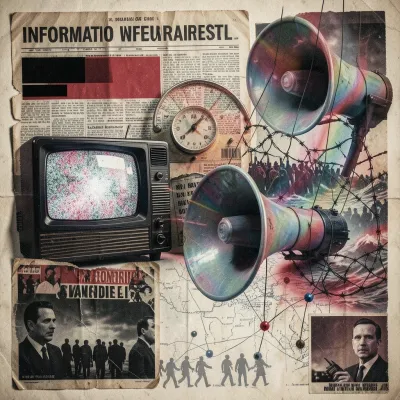
"Front Pages and Frontlines: Propaganda, Media, and Public Opinion in Wars" offers a comprehensive historical and thematic analysis of information warfare, tracing its evolution from early modern pamphlets to the complexities of the digital age. The book argues that war is fundamentally a contest over perception and narrative, unfolding across various media platforms where actors strive to mobilize populations, demonize enemies, and secure legitimacy. It emphasizes that propaganda is not merely about lies, but the strategic arrangement of truth, omission, and emotion, operating along a spectrum that includes public diplomacy and psychological operations.
The book employs a case-study approach, examining critical moments and conflicts across different eras and media technologies. It explores how World War I saw the institutionalization of propaganda through efforts like the Creel Committee, shaping home front morale, and how World War II deepened this with total war messaging from both Axis and Allied powers. The narrative then moves through the radio wars of decolonization, the Cold War's ideological struggle via broadcasters like Voice of America, and Vietnam's "living-room war," which exposed the "credibility gap" due to televised images. Subsequent chapters delve into the Iran-Iraq War's blend of faith and state media, the Gulf War's "CNN effect," and the Yugoslav Wars' ethnonationalist disinformation.
The latter part of the book focuses on the challenges of the 21st century, detailing how 9/11 and the Global War on Terror ushered in an era of strategic communication alongside insurgent media, and how the Israeli-Palestinian conflict exemplifies competing narratives on a global stage. It analyzes the Arab Spring's use of hashtags and citizen journalism, Russia's sophisticated information warfare in Ukraine, and China's comprehensive strategy for domestic media control and global narrative projection. Finally, the book addresses the profound impact of algorithms, bots, deepfakes, and synthetic media, alongside the emergence of memes, on shaping public opinion and challenging visual proof.
Ultimately, "Front Pages and Frontlines" concludes by exploring countermeasures and strategies for resilience, including open-source intelligence (OSINT), verification techniques, media literacy, and democratic defense. It highlights the ethical dilemmas inherent in information control, the persistent problem of attribution, and the blurring lines between journalism, advocacy, and manipulation. The book underscores that the information front is a central battleground, where the ability to win hearts and minds is as crucial as military might, continually evolving with technology and demanding constant vigilance, critical thinking, and robust societal resilience.
What You'll Find Inside:
- The historical evolution of propaganda from early modern pamphlets to contemporary deepfakes and algorithmic amplification
- How different media technologies (print, radio, television, and digital platforms) have been strategically exploited in warfare across centuries
- Case studies of pivotal conflicts—from World War I's Creel Committee to Russia-Ukraine information warfare—revealing recurring patterns in narrative control
- The dynamic tension between state censorship/moderation efforts and public resistance through citizen journalism, OSINT, and transnational networks
- Modern counter-propaganda toolkit including verification methodologies, media literacy frameworks, and ethical considerations for democratic defense
Who's It For:
This book is essential for students and scholars of media studies, political science, and international relations; journalists and media professionals seeking to understand information warfare mechanisms; policymakers and military strategists involved in communication and influence operations; and informed citizens looking to develop critical resilience against contemporary disinformation during conflicts.
Table of Contents:
- Introduction
- Chapter 1 From Pamphlets to Posters: Early Modern War Narratives
- Chapter 2 The Birth of Mass Media: Newspapers and the Nation at War
- Chapter 3 World War I: The Creel Committee and the Home Front
- Chapter 4 Total War Messaging: Axis and Allied Propaganda in World War II
- Chapter 5 Decolonization on the Airwaves: Radio Wars from North Africa to Southeast Asia
- Chapter 6 The Cold War Information Order: Voice of America, Radio Free Europe, and Pravda
- Chapter 7 Vietnam’s “Living-Room War”: Television, Images, and the Credibility Gap
- Chapter 8 Faith, Martyrdom, and the State: Media in the Iran–Iraq War
- Chapter 9 The Gulf War and the CNN Effect: 24/7 News as Battlespace
- Chapter 10 The Yugoslav Wars: Ethnonationalism, Rumor, and Disinformation
- Chapter 11 Rwanda 1994: Radio, Hate Speech, and International Inaction
- Chapter 12 9/11 and the Global War on Terror: Strategic Communication and Insurgent Media
- Chapter 13 The Israeli–Palestinian Arena: Competing Frames on a Global Stage
- Chapter 14 The Arab Spring: Hashtags, Citizen Journalism, and State Countermoves
- Chapter 15 Russia and Ukraine: From Crimea to Full-Scale Information Warfare
- Chapter 16 China’s Media Strategy: Domestic Control and Global Narratives
- Chapter 17 Algorithms and Attention: Platforms, Bots, and Amplification
- Chapter 18 Memes and Morale: Humor, Satire, and the Battlefield of Culture
- Chapter 19 Censorship, Moderation, and the Fog of War
- Chapter 20 Psychological Operations and Influence Campaigns: Methods and Ethics
- Chapter 21 Deepfakes, Synthetic Media, and the Problem of Visual Proof
- Chapter 22 Verification and OSINT: The Counter-Propaganda Toolkit
- Chapter 23 Diasporas, Refugees, and Transnational Publics
- Chapter 24 Lawfare: Legal Frameworks, Human Rights, and Information Control
- Chapter 25 Building Resilience: Media Literacy, Preparedness, and Democratic Defense
Author:
Published By:
Date Published:
May 6, 2026
Type:
Nonfiction
Language:
English
Word Count:
90,979 words
Reading Time:
6 hours 22 minutes
Sample:
Order:
Order Front Pages and Frontlines: Propaganda, Media, and Public Opinion in Wars (Paperback) on MixCache.com:
Buy NowPrint copy is made to order and ships worldwide. Includes the ebook free, ready to read instantly.
$5 account credit for all new MixCache.com accounts, usable toward any ebook purchase!*