Browse by Category
Fiction
- Action & Adventure
- African American
- Anthologies
- Children's Fiction
- Classics
- Comics & Graphic Novels
- Coming of Age
- Contemporary
- Cultural & Regional
- Drama
- Erotica
- Fantasy
- General
- Historical Fiction
- Horror
- Humor & Satire
- Literary Fiction
- Mystery, Thriller & Suspense
- Poetry
- Religious & Inspirational
- Romance
- Science Fiction
- Short Stories
- War & Military
- Westerns
- Women's Fiction
- Young Adult
Non-Fiction
- Antiques & Collectibles
- Arts & Photography
- Biographies & Memoirs
- Business & Money
- Children's Non-Fiction
-
Computers & Technology
- Artificial Intelligence
- Computer Science
- Cybersecurity & Cryptography
- Data Science & Analytics
- Databases & Big Data
- Game Development & Design
- General
- Hardware & DIY
- Mobile App Development
- Networking & Cloud Computing
- Operating Systems
- Programming
- Robotics
- Software
- Software Engineering
- User Experience (UX) & Design
- Web Development & Design
- Cooking, Food & Wine
- Crafts, Hobbies & Home
- Education & Teaching
- Engineering
- General
- Health, Fitness & Dieting
-
History
- African History
- African History - North Africa
- African History - Sub-Saharan Africa
- American History
- American History - 20th Century
- American History - Civil War
- American History - Colonial Period
- Ancient History
- Asian History
- Asian History - China
- Asian History - India
- Asian History - Japan
- Asian History - Southeast Asia
- European History
- European History - Ancient Greece
- European History - Ancient Rome
- European History - Medieval
- European History - Modern
- European History - Renaissance
- General
- Middle Eastern History
- Military History
- Military History - Aviation
- Military History - Naval
- Social & Cultural History
- World History
- Humor & Entertainment
- Industrial Technology
- Language Learning
- Law
- LGBTQ+ Non-Fiction
- Literary Criticism
- Medical Books
- Parenting & Relationships
- Philosophy
- Politics & Social Sciences
- Reference
- Religion & Spirituality
-
Science & Math
- Agricultural Sciences
- Astronomy & Space Science
- Behavioral Sciences
- Biological Sciences
- Botany & Plant Science
- Chemistry
- Earth Sciences
- Engineering - Chemical
- Engineering - Civil
- Engineering - Electrical
- Engineering - Mechanical
- Environment
- General
- Geology
- Mathematics
- Nature & Ecology
- Oceanography
- Paleontology
- Physics
- Statistics
- Self-Help
- Sports & Outdoors
- Study Aids
- Sustainability & Green Living
- Textbooks
- Transportation
- Travel
- True Crime
- Urban Planning & Development
- Veterinary Medicine
- Writing & Publishing
Jump to Section

Want unlimited access to all books published by MixCache.com (plus their audiobooks)? Try MixCache.com Total Access. Look for the MTA badge on book covers to identify included titles.
Access to infinite ebooks: Don't see the book you want? Suggest it and we'll create it (free!) for you from scratch with our powerful AI book writer. Then read it with MTA - besides profiting from any sales it makes!
Axum's Legacy: Trade, Christianity, and Empire in the Horn of Africa
MTA
Economic Networks and Religious Transformation from Antiquity to the Middle Ages
About this book:
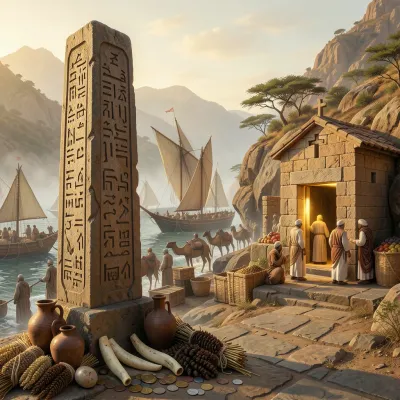
"Axum's Legacy" comprehensively examines the Axumite Empire's pivotal role in connecting the Mediterranean, Arabian, and Indian Ocean worlds from antiquity to the Middle Ages. The book argues that Axum was a central player in global antiquity, leveraging extensive trade networks, adapting Christianity, and developing a unique imperial identity. Drawing on diverse material evidence like coinage, multilingual inscriptions (Geʿez, Sabaic, Greek), and archaeological excavations at sites like the port of Adulis, the narrative reconstructs Axum's economic, political, and cultural evolution.
The empire's rise is traced from the earlier Dʿmt polity, highlighting continuities in state formation, monumental construction (stelae, thrones), and the development of the Geʿez language. Axum's sophisticated administrative and economic systems are detailed through chapters on coinage, which served as a declaration of sovereignty and facilitated trade, and the complex networks involved in moving commodities such as ivory, gold, frankincense, slaves, and textiles. The book emphasizes the critical role of the Red Sea and Indian Ocean monsoons in shaping maritime trade and cultural exchange, making Axum a nexus of global circulation.
A central theme is the transformative impact of Christianity on Axum, beginning with King Ezana's conversion in the 4th century CE. This religious shift is documented through changing coin iconography and inscriptions, establishing Axum as one of the earliest Christian states and aligning it with Byzantium. The book explores how this new faith was translated into local contexts through scripture, liturgy, and the growth of monasticism, and how it influenced the visual culture of churches and art. Diplomacy and military alliances with powers like Rome/Byzantium and the Himyarite kingdom in South Arabia, often intertwined with religious motivations, further illustrate Axum's active engagement on a geopolitical stage.
"Axum's Legacy" also investigates the internal workings of the empire, detailing governance through law, taxation, and land management, and examining settlement patterns from bustling ports to highland villages. It addresses the eventual decline and retreat of Axumite centralized power, attributing it to environmental stress, shifting trade routes, and the rise of new regional powers, particularly with the advent of Islam. However, the book stresses continuity, demonstrating how Axum's traditions—in faith, language, and cultural practices—persisted and influenced subsequent medieval Christian kingdoms like the Zagwe dynasty. The final chapters delve into how Axum's memory and myth were actively curated in later Ethiopian chronicles, securing its place as a foundational element of Ethiopian identity and in the broader context of world history.
What You'll Find Inside:
- The book reveals how Axum functioned as a pivotal trade hub connecting the Mediterranean, Red Sea, and Indian Ocean worlds through its control of Adulis port and extensive caravan networks that exchanged commodities like ivory, gold, frankincense, and textiles.
- It examines Axum's early adoption of Christianity under King Ezana (4th century CE), showing how the empire localized the faith through Ge'ez script translation, distinctive church architecture, and integration with existing political structures rather than simply importing foreign religion.
- Through detailed analysis of Axumite coinage, inscriptions, and monuments, the book demonstrates how the empire projected power and ideology across centuries, using material culture to communicate legitimacy to diverse audiences locally and internationally.
- The work traces Axum's enduring legacy beyond its political decline, showing how its cultural, religious, and economic foundations were preserved and transformed in medieval Ethiopian kingdoms like the Zagwe and Solomonic dynasties through continued church building, manuscript production, and pilgrimage traditions.
- It presents Axum not as an isolated African kingdom but as an active participant in global antiquity, using interdisciplinary methods (archaeology, numismatics, epigraphy) to reveal its role in broader networks of exchange that shaped the Horn of Africa's connections to Eurasia.
Who's It For:
This book will most benefit university students and scholars of African history, ancient trade networks, early Christianity, and imperial studies who seek to understand how an African empire functioned as a global player in antiquity. It's also well-suited for general readers with a strong interest in world history, particularly those fascinated by the interconnected histories of Africa, the Mediterranean, and the Indian Ocean, due to its accessible yet scholarly approach to complex historical processes involving trade, religion, and state formation.
Author:
Published By:
Date Published:
May 6, 2026
Type:
Nonfiction
Language:
English
Word Count:
61,591 words
Reading Time:
4 hours 19 minutes
Sample:
Order:
Order Axum's Legacy: Trade, Christianity, and Empire in the Horn of Africa (Hardcover) on MixCache.com:
Buy NowPrint copy is made to order and ships worldwide. Includes the ebook free, ready to read instantly.
$5 account credit for all new MixCache.com accounts, usable toward any ebook purchase!*