
Browse by Category
Fiction
- Action & Adventure
- African American
- Anthologies
- Children's Fiction
- Classics
- Comics & Graphic Novels
- Coming of Age
- Contemporary
- Cultural & Regional
- Drama
- Erotica
- Fantasy
- General
- Historical Fiction
- Horror
- Humor & Satire
- Literary Fiction
- Mystery, Thriller & Suspense
- Poetry
- Religious & Inspirational
- Romance
- Science Fiction
- Short Stories
- War & Military
- Westerns
- Women's Fiction
- Young Adult
Non-Fiction
- Antiques & Collectibles
- Arts & Photography
- Biographies & Memoirs
- Business & Money
- Children's Non-Fiction
-
Computers & Technology
- Artificial Intelligence
- Computer Science
- Cybersecurity & Cryptography
- Data Science & Analytics
- Databases & Big Data
- Game Development & Design
- General
- Hardware & DIY
- Mobile App Development
- Networking & Cloud Computing
- Operating Systems
- Programming
- Robotics
- Software
- Software Engineering
- User Experience (UX) & Design
- Web Development & Design
- Cooking, Food & Wine
- Crafts, Hobbies & Home
- Education & Teaching
- Engineering
- General
- Health, Fitness & Dieting
-
History
- African History
- African History - North Africa
- African History - Sub-Saharan Africa
- American History
- American History - 20th Century
- American History - Civil War
- American History - Colonial Period
- Ancient History
- Asian History
- Asian History - China
- Asian History - India
- Asian History - Japan
- Asian History - Southeast Asia
- European History
- European History - Ancient Greece
- European History - Ancient Rome
- European History - Medieval
- European History - Modern
- European History - Renaissance
- General
- Middle Eastern History
- Military History
- Military History - Aviation
- Military History - Naval
- Social & Cultural History
- World History
- Humor & Entertainment
- Industrial Technology
- Language Learning
- Law
- LGBTQ+ Non-Fiction
- Literary Criticism
- Medical Books
- Parenting & Relationships
- Philosophy
- Politics & Social Sciences
- Reference
- Religion & Spirituality
-
Science & Math
- Agricultural Sciences
- Astronomy & Space Science
- Behavioral Sciences
- Biological Sciences
- Botany & Plant Science
- Chemistry
- Earth Sciences
- Engineering - Chemical
- Engineering - Civil
- Engineering - Electrical
- Engineering - Mechanical
- Environment
- General
- Geology
- Mathematics
- Nature & Ecology
- Oceanography
- Paleontology
- Physics
- Statistics
- Self-Help
- Sports & Outdoors
- Study Aids
- Sustainability & Green Living
- Textbooks
- Transportation
- Travel
- True Crime
- Urban Planning & Development
- Veterinary Medicine
- Writing & Publishing
Jump to Section
MixCache.com Total Access
Unlimited reading and audiobooks for every book published by MixCache.com.
Included titles carry the MTA badge.
Learn more →
Carthage and the Mediterranean Web: Phoenician Networks, Commerce, and the Punic World
MTA
Maritime Trade, Urbanization, and Conflict in North Africa and Beyond
About this book:
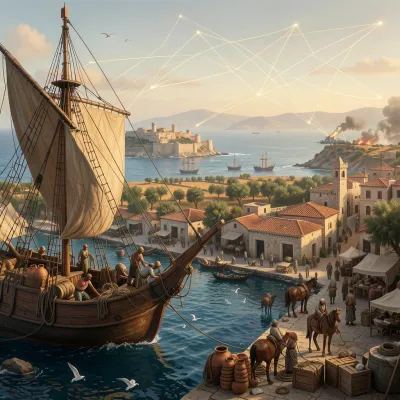
*Carthage and the Mediterranean Web* presents a comprehensive study of Carthage, not as an isolated empire, but as a crucial node within a complex and dynamic Mediterranean network forged through Phoenician heritage. The book argues that Carthage's power stemmed from its ability to orchestrate dispersed communities, technologies, and beliefs into a resilient web of maritime trade, urbanization, and diplomacy. This network facilitated the flow of essential commodities like metals, grain, timber, and purple dye, supported by sophisticated systems of credit, contracts, and an evolving coinage. From its strategically engineered harbors—including the famous dual commercial and military basins—to its well-planned urban grids and advanced water management, Carthage built cities designed for efficiency, defense, and sustained economic activity, extending these principles to its numerous colonies and contact zones across Sicily, Sardinia, and Iberia.
The book details how Carthage's strategic position enabled it to leverage seasonal winds, currents, and island networks, effectively using the sea as a highway for communication, resource acquisition, and the projection of influence. The study emphasizes the human element of this web, examining the roles of shipwrights, skilled sailors, and the diverse populations—including citizens, mercenaries, and enslaved peoples—whose mobility and labor underpinned Carthaginian prosperity. This societal structure fostered a pragmatic cosmopolitanism, where different languages, religions, and customs coexisted and often blended, creating a vibrant, adaptable culture that valued practical efficiency and reliable exchange over strict uniformity. Temples, for instance, often functioned as central points for finance, arbitration, and record-keeping, blurring the lines between sacred and secular in supporting the city's economic activities.
The narrative extends through Carthage's fraught relationship with its rivals, particularly the Greek cities of Sicily and, most significantly, Rome. The Punic Wars are re-examined as periods of intense innovation, attrition, and adaptation, forcing Carthage to continually refine its military, naval, and logistical strategies. While Roman expansion ultimately led to Carthage's destruction, the book highlights the city's remarkable resilience in the period between the wars, where it rebuilt its economy through intensified agriculture and trade in its remaining African territories. Even after its final destruction in 146 BCE, *Carthage and the Mediterranean Web* argues that the Punic urban logic, economic practices, and cultural memory subtly persisted, influencing the Roman province that rose from its ashes and leaving an indelible mark on the broader Mediterranean web.
By integrating archaeological evidence from shipwrecks and urban excavations with critical readings of classical texts and Punic inscriptions, the book offers a nuanced and multifaceted reconstruction of Carthage. It moves beyond simplistic narratives of barbarian ruthlessness or tragic heroism, instead presenting a complex civilization that mastered the art of connectivity in the ancient world. The Punic experience, with its dynamics of integration, inequality, and resilience, provides enduring lessons about the challenges and opportunities inherent in building and maintaining vast, interconnected networks across diverse political and cultural landscapes.
What You'll Find Inside:
- Carthage's power stemmed from network-based connections rather than territorial domination, building trust, institutions, and exchange across a Mediterranean web of routes, colonies, and partners.
- The book integrates maritime archaeology (shipwrecks, harbor works, amphorae) with textual analysis to reconstruct Carthaginian society beyond biased Greco-Roman narratives.
- Religious sanctuaries functioned as economic hubs—serving as customs posts, credit centers, and neutral ground for dispute resolution, blending ritual with commerce.
- Sophisticated financial systems enabled cross-cultural trade through credit networks, partnerships, standardized weights/measures, and coinage that transcended linguistic boundaries.
- Punic urbanism featured pragmatic resilience: grid plans, advanced water cisterns, and formidable fortifications that supported Carthage's maritime economy and endurance during sieges.
Who's It For:
This book is ideal for students and scholars of ancient Mediterranean history, maritime archaeologists, and economic historians interested in trade networks and urbanism. It will particularly benefit readers seeking a nuanced, evidence-based understanding of Carthage that moves beyond Roman-centric narratives to explore how Phoenician-inherited networks of trust, commerce, and cultural adaptation created a resilient yet ultimately vulnerable Mediterranean world.
Table of Contents:
- Introduction
- Chapter 1 The Phoenician Inheritance: Networks Across the Sea
- Chapter 2 Founding Carthage: Myth, Memory, and Archaeology
- Chapter 3 Ports and Harbors of Carthage: Urban Topography at the Water’s Edge
- Chapter 4 The Mediterranean Web: Currents, Routes, and Communication
- Chapter 5 Shipwrights and Sailors: Technologies of Punic Seafaring
- Chapter 6 Commodities in Motion: Metals, Grain, Timber, and Purple
- Chapter 7 Markets Without Borders: Credit, Contracts, and Coinage
- Chapter 8 Sanctuaries and Storehouses: Religion, Ritual, and Exchange
- Chapter 9 Colonies and Contact Zones: From Gadir to Motya
- Chapter 10 Urbanism Ashore: Grids, Water, and Walls in Punic Cities
- Chapter 11 Houses, Workshops, and Neighborhoods: Everyday Economies
- Chapter 12 Agriculture and the Hinterland: Feeding a Maritime Power
- Chapter 13 Peoples on the Move: Migration, Slavery, and Diaspora
- Chapter 14 Diplomacy and Hegemony: Treaties, Allies, and Rivals
- Chapter 15 Mercenaries and Citizens: Armies, Navies, and Pay
- Chapter 16 Sicily at the Center: Entanglements with Greeks and Rome
- Chapter 17 The First Punic War: Innovation, Attrition, and Adaptation
- Chapter 18 Between the Wars: Reform, Expansion, and Unrest
- Chapter 19 The Second Punic War: Hannibal, Strategy, and the Western Mediterranean
- Chapter 20 Defeat and Resilience: Economy and Society after Zama
- Chapter 21 The Third Punic War: Siege, Destruction, and Memory
- Chapter 22 After Carthage: Roman Africa and the Afterlife of Punic Culture
- Chapter 23 Reading the Sea: Wrecks, Cargoes, and Underwater Landscapes
- Chapter 24 Texts in Dialogue: Classical Authors, Inscriptions, and New Evidence
- Chapter 25 Networks Reconsidered: Integration, Inequality, and the Lessons of the Punic World
Author:
Published By:
Date Published:
May 5, 2026
Type:
Nonfiction
Language:
English
Word Count:
70,752 words
Reading Time:
4 hours 57 minutes
Sample:
Order:
Order Carthage and the Mediterranean Web: Phoenician Networks, Commerce, and the Punic World (Paperback) on MixCache.com:
Buy NowPrint copy is made to order and ships worldwide. Includes the ebook free, ready to read instantly.
$5 account credit for all new MixCache.com accounts, usable toward any ebook purchase!*


