Browse by Category
Fiction
- Action & Adventure
- African American
- Anthologies
- Children's Fiction
- Classics
- Comics & Graphic Novels
- Coming of Age
- Contemporary
- Cultural & Regional
- Drama
- Erotica
- Fantasy
- General
- Historical Fiction
- Horror
- Humor & Satire
- Literary Fiction
- Mystery, Thriller & Suspense
- Poetry
- Religious & Inspirational
- Romance
- Science Fiction
- Short Stories
- War & Military
- Westerns
- Women's Fiction
- Young Adult
Non-Fiction
- Antiques & Collectibles
- Arts & Photography
- Biographies & Memoirs
- Business & Money
- Children's Non-Fiction
-
Computers & Technology
- Artificial Intelligence
- Computer Science
- Cybersecurity & Cryptography
- Data Science & Analytics
- Databases & Big Data
- Game Development & Design
- General
- Hardware & DIY
- Mobile App Development
- Networking & Cloud Computing
- Operating Systems
- Programming
- Robotics
- Software
- Software Engineering
- User Experience (UX) & Design
- Web Development & Design
- Cooking, Food & Wine
- Crafts, Hobbies & Home
- Education & Teaching
- Engineering
- General
- Health, Fitness & Dieting
-
History
- African History
- African History - North Africa
- African History - Sub-Saharan Africa
- American History
- American History - 20th Century
- American History - Civil War
- American History - Colonial Period
- Ancient History
- Asian History
- Asian History - China
- Asian History - India
- Asian History - Japan
- Asian History - Southeast Asia
- European History
- European History - Ancient Greece
- European History - Ancient Rome
- European History - Medieval
- European History - Modern
- European History - Renaissance
- General
- Middle Eastern History
- Military History
- Military History - Aviation
- Military History - Naval
- Social & Cultural History
- World History
- Humor & Entertainment
- Industrial Technology
- Language Learning
- Law
- LGBTQ+ Non-Fiction
- Literary Criticism
- Medical Books
- Parenting & Relationships
- Philosophy
- Politics & Social Sciences
- Reference
- Religion & Spirituality
-
Science & Math
- Agricultural Sciences
- Astronomy & Space Science
- Behavioral Sciences
- Biological Sciences
- Botany & Plant Science
- Chemistry
- Earth Sciences
- Engineering - Chemical
- Engineering - Civil
- Engineering - Electrical
- Engineering - Mechanical
- Environment
- General
- Geology
- Mathematics
- Nature & Ecology
- Oceanography
- Paleontology
- Physics
- Statistics
- Self-Help
- Sports & Outdoors
- Study Aids
- Sustainability & Green Living
- Textbooks
- Transportation
- Travel
- True Crime
- Urban Planning & Development
- Veterinary Medicine
- Writing & Publishing
Jump to Section
MixCache.com Total Access
Unlimited reading and audiobooks for every book published by MixCache.com.
Included titles carry the MTA badge.
Learn more →
Across the Sands: Trans-Saharan Trade Routes and Cultural Transmission
MTA
Camels, Caravans, and the Movement of Ideas and Goods
About this book:
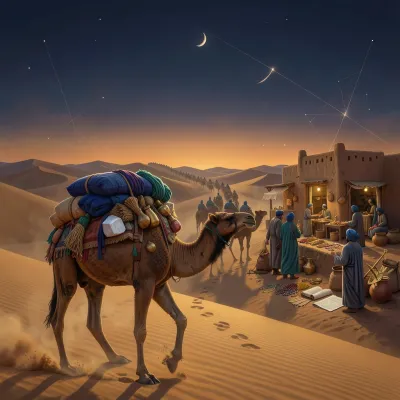
*Across the Sands: Trans-Saharan Trade Routes and Cultural Transmission* recontextualizes the Sahara Desert not as an impassable barrier, but as a vibrant "historical engine" and a corridor that bridged sub-Saharan Africa, North Africa, and the Mediterranean for over a millennium. The book explores the essential infrastructures of this globalization—from the biological and technological revolution of the camel and the specialized craft of the Berber and Tuareg guides to the sophisticated hydraulic engineering of oases and foggara tunnels. These elements allowed for the systematic movement of high-value goods, most notably gold from the Sahelian fields of Bambuk and Bure and salt from Saharan mines like Taghaza, which anchored a complex continental economy.
The narrative traces the rise and fall of great empires such as Ghana, Mali, and Songhai, illustrating how their power was predicated on the taxation and protection of these trade networks. Beyond the exchange of commodities like copper, cloth, and cowries, the book emphasizes the Sahara's role as a "library with legs." Caravans were conduits for the spread of Islam, Maliki jurisprudence, and Sufi networks, transforming towns like Timbuktu, Jenne, and Gao into world-renowned centers of scholarship and manuscript production. This intellectual and religious transmission created a shared cultural grammar across vast distances, enabling trust and credit systems that underpinned long-distance commerce.
However, the text does not romanticize these routes, providing a blunt examination of the human cost of the trans-Saharan slave trade and the persistent risks of banditry and environmental volatility. It details how the desert’s harsh ecology dictated the timing and security of trade, forcing a pragmatic resilience among its inhabitants. As the Atlantic trade rose and European colonial projects began to redraw the map, the traditional caravan networks did not disappear but rather reconfigured. The book concludes by examining the archaeological traces and contemporary legacies of these routes, arguing that the Sahara’s history of connectivity continues to echo in the modern political, cultural, and economic landscapes of the region.
What You'll Find Inside:
- The Sahara functioned as a dynamic corridor of exchange rather than an impenetrable barrier, facilitating the movement of goods, ideas, and people between sub-Saharan Africa and the Mediterranean for over a millennium.
- Camels were the indispensable 'beasts of burden' whose unique physiological adaptations and associated technologies (saddles, watering systems) made sustained trans-Saharan caravan trade possible.
- Trans-Saharan trade involved complex economic systems where gold moved north while salt moved south, alongside slaves, cloth, copper, and cowries, all supported by sophisticated financial practices including credit, weighing, and taxation.
- Islamic scholarship and legal traditions spread along caravan routes, transforming towns like Timbuktu into centers of learning while Berber mediator groups (Sanhaja, Tuareg) provided essential guidance, protection, and cultural brokering.
- The trade networks demonstrated remarkable resilience and adaptability in response to environmental challenges, political shifts, and changing global dynamics, from Roman times through the Atlantic era and into contemporary periods.
Who's It For:
This book is intended for students, scholars, and general readers interested in African history, Islamic studies, and the history of global trade. It will particularly benefit those seeking to understand how environmental factors, technological innovations, and cultural exchanges shaped one of the world's most significant pre-modern trade networks, as well as readers interested in the interconnected histories of North Africa, West Africa, and the Mediterranean world.
Table of Contents:
- Introduction
- Chapter 1 Desert as Corridor: Geography and Ecology of the Sahara
- Chapter 2 Beasts of Burden: The Camel and the Technology of Mobility
- Chapter 3 Wells, Oases, and Foggara: Infrastructures of Survival
- Chapter 4 Mapping the Routes: From Fezzan to the Niger Bend
- Chapter 5 Early Connectors: Garamantes, Romans, and Late Antiquity Networks
- Chapter 6 Berber Mediators: Sanhaja, Tuareg, and the Craft of Caravanning
- Chapter 7 Goldfields and Gateways: Bambuk, Bure, and the Rise of Ghana
- Chapter 8 Salt of the Sahara: Taghaza, Taoudenni, and the Economy of Extraction
- Chapter 9 Copper, Cloth, and Cowries: The Goods that Traveled
- Chapter 10 Counting, Weighing, Taxing: Finance, Currencies, and Custom Houses
- Chapter 11 Towns of Exchange: Aoudaghost, Gao, Jenne, and Timbuktu
- Chapter 12 Empire on the Move: Mali, Mansa Musa, and Transcontinental Ties
- Chapter 13 Faith on the Caravan: Islamization, Jurists, and Sufi Networks
- Chapter 14 Hajj and Highways: Pilgrimage, Prestige, and Patronage
- Chapter 15 Scholars and Scriptoria: Manuscripts, Madrasas, and the Life of the Mind
- Chapter 16 Words Across the Dunes: Languages, Literacies, and Oral Transmission
- Chapter 17 Chains in the Sand: Slavery, Captivity, and Human Consequences
- Chapter 18 Risk and Resilience: Bandits, States, and the Security of Trade
- Chapter 19 North African Gateways: Maghrib, Ifriqiya, and Egyptian Linkages
- Chapter 20 Across the Sea: Mediterranean Entrepôts and European Demand
- Chapter 21 Shifting Tides: Atlantic Competition and Reconfigured Networks
- Chapter 22 Ottoman, Saadian, and Moroccan Projects in the Sahara
- Chapter 23 The Archaeology of Caravans: Sites, Surveys, and Material Traces
- Chapter 24 Time, Climate, and Desertification: Environmental Change and Trade
- Chapter 25 Legacies and Afterlives: Memory, Heritage, and Contemporary Echoes
Author:
Published By:
Date Published:
May 5, 2026
Type:
Nonfiction
Language:
English
Word Count:
74,382 words
Reading Time:
5 hours 13 minutes
Sample:
Order:
Order Across the Sands: Trans-Saharan Trade Routes and Cultural Transmission (Paperback) on MixCache.com:
Buy NowPrint copy is made to order and ships worldwide. Includes the ebook free, ready to read instantly.
$5 account credit for all new MixCache.com accounts, usable toward any ebook purchase!*