
Browse by Category
Fiction
- Action & Adventure
- African American
- Anthologies
- Children's Fiction
- Classics
- Comics & Graphic Novels
- Coming of Age
- Contemporary
- Cultural & Regional
- Drama
- Erotica
- Fantasy
- General
- Historical Fiction
- Horror
- Humor & Satire
- Literary Fiction
- Mystery, Thriller & Suspense
- Poetry
- Religious & Inspirational
- Romance
- Science Fiction
- Short Stories
- War & Military
- Westerns
- Women's Fiction
- Young Adult
Non-Fiction
- Antiques & Collectibles
- Arts & Photography
- Biographies & Memoirs
- Business & Money
- Children's Non-Fiction
-
Computers & Technology
- Artificial Intelligence
- Computer Science
- Cybersecurity & Cryptography
- Data Science & Analytics
- Databases & Big Data
- Game Development & Design
- General
- Hardware & DIY
- Mobile App Development
- Networking & Cloud Computing
- Operating Systems
- Programming
- Robotics
- Software
- Software Engineering
- User Experience (UX) & Design
- Web Development & Design
- Cooking, Food & Wine
- Crafts, Hobbies & Home
- Education & Teaching
- Engineering
- General
- Health, Fitness & Dieting
-
History
- African History
- African History - North Africa
- African History - Sub-Saharan Africa
- American History
- American History - 20th Century
- American History - Civil War
- American History - Colonial Period
- Ancient History
- Asian History
- Asian History - China
- Asian History - India
- Asian History - Japan
- Asian History - Southeast Asia
- European History
- European History - Ancient Greece
- European History - Ancient Rome
- European History - Medieval
- European History - Modern
- European History - Renaissance
- General
- Middle Eastern History
- Military History
- Military History - Aviation
- Military History - Naval
- Social & Cultural History
- World History
- Humor & Entertainment
- Industrial Technology
- Language Learning
- Law
- LGBTQ+ Non-Fiction
- Literary Criticism
- Medical Books
- Parenting & Relationships
- Philosophy
- Politics & Social Sciences
- Reference
- Religion & Spirituality
-
Science & Math
- Agricultural Sciences
- Astronomy & Space Science
- Behavioral Sciences
- Biological Sciences
- Botany & Plant Science
- Chemistry
- Earth Sciences
- Engineering - Chemical
- Engineering - Civil
- Engineering - Electrical
- Engineering - Mechanical
- Environment
- General
- Geology
- Mathematics
- Nature & Ecology
- Oceanography
- Paleontology
- Physics
- Statistics
- Self-Help
- Sports & Outdoors
- Study Aids
- Sustainability & Green Living
- Textbooks
- Transportation
- Travel
- True Crime
- Urban Planning & Development
- Veterinary Medicine
- Writing & Publishing
Jump to Section
MixCache.com Total Access
Unlimited reading and audiobooks for every book published by MixCache.com.
Included titles carry the MTA badge.
Learn more →
Cold War in the Backyard: US Interventions in Latin America, 1945–1991
MTA
Covert operations, support for coups, and the battle against perceived communist threats
About this book:
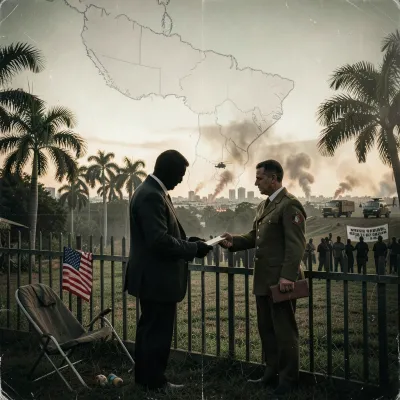
*Cold War in the Backyard* examines the extensive history of United States military and intelligence interventions in Latin America from the end of World War II to the collapse of the Soviet Union. The book details a recurring pattern where Washington, driven by the doctrine of containment and hemispheric security, frequently conflated local movements for social reform or nationalism with global communist subversion. This ideological framework justified a diverse toolkit of intervention, ranging from the landmark 1954 CIA-led coup in Guatemala and the failed Bay of Pigs invasion in Cuba to the quiet cultivation of military juntas in Brazil and the Southern Cone.
The narrative explores the institutionalization of repression through transnational networks like Operation Condor and the "Dirty Wars" of Argentina and Chile, where U.S. knowledge and technical assistance supported systemic human rights abuses. As the Cold War progressed into the 1980s, the focus shifted toward Central America, characterized by the proxy war against the Sandinistas in Nicaragua and the heavy militarization of El Salvador and Honduras. During this era, the Reagan administration often bypassed congressional oversight—culminating in the Iran-Contra scandal—to maintain support for anti-communist paramilitaries and authoritarian allies.
Beyond covert action, the book analyzes the role of "soft power" and shadow diplomacy, including the use of media operations, front groups, and the Alliance for Progress to shape Latin American political and economic landscapes. The text argues that while these interventions often achieved the short-term goal of stabilizing pro-U.S. regimes, they left a legacy of institutionalized violence, deep socioeconomic inequality, and democratic fragility. The 1989 invasion of Panama and the 1991 hinge point serve as the conclusion of this era, marking a transition from anti-communist paradigms to new justifications involving the War on Drugs and neoliberal reform.
Ultimately, the book serves as a historical reckoning, utilizing declassified documents and survivor testimony to bridge the gap between public diplomatic rhetoric and the reality of state-sponsored violence. It concludes by examining the ongoing struggle for memory and justice through truth commissions and reparations. By documenting the human and political costs of nearly fifty years of intervention, the work highlights the long-term impact of Cold War policies on contemporary Latin American sovereignty and the persistent debates over accountability in the Americas.
What You'll Find Inside:
- The book documents how the US employed a consistent toolkit of covert operations, economic pressure, and support for authoritarian regimes to prevent perceived communist threats in Latin America from 1945-1991.
- It examines specific interventions like the 1954 Guatemala coup, Bay of Pigs invasion, Chile 1973 coup, and Central American conflicts of the 1980s, revealing patterns of intervention and their consequences.
- The work analyzes how US policy blended anti-communist ideology with economic interests, often conflating nationalism and social reform with Soviet influence.
- It explores the long-term legacies of interventions including human rights abuses, institutionalized repression, and the complex aftermath addressed through truth commissions and reparations.
- The book investigates the evolution of US intelligence operations, congressional oversight struggles, and the tension between public rhetoric and private actions throughout the Cold War era.
Who's It For:
This book is essential reading for students and scholars of Latin American history, Cold War studies, and US foreign policy. It will particularly benefit researchers interested in human rights, interventionism, and the mechanics of covert operations, as well as policymakers and analysts seeking to understand historical patterns of US engagement in the region. General readers with an interest in how powerful nations influence smaller neighbors will also find valuable insights into the complexities of hemispheric relations.
Table of Contents:
- Introduction
- Chapter 1 Setting the Stage: Hemispheric Security and the End of World War II (1945–1949)
- Chapter 2 Blueprints for Influence: The Birth of the CIA and Early Latin American Operations
- Chapter 3 Guatemala 1954: Operation PBSUCCESS and the Fall of Árbenz
- Chapter 4 Cuba: Revolution, Bay of Pigs, and the Long Shadow of Mongoose
- Chapter 5 The Alliance for Progress: Aid, Development, and Counterinsurgency
- Chapter 6 Brazil 1964: Business, Generals, and the Quiet Coup
- Chapter 7 Dominican Republic 1965: Marines in Santo Domingo
- Chapter 8 Bolivia: Tracking Che and Exporting Counterinsurgency, 1964–1967
- Chapter 9 The Southern Cone Laboratories: Uruguay and Paraguay under Watch
- Chapter 10 Chile 1970–1973: “Make the Economy Scream” and the Pinochet Coup
- Chapter 11 Operation Condor: Transnational Repression and U.S. Knowledge
- Chapter 12 Argentina’s Dirty War: Security Doctrine and Disappeared Lives
- Chapter 13 Central America on Fire: Nicaragua, the Sandinistas, and the Contras
- Chapter 14 El Salvador: Death Squads, Elections, and U.S. Military Aid
- Chapter 15 Honduras: The “Unsinkable Aircraft Carrier” of the Reagan Era
- Chapter 16 Guatemala’s Long War: Genocide, Green Berets, and Denials
- Chapter 17 Grenada 1983: Urgent Fury and the Optics of Liberation
- Chapter 18 Suriname and the Caribbean Periphery: Small States, Big Pressures
- Chapter 19 Panama 1989: Noriega, the Drug War, and “Just Cause”
- Chapter 20 Colombia: Counterinsurgency, Narcopolitics, and Intelligence Partnerships
- Chapter 21 Peru: Shining Path, MRTA, and U.S. Assistance in the Andean War
- Chapter 22 Mexico and the Borderlands: Security Cooperation and Quiet Leverage
- Chapter 23 Diplomacy in the Shadows: Ambassadors, Front Groups, and Media Operations
- Chapter 24 Law, Congress, and Oversight: Church Committee to Iran-Contra
- Chapter 25 Aftermath and Memory: Truth Commissions, Reparations, and the 1991 Hinge
Author:
Published By:
Date Published:
May 5, 2026
Type:
Nonfiction
Language:
English
Word Count:
71,955 words
Reading Time:
5 hours 2 minutes
Sample:
Order:
Order Cold War in the Backyard: US Interventions in Latin America, 1945–1991 (Hardcover) on MixCache.com:
Buy NowPrint copy is made to order and ships worldwide. Includes the ebook free, ready to read instantly.
$5 account credit for all new MixCache.com accounts, usable toward any ebook purchase!*


