Browse by Category
Fiction
- Action & Adventure
- African American
- Anthologies
- Children's Fiction
- Classics
- Comics & Graphic Novels
- Coming of Age
- Contemporary
- Cultural & Regional
- Drama
- Erotica
- Fantasy
- General
- Historical Fiction
- Horror
- Humor & Satire
- Literary Fiction
- Mystery, Thriller & Suspense
- Poetry
- Religious & Inspirational
- Romance
- Science Fiction
- Short Stories
- War & Military
- Westerns
- Women's Fiction
- Young Adult
Non-Fiction
- Antiques & Collectibles
- Arts & Photography
- Biographies & Memoirs
- Business & Money
- Children's Non-Fiction
-
Computers & Technology
- Artificial Intelligence
- Computer Science
- Cybersecurity & Cryptography
- Data Science & Analytics
- Databases & Big Data
- Game Development & Design
- General
- Hardware & DIY
- Mobile App Development
- Networking & Cloud Computing
- Operating Systems
- Programming
- Robotics
- Software
- Software Engineering
- User Experience (UX) & Design
- Web Development & Design
- Cooking, Food & Wine
- Crafts, Hobbies & Home
- Education & Teaching
- Engineering
- General
- Health, Fitness & Dieting
-
History
- African History
- African History - North Africa
- African History - Sub-Saharan Africa
- American History
- American History - 20th Century
- American History - Civil War
- American History - Colonial Period
- Ancient History
- Asian History
- Asian History - China
- Asian History - India
- Asian History - Japan
- Asian History - Southeast Asia
- European History
- European History - Ancient Greece
- European History - Ancient Rome
- European History - Medieval
- European History - Modern
- European History - Renaissance
- General
- Middle Eastern History
- Military History
- Military History - Aviation
- Military History - Naval
- Social & Cultural History
- World History
- Humor & Entertainment
- Industrial Technology
- Language Learning
- Law
- LGBTQ+ Non-Fiction
- Literary Criticism
- Medical Books
- Parenting & Relationships
- Philosophy
- Politics & Social Sciences
- Reference
- Religion & Spirituality
-
Science & Math
- Agricultural Sciences
- Astronomy & Space Science
- Behavioral Sciences
- Biological Sciences
- Botany & Plant Science
- Chemistry
- Earth Sciences
- Engineering - Chemical
- Engineering - Civil
- Engineering - Electrical
- Engineering - Mechanical
- Environment
- General
- Geology
- Mathematics
- Nature & Ecology
- Oceanography
- Paleontology
- Physics
- Statistics
- Self-Help
- Sports & Outdoors
- Study Aids
- Sustainability & Green Living
- Textbooks
- Transportation
- Travel
- True Crime
- Urban Planning & Development
- Veterinary Medicine
- Writing & Publishing
Jump to Section

Want unlimited access to all books published by MixCache.com (plus their audiobooks)? Try MixCache.com Total Access. Look for the MTA badge on book covers to identify included titles.
Access to infinite ebooks: Don't see the book you want? Suggest it and we'll create it (free!) for you from scratch with our powerful AI book writer. Then read it with MTA - besides profiting from any sales it makes!
Chains and Resistance: The History of Slavery in the Americas
MTA
Transatlantic slavery, maroon communities, and processes of emancipation across North and South America
About this book:
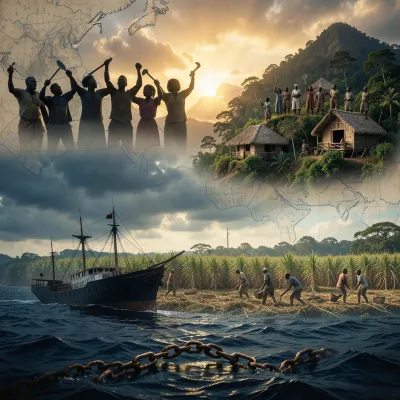
*Chains and Resistance: The History of Slavery in the Americas* provides a comprehensive comparative analysis of the development, maintenance, and eventual dismantling of chattel slavery across the Western Hemisphere. The text traces the evolution of labor regimes from the early enslavement of Indigenous populations to the massive expansion of the transatlantic slave trade, driven by the high European demand for commodities like sugar, tobacco, cotton, and coffee. It highlights how different colonial powers—Spanish, Portuguese, French, and British—codified racial hierarchies through diverse legal frameworks, ranging from the Iberian *Siete Partidas* to the French *Code Noir* and Anglo-American slave codes.
Central to the book is the theme of agency and resistance among the enslaved. The narrative explores a spectrum of defiance, including everyday acts of sabotage, the preservation of African-derived cosmologies and kinship networks, and large-scale armed rebellions like the Haitian Revolution. A significant portion of the work is dedicated to the formation of autonomous maroon communities, such as the *quilombos* of Brazil (notably Palmares) and the treatied maroons of Jamaica, which established independent polities that forced colonial authorities into diplomatic negotiations.
The book also details the uneven and protracted paths to emancipation, illustrating that the end of slavery was a process rather than a singular event. It contrasts the British system of apprenticeship and the American Civil War with the gradualist legal paths taken in Spanish America and the late abolitions in Cuba and Brazil. By examining "afterlives" such as sharecropping, debt peonage, and racialized policing, the text argues that the structural legacies of slavery continued to shape labor markets and citizenship long after legal manumission.
Finally, the work emphasizes the importance of the archive in reconstructing these histories. By synthesizing plantation ledgers, legal petitions, and runaway advertisements with personal survivor narratives and oral traditions, the book seeks to recover voices silenced by traditional history. It concludes that the history of the Americas is defined not only by the machinery of bondage but by the persistent world-making and pursuit of dignity by those who resisted it.
What You'll Find Inside:
- The transatlantic slave trade's origins, mechanics, and devastating human impact from Portuguese explorations to its 19th-century peak
- Diverse forms of resistance including maroon communities (quilombos, palenques, Jamaican Maroons), everyday acts of defiance, and major revolts like the Haitian Revolution
- Legal frameworks governing slavery from Iberian traditions to slave codes, and how enslaved people navigated manumission, coartación, and freedom suits
- Comparative emancipation processes across the Americas - British apprenticeship, US Civil War/Reconstruction, Spanish American gradualism, and Cuba/Brazil's prolonged endings
- The social and cultural worlds forged under slavery: family and kinship systems, religious syncretism, skilled labor, and the enduring agency of enslaved people
Who's It For:
This book is designed for students of social and legal history seeking a comprehensive understanding of slavery in the Americas, researchers requiring a comparative framework for analyzing different colonial systems, and general readers interested in how bondage and freedom were constructed across the hemisphere. It will particularly benefit those who want to center the experiences and agency of enslaved and formerly enslaved people while understanding the economic, legal, and cultural dimensions of slavery and emancipation.
Author:
Published By:
Date Published:
May 5, 2026
Type:
Nonfiction
Language:
English
Word Count:
61,062 words
Reading Time:
4 hours 17 minutes
Sample:
Order:
Order Chains and Resistance: The History of Slavery in the Americas (Paperback) on MixCache.com:
Buy NowPrint copy is made to order and ships worldwide. Includes the ebook free, ready to read instantly.
$5 account credit for all new MixCache.com accounts, usable toward any ebook purchase!*