Browse by Category
Fiction
- Action & Adventure
- African American
- Anthologies
- Children's Fiction
- Classics
- Comics & Graphic Novels
- Coming of Age
- Contemporary
- Cultural & Regional
- Drama
- Erotica
- Fantasy
- General
- Historical Fiction
- Horror
- Humor & Satire
- Literary Fiction
- Mystery, Thriller & Suspense
- Poetry
- Religious & Inspirational
- Romance
- Science Fiction
- Short Stories
- War & Military
- Westerns
- Women's Fiction
- Young Adult
Non-Fiction
- Antiques & Collectibles
- Arts & Photography
- Biographies & Memoirs
- Business & Money
- Children's Non-Fiction
-
Computers & Technology
- Artificial Intelligence
- Computer Science
- Cybersecurity & Cryptography
- Data Science & Analytics
- Databases & Big Data
- Game Development & Design
- General
- Hardware & DIY
- Mobile App Development
- Networking & Cloud Computing
- Operating Systems
- Programming
- Robotics
- Software
- Software Engineering
- User Experience (UX) & Design
- Web Development & Design
- Cooking, Food & Wine
- Crafts, Hobbies & Home
- Education & Teaching
- Engineering
- General
- Health, Fitness & Dieting
-
History
- African History
- African History - North Africa
- African History - Sub-Saharan Africa
- American History
- American History - 20th Century
- American History - Civil War
- American History - Colonial Period
- Ancient History
- Asian History
- Asian History - China
- Asian History - India
- Asian History - Japan
- Asian History - Southeast Asia
- European History
- European History - Ancient Greece
- European History - Ancient Rome
- European History - Medieval
- European History - Modern
- European History - Renaissance
- General
- Middle Eastern History
- Military History
- Military History - Aviation
- Military History - Naval
- Social & Cultural History
- World History
- Humor & Entertainment
- Industrial Technology
- Language Learning
- Law
- LGBTQ+ Non-Fiction
- Literary Criticism
- Medical Books
- Parenting & Relationships
- Philosophy
- Politics & Social Sciences
- Reference
- Religion & Spirituality
-
Science & Math
- Agricultural Sciences
- Astronomy & Space Science
- Behavioral Sciences
- Biological Sciences
- Botany & Plant Science
- Chemistry
- Earth Sciences
- Engineering - Chemical
- Engineering - Civil
- Engineering - Electrical
- Engineering - Mechanical
- Environment
- General
- Geology
- Mathematics
- Nature & Ecology
- Oceanography
- Paleontology
- Physics
- Statistics
- Self-Help
- Sports & Outdoors
- Study Aids
- Sustainability & Green Living
- Textbooks
- Transportation
- Travel
- True Crime
- Urban Planning & Development
- Veterinary Medicine
- Writing & Publishing
Jump to Section

Want unlimited access to all books published by MixCache.com (plus their audiobooks)? Try MixCache.com Total Access. Look for the MTA badge on book covers to identify included titles.
Access to infinite ebooks: Don't see the book you want? Suggest it and we'll create it (free!) for you from scratch with our powerful AI book writer. Then read it with MTA - besides profiting from any sales it makes!
Rivers, Dams, and Famine: An Environmental History of China
MTA
Ecology, climate, and human responses from agrarian times to modern engineering projects
About this book:
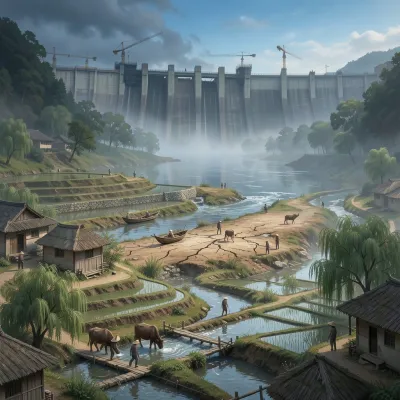
"Rivers, Dams, and Famine: An Environmental History of China" offers a comprehensive exploration of China's profound and intricate relationship with its waterways, tracing the interplay among climate, ecology, and human intervention from ancient agrarian societies to modern mega-engineering projects. The book argues that China's environmental history is fundamentally a history of its rivers, particularly the Yellow and Yangtze, which have shaped settlement patterns, agricultural practices, state legitimacy, and national identity for millennia. It highlights how the unpredictable monsoon climate and diverse topography, especially the sediment-rich Loess Plateau and the vast Tibetan Plateau, have dictated a continuous struggle between harnessing water for prosperity and mitigating its destructive power.
The narrative details the evolution of hydraulic statecraft, beginning with legendary figures like Yu the Great and the early development of dikes, polders, and canals under dynasties like Qin and Han. These early interventions established a cycle of intensive labor (corvée), the "mandate of water" as a cornerstone of imperial legitimacy, and the recurring challenge of managing the Yellow River's restless, silt-laden course. The book contrasts this with the "wet rice worlds" of the Yangtze, where sophisticated paddy systems fostered a localized, community-based approach to water management. It also examines the environmental consequences of land-use changes, such as deforestation and erosion, which intensified throughout the middle ages to meet growing demands for fuel and farmland, exacerbating river instability.
The modern era, particularly the 20th and 21st centuries, marks a dramatic escalation in China's ambition to control its rivers. From the republican era's vision of a scientifically managed nation to the Mao-era "Conquest of Nature" campaigns, large-scale engineering projects like the Sanmenxia Dam and, most notably, the Three Gorges Project, promised unparalleled flood control, power generation, and navigation. While delivering on some benefits, these mega-projects also came with profound costs, including mass displacement, significant environmental degradation (e.g., "hungry water" phenomenon, loss of biodiversity, increased landslides), and complex social and economic trade-offs. The South-North Water Transfer Project further exemplifies this ambition, attempting to re-plumb the nation by diverting water to the arid north, creating new challenges in water quality and inter-regional dependencies.
Ultimately, the book concludes by looking "beyond the dam," exploring contemporary efforts toward resilience and sustainability. It discusses the rise of environmental NGOs, the increasing contestation over "river rights," and innovative approaches like "sponge cities" that seek to work with, rather than against, natural hydrological processes. Faced with intensifying climate change, shrinking glaciers, and more frequent extreme weather events, China is grappling with the legacy of its hydraulic past and the imperative to develop adaptive, integrated water management strategies. The ongoing story is one of continuous negotiation between human ambition, technological prowess, ecological limits, and the irreducible power of water, underscoring that while control may be sought, true sustainability requires flexibility, participation, and a humble acknowledgment of nature's enduring autonomy.
What You'll Find Inside:
- The book shows how control of rivers was tied to political legitimacy from ancient myths of Yu the Great to modern mega‑projects, embedding water management in the Mandate of Heaven and state authority.
- It outlines the ecological trade‑offs of centuries of hydraulic engineering—silt aggradation, perched rivers, sediment starvation, and hungry water—revealing the costs of flood control, irrigation, and power generation.
- Famine chapters demonstrate how climatic variability (monsoons, ENSO) interacted with social institutions, turning droughts and floods into crises that amplified existing inequalities rather than being purely natural events.
- Modern case studies such as the Three Gorges Dam and the South–North Water Transfer are analyzed for their promised benefits (energy, flood mitigation, water redistribution) and their unintended consequences (displacement, ecosystem loss, downstream erosion).
- The concluding chapters argue for resilience and sustainability, advocating adaptive governance that blends engineering with local knowledge, climate uncertainty, and equitable benefit‑sharing for future water management.
Who's It For:
Scholars and graduate students in environmental history, Asian studies, water resources engineering, and development studies will find the book essential for understanding China’s long‑term river‑society dynamics. Policymakers, planners, and practitioners involved in China’s water infrastructure, flood management, and climate adaptation will gain insight into the historical antecedents and trade‑offs of contemporary projects. The work also appeals to informed readers interested in how technology, environment, and power intersect in large‑scale river basins.
Author:
Published By:
Date Published:
May 4, 2026
Type:
Nonfiction
Language:
English
Word Count:
56,319 words
Reading Time:
3 hours 57 minutes
Sample:
Order:
Order Rivers, Dams, and Famine: An Environmental History of China (Hardcover) on MixCache.com:
Buy NowPrint copy is made to order and ships worldwide. Includes the ebook free, ready to read instantly.
$5 account credit for all new MixCache.com accounts, usable toward any ebook purchase!*