
Browse by Category
Fiction
- Action & Adventure
- African American
- Anthologies
- Children's Fiction
- Classics
- Comics & Graphic Novels
- Coming of Age
- Contemporary
- Cultural & Regional
- Drama
- Erotica
- Fantasy
- General
- Historical Fiction
- Horror
- Humor & Satire
- Literary Fiction
- Mystery, Thriller & Suspense
- Poetry
- Religious & Inspirational
- Romance
- Science Fiction
- Short Stories
- War & Military
- Westerns
- Women's Fiction
- Young Adult
Non-Fiction
- Antiques & Collectibles
- Arts & Photography
- Biographies & Memoirs
- Business & Money
- Children's Non-Fiction
-
Computers & Technology
- Artificial Intelligence
- Computer Science
- Cybersecurity & Cryptography
- Data Science & Analytics
- Databases & Big Data
- Game Development & Design
- General
- Hardware & DIY
- Mobile App Development
- Networking & Cloud Computing
- Operating Systems
- Programming
- Robotics
- Software
- Software Engineering
- User Experience (UX) & Design
- Web Development & Design
- Cooking, Food & Wine
- Crafts, Hobbies & Home
- Education & Teaching
- Engineering
- General
- Health, Fitness & Dieting
-
History
- African History
- African History - North Africa
- African History - Sub-Saharan Africa
- American History
- American History - 20th Century
- American History - Civil War
- American History - Colonial Period
- Ancient History
- Asian History
- Asian History - China
- Asian History - India
- Asian History - Japan
- Asian History - Southeast Asia
- European History
- European History - Ancient Greece
- European History - Ancient Rome
- European History - Medieval
- European History - Modern
- European History - Renaissance
- General
- Middle Eastern History
- Military History
- Military History - Aviation
- Military History - Naval
- Social & Cultural History
- World History
- Humor & Entertainment
- Industrial Technology
- Language Learning
- Law
- LGBTQ+ Non-Fiction
- Literary Criticism
- Medical Books
- Parenting & Relationships
- Philosophy
- Politics & Social Sciences
- Reference
- Religion & Spirituality
-
Science & Math
- Agricultural Sciences
- Astronomy & Space Science
- Behavioral Sciences
- Biological Sciences
- Botany & Plant Science
- Chemistry
- Earth Sciences
- Engineering - Chemical
- Engineering - Civil
- Engineering - Electrical
- Engineering - Mechanical
- Environment
- General
- Geology
- Mathematics
- Nature & Ecology
- Oceanography
- Paleontology
- Physics
- Statistics
- Self-Help
- Sports & Outdoors
- Study Aids
- Sustainability & Green Living
- Textbooks
- Transportation
- Travel
- True Crime
- Urban Planning & Development
- Veterinary Medicine
- Writing & Publishing
Jump to Section
MixCache.com Total Access
Unlimited reading and audiobooks for every book published by MixCache.com.
Included titles carry the MTA badge.
Learn more →
Green Deen: Environmental Ethics and Activism in Muslim Communities
MTA
Theology, jurisprudence, and grassroots projects for ecological stewardship in Islam
About this book:
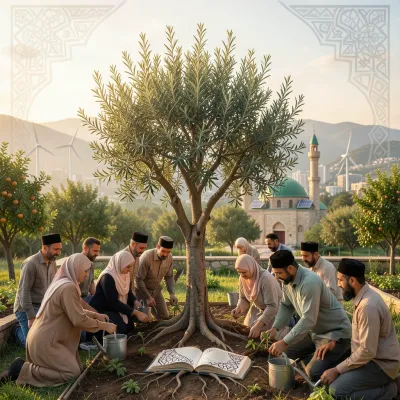
Green Deen presents a comprehensive Islamic framework for environmental stewardship, grounding ecological responsibility in the core theological concepts of Tawhid (Divine Oneness), Khalifah (trusteeship), and Amanah (sacred trust). Drawing from Qur’anic verses that depict nature as signs of God, the Prophetic Sunnah’s models of moderation, compassion, and resource conservation, and the higher objectives of Shari‘ah (Maqasid al‑Shari‘ah), the book argues that caring for the Earth is not an optional add‑on but a fundamental act of worship and justice. It shows how classical Islamic institutions such as hima (protected areas), harim (inviolate zones), waqf (endowments), and hisbah (public accountability) can be revived and reinterpreted to address contemporary crises like climate change, water scarcity, biodiversity loss, and pollution.
The work then translates these principles into practical domains: water ethics emphasizing purity, conservation, and equitable rights; land stewardship through community‑managed hima and harim; animal welfare extending halal beyond slaughter to humane treatment and sustainable consumption; waste reduction guided by the prohibitions of israf (excess) and the encouragement of iqtisdad (moderation); energy and technology evaluated through the lenses of harm‑prevention (darar yuzal) and public interest (maslahah); and finance mobilized via zakat, green awqaf, and green sukuk to support renewable energy, sustainable agriculture, and resilience projects. Chapters on mosques as green hubs, eco‑literacy in curricula and pulpit, women and youth leadership, community organizing, policy advocacy, environmental law, health and environmental justice, food systems, urban planning, disaster resilience, diaspora engagement, and real‑world case studies illustrate how Muslim communities worldwide are already putting these ideas into practice—from mangrove restoration in Southeast Asia to solar-powered desalination in North Africa.
Finally, Green Deen stresses the importance of measuring impact, ensuring accountability, and recognizing the spiritual growth that accompanies ecological action. By linking tangible indicators (energy saved, waste diverted, trees planted) with internal virtues such as gratitude (shukr), patience (sabr), justice (‘adl), and trust (tawakkul), the book demonstrates that environmental stewardship is both a practical necessity and a path to deepening faith. It calls for an integrated approach where legal reform, financial innovation, education, grassroots mobilization, and personal devotion converge to fulfill the divine trust of protecting creation for present and future generations.
What You'll Find Inside:
- Explores Qur'anic and Prophetic foundations for environmental stewardship, establishing concepts like khalifah (trusteeship) and amanah (sacred trust) as core to Islamic faith.
- Details how Islamic jurisprudence (maqasid al-shari'ah, fiqh al-bi'ah) provides frameworks for addressing modern ecological crises through principles of public interest and harm prevention.
- Examines practical applications including water ethics, land conservation (hima/harim), animal welfare, waste reduction, and sustainable energy transitions rooted in Islamic teachings.
- Highlights community mobilization strategies: transforming mosques into green hubs, educating youth and women leaders, and building coalitions for policy advocacy.
- Presents global case studies from Southeast Asian mangrove restoration to Middle Eastern solar initiatives, demonstrating measurable impact and spiritual growth through eco-activism.
Who's It For:
This book is designed for three interconnected audiences: faith-based activists seeking to frame environmental action as religious devotion; policy advocates needing Shari'ah-based reasoning to influence climate debates; and educators (imams, teachers, curriculum developers) aiming to integrate eco-literacy into Islamic educational spaces. It specifically benefits Muslim community leaders, activists, scholars, and practitioners working at the intersection of faith and sustainability who want practical tools grounded in Islamic tradition to address ecological challenges.
Table of Contents:
- Introduction
- Chapter 1 Revelation and Creation: Qur’anic Foundations for Stewardship
- Chapter 2 The Prophetic Ecology: Sunnah, Hadith, and Daily Ethics
- Chapter 3 Tawhid, Khalifah, and Amanah: Theological Pillars of Responsibility
- Chapter 4 Maqasid al-Shari‘ah and Ecological Well-Being
- Chapter 5 Fiqh al-Bi’ah: Toward an Islamic Environmental Jurisprudence
- Chapter 6 Water Ethics: Purity, Scarcity, and Rights
- Chapter 7 Land, Hima, and Harim: Classical Conservation Revived
- Chapter 8 Animals, Compassion, and Consumption: Halal Beyond the Plate
- Chapter 9 Waste, Moderation, and the Ethics of Use: Israf and Iqtisad
- Chapter 10 Energy, Technology, and Ethical Transitions
- Chapter 11 Finance for the Earth: Zakat, Waqf, and Green Sukuk
- Chapter 12 Mosques as Green Hubs: Architecture and Operations
- Chapter 13 Curriculum and Pulpit: Teaching Eco-Literacy in Muslim Spaces
- Chapter 14 Women, Youth, and Intergenerational Leadership
- Chapter 15 Community Organizing: From Khutbah to Campaign
- Chapter 16 Policy Advocacy: Shari‘ah Reasoning in Public Climate Debates
- Chapter 17 Law and Governance: Hisbah, Regulation, and Modern Institutions
- Chapter 18 Health, Air, and Environmental Justice in Muslim Communities
- Chapter 19 Food Systems: Farming, Permaculture, and Ethical Trade
- Chapter 20 Cities and Mobility: Urban Planning through an Islamic Lens
- Chapter 21 Disaster Response and Climate Resilience
- Chapter 22 Diaspora Dynamics: Building Coalitions in Minority Contexts
- Chapter 23 Case Studies I: Southeast Asia’s Mangroves and Forests
- Chapter 24 Case Studies II: North Africa and the Middle East’s Solar and Water Initiatives
- Chapter 25 Measuring Impact: Indicators, Accountability, and Spiritual Growth
Author:
Published By:
Date Published:
May 20, 2026
Type:
Nonfiction
Language:
English
Word Count:
45,427 words
Reading Time:
3 hours 11 minutes
Sample:
MixCache.com Total Access
Get unlimited access to this book + all books published by MixCache.com for $11.99/month
Subscribe to MTAOr purchase this book individually below
Order:
Buy the Green Deen: Environmental Ethics and Activism in Muslim Communities ebook on MixCache.com:
Buy Now
Full ebook will be available immediately
- read online or download as a PDF file.
$5 account credit for all new MixCache.com accounts, usable toward any ebook purchase!*






Ratings & Reviews
Ask Questions About This Book
Have a question about the content? Ask our AI assistant!
Start by asking a question about "Green Deen: Environmental Ethics and Activism in Muslim Communities"
Example: "Does this book mention William Shakespeare?"
Thinking...