Browse by Category
Fiction
- Action & Adventure
- African American
- Anthologies
- Children's Fiction
- Classics
- Comics & Graphic Novels
- Coming of Age
- Contemporary
- Cultural & Regional
- Drama
- Erotica
- Fantasy
- General
- Historical Fiction
- Horror
- Humor & Satire
- Literary Fiction
- Mystery, Thriller & Suspense
- Poetry
- Religious & Inspirational
- Romance
- Science Fiction
- Short Stories
- War & Military
- Westerns
- Women's Fiction
- Young Adult
Non-Fiction
- Antiques & Collectibles
- Arts & Photography
- Biographies & Memoirs
- Business & Money
- Children's Non-Fiction
-
Computers & Technology
- Artificial Intelligence
- Computer Science
- Cybersecurity & Cryptography
- Data Science & Analytics
- Databases & Big Data
- Game Development & Design
- General
- Hardware & DIY
- Mobile App Development
- Networking & Cloud Computing
- Operating Systems
- Programming
- Robotics
- Software
- Software Engineering
- User Experience (UX) & Design
- Web Development & Design
- Cooking, Food & Wine
- Crafts, Hobbies & Home
- Education & Teaching
- Engineering
- General
- Health, Fitness & Dieting
-
History
- African History
- African History - North Africa
- African History - Sub-Saharan Africa
- American History
- American History - 20th Century
- American History - Civil War
- American History - Colonial Period
- Ancient History
- Asian History
- Asian History - China
- Asian History - India
- Asian History - Japan
- Asian History - Southeast Asia
- European History
- European History - Ancient Greece
- European History - Ancient Rome
- European History - Medieval
- European History - Modern
- European History - Renaissance
- General
- Middle Eastern History
- Military History
- Military History - Aviation
- Military History - Naval
- Social & Cultural History
- World History
- Humor & Entertainment
- Industrial Technology
- Language Learning
- Law
- LGBTQ+ Non-Fiction
- Literary Criticism
- Medical Books
- Parenting & Relationships
- Philosophy
- Politics & Social Sciences
- Reference
- Religion & Spirituality
-
Science & Math
- Agricultural Sciences
- Astronomy & Space Science
- Behavioral Sciences
- Biological Sciences
- Botany & Plant Science
- Chemistry
- Earth Sciences
- Engineering - Chemical
- Engineering - Civil
- Engineering - Electrical
- Engineering - Mechanical
- Environment
- General
- Geology
- Mathematics
- Nature & Ecology
- Oceanography
- Paleontology
- Physics
- Statistics
- Self-Help
- Sports & Outdoors
- Study Aids
- Sustainability & Green Living
- Textbooks
- Transportation
- Travel
- True Crime
- Urban Planning & Development
- Veterinary Medicine
- Writing & Publishing
Jump to Section

Want unlimited access to all books published by MixCache.com (plus their audiobooks)? Try MixCache.com Total Access. Look for the MTA badge on book covers to identify included titles.
Access to infinite ebooks: Don't see the book you want? Suggest it and we'll create it (free!) for you from scratch with our powerful AI book writer. Then read it with MTA - besides profiting from any sales it makes!
Marine Law and Policy: Governance of the High Seas and Coastal Zones
MTA
An accessible guide to international conventions, national law, and governance tools for ocean management
About this book:
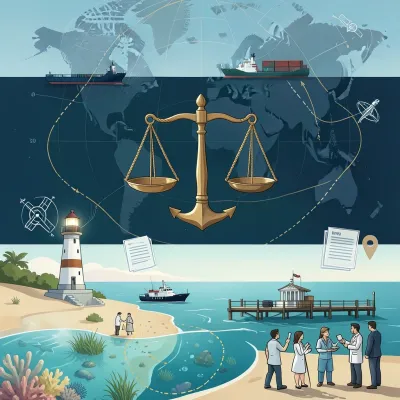
*Marine Law and Policy: Governance of the High Seas and Coastal Zones* provides a comprehensive examination of the legal and institutional frameworks governing human interaction with the ocean. Centered on the United Nations Convention on the Law of the Sea (UNCLOS), the text details the spatial architecture of maritime jurisdictions—ranging from internal waters and territorial seas to the Exclusive Economic Zone and the high seas. It explores how these boundaries balance the sovereign rights of coastal states with the traditional freedoms of the international community, such as navigation, scientific research, and submarine cable maintenance.
The book delves into sectoral management challenges, specifically focusing on fisheries governance, the regulation of deep-seabed mining through the International Seabed Authority, and the jurisdictional triad of flag, port, and coastal state controls. It addresses the persistent threat of illegal, unreported, and unregulated (IUU) fishing, emphasizing the role of compliance technologies like satellite monitoring and eDNA. Furthermore, it highlights the transition toward ecosystem-based management and marine spatial planning as essential tools for reconciling economic development—often termed the "Blue Economy"—with the imperative of environmental conservation.
A significant portion of the text is dedicated to emerging legal frontiers and the evolution of international stewardship. This includes an analysis of the new High Seas Treaty regarding Biodiversity Beyond National Jurisdiction (BBNJ) and the integration of social equity for Indigenous peoples and small-scale fishers. The book also confronts the destabilizing effects of climate change, ocean acidification, and sea-level rise, noting how these phenomena challenge static legal baselines and necessitate more adaptive, resilient governance structures to manage shifting biological and geographical realities.
Ultimately, the work emphasizes that effective ocean governance requires a move away from fragmented, sectoral silos toward integrated, transparent, and participatory models. By utilizing comparative case studies of maritime boundary disputes and policy implementation, the book illustrates the practical complexities of applying international law in a dynamic environment. It concludes by advocating for a future-oriented approach to marine policy that leverages technological innovation and international cooperation to safeguard the ocean as a common heritage for future generations.
What You'll Find Inside:
- Comprehensive explanation of UNCLOS as the 'constitution for the oceans,' including its architecture, principles, and key institutions like ITLOS and the International Seabed Authority.
- Practical governance tools such as ecosystem-based management, marine spatial planning, and rights-based fisheries approaches that translate legal requirements into actionable strategies.
- Coverage of emerging high seas governance including the new BBNJ Treaty, biodiversity conservation beyond national jurisdiction, and seabed mining regulation under the common heritage principle.
- Analysis of compliance technologies like satellite monitoring, eDNA analysis, and digital tracking systems that are revolutionizing enforcement of ocean regulations.
- Examination of equity dimensions including Indigenous rights, small-scale fisheries, social equity, and blue economy finance mechanisms for sustainable ocean development.
Who's It For:
This book is designed for practitioners, policymakers, students, and advocates working in ocean governance who need clear, practical guidance grounded in real-world applications. It serves professionals involved in marine policy implementation, international law, fisheries management, environmental protection, and coastal development who require accessible explanations of complex legal frameworks. The content is particularly valuable for those needing to navigate jurisdictional complexities, design effective conservation measures, or understand emerging challenges like climate change impacts and high seas biodiversity governance.
Author:
Published By:
Date Published:
May 4, 2026
Type:
Nonfiction
Language:
English
Word Count:
89,501 words
Reading Time:
6 hours 16 minutes
Sample:
Order:
Order Marine Law and Policy: Governance of the High Seas and Coastal Zones (Hardcover) on MixCache.com:
Buy NowPrint copy is made to order and ships worldwide. Includes the ebook free, ready to read instantly.
$5 account credit for all new MixCache.com accounts, usable toward any ebook purchase!*