
Browse by Category
Fiction
- Action & Adventure
- African American
- Anthologies
- Children's Fiction
- Classics
- Comics & Graphic Novels
- Coming of Age
- Contemporary
- Cultural & Regional
- Drama
- Erotica
- Fantasy
- General
- Historical Fiction
- Horror
- Humor & Satire
- Literary Fiction
- Mystery, Thriller & Suspense
- Poetry
- Religious & Inspirational
- Romance
- Science Fiction
- Short Stories
- War & Military
- Westerns
- Women's Fiction
- Young Adult
Non-Fiction
- Antiques & Collectibles
- Arts & Photography
- Biographies & Memoirs
- Business & Money
- Children's Non-Fiction
-
Computers & Technology
- Artificial Intelligence
- Computer Science
- Cybersecurity & Cryptography
- Data Science & Analytics
- Databases & Big Data
- Game Development & Design
- General
- Hardware & DIY
- Mobile App Development
- Networking & Cloud Computing
- Operating Systems
- Programming
- Robotics
- Software
- Software Engineering
- User Experience (UX) & Design
- Web Development & Design
- Cooking, Food & Wine
- Crafts, Hobbies & Home
- Education & Teaching
- Engineering
- General
- Health, Fitness & Dieting
-
History
- African History
- African History - North Africa
- African History - Sub-Saharan Africa
- American History
- American History - 20th Century
- American History - Civil War
- American History - Colonial Period
- Ancient History
- Asian History
- Asian History - China
- Asian History - India
- Asian History - Japan
- Asian History - Southeast Asia
- European History
- European History - Ancient Greece
- European History - Ancient Rome
- European History - Medieval
- European History - Modern
- European History - Renaissance
- General
- Middle Eastern History
- Military History
- Military History - Aviation
- Military History - Naval
- Social & Cultural History
- World History
- Humor & Entertainment
- Industrial Technology
- Language Learning
- Law
- LGBTQ+ Non-Fiction
- Literary Criticism
- Medical Books
- Parenting & Relationships
- Philosophy
- Politics & Social Sciences
- Reference
- Religion & Spirituality
-
Science & Math
- Agricultural Sciences
- Astronomy & Space Science
- Behavioral Sciences
- Biological Sciences
- Botany & Plant Science
- Chemistry
- Earth Sciences
- Engineering - Chemical
- Engineering - Civil
- Engineering - Electrical
- Engineering - Mechanical
- Environment
- General
- Geology
- Mathematics
- Nature & Ecology
- Oceanography
- Paleontology
- Physics
- Statistics
- Self-Help
- Sports & Outdoors
- Study Aids
- Sustainability & Green Living
- Textbooks
- Transportation
- Travel
- True Crime
- Urban Planning & Development
- Veterinary Medicine
- Writing & Publishing
Jump to Section
MixCache.com Total Access
Unlimited reading and audiobooks for every book published by MixCache.com.
Included titles carry the MTA badge.
Learn more →
Heritage Conservation in New Delhi
MTA
Case studies on preserving monuments, neighborhoods, and intangible culture
About this book:
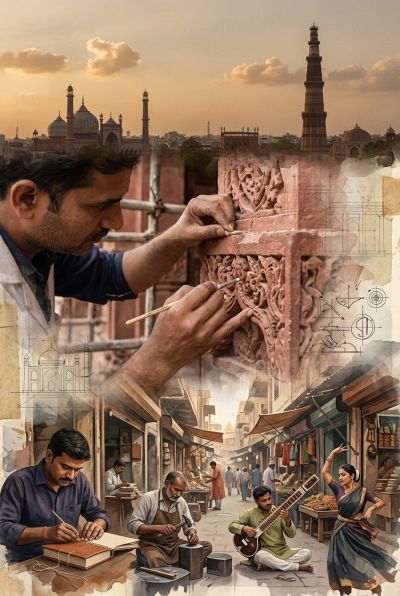
Heritage Conservation in New Delhi explores the city’s multilayered past—spanning ancient settlements, Mughal grandeur, colonial planning, and post‑independence development—through detailed case studies of monuments, neighborhoods, and intangible traditions. The book situates conservation within a complex web of legal instruments (the AMASR Act, Master Plans, municipal bye‑laws), institutional actors (ASI, DDA, NDMC, DUAC, INTACH, community groups), and competing pressures from urban growth, security concerns, tourism, and commercial interests. It emphasizes that successful preservation requires moving beyond technical restoration to integrated approaches that link tangible fabric with living practices such as qawwali, street foodways, and craft economies.
Key case studies illustrate both achievements and tensions: the Nizamuddin Revitalization Project demonstrates how monument restoration can be coupled with infrastructure upgrades, livelihood generation, and community participation; Sunder Nursery and Mehrauli Archaeological Park show ecological recovery and landscape‑led revitalization; the adaptive reuse of Dharampura Haveli highlights private‑sector potential while raising questions of accessibility and gentrification; and controversies around the Chandni Chowk redevelopment, Central Vista transformation, and the demolition of the Hall of Nations reveal the difficulties of balancing heritage safeguards with modernization agendas. Throughout, the volume stresses the importance of stakeholder engagement, nuanced legal frameworks (including heritage impact assessments and monument‑specific bye‑laws), and financial models that sustain conservation efforts.
The concluding chapters outline practical tools for practitioners: heritage impact assessments, GIS‑based documentation, adaptive reuse strategies, participatory planning, and innovative financing via CSR, philanthropy, and revenue‑generating reuse. By treating heritage as a dynamic resource rather than a static obstacle, the book argues that conservation can drive inclusive growth, environmental resilience, and cultural vitality in Delhi—and offers lessons applicable to other rapidly evolving historic cities.
What You'll Find Inside:
- Heritage conservation in Delhi requires navigating layered historical periods and diverse stakeholder interests, from ancient settlements to post-independence modern heritage, as demonstrated through case studies spanning Humayun's Tomb to Connaught Place.
- Integrated conservation approaches that link tangible monument restoration with intangible cultural preservation and community development—exemplified by the Nizamuddin Revitalization Project—prove most sustainable for historic precincts with living communities.
- Legal frameworks like the AMASR Act and Master Plans create both protections and tensions, particularly around buffer zones and development rights, as seen in conflicts at Qutub Complex and Lutyens' Bungalow Zone.
- Adaptive reuse of heritage structures—from havelis transformed into boutique hotels to colonial buildings repurposed for public culture—offers viable pathways for economic sustainability while maintaining historical character.
- Practical tools including Heritage Impact Assessments, GIS mapping, community engagement strategies, and innovative financing models are essential for balancing conservation with urban development needs in complex metropolitan contexts.
Who's It For:
This book is essential for heritage conservation professionals, urban planners, and policymakers working in Delhi or comparable historic cities. It will particularly benefit those seeking to integrate tangible and intangible heritage preservation with community development needs, navigate legal and institutional complexities, and implement adaptive reuse strategies. Students of urban conservation, architecture, and South Asian studies will find the detailed case studies and practical frameworks invaluable for understanding heritage management in rapidly urbanizing contexts.
Table of Contents:
- Introduction
- Chapter 1 Mapping Delhi’s Heritage Landscape: Layers of a Capital
- Chapter 2 Laws that Shape the Past: AMASR, Master Plans, and Municipal Bye-laws
- Chapter 3 Institutions and Actors: ASI, DDA, NDMC, DUAC, INTACH, and Community Voices
- Chapter 4 Humayun’s Tomb–Nizamuddin: Integrated Conservation and Community Renewal
- Chapter 5 Sunder Nursery: From Arboretum to People’s Park
- Chapter 6 Mehrauli Archaeological Park: Stitching Ruins into a Living City
- Chapter 7 Qutub Complex and the 300-Meter Rule: Managing Pressures at the Edge
- Chapter 8 Shahjahanabad/Old Delhi: Havelis, Streetscapes, and Services
- Chapter 9 Chandni Chowk Redevelopment: Pedestrianization, Commerce, and Memory
- Chapter 10 Dharampura Haveli: Adaptive Reuse in a Dense Historic Fabric
- Chapter 11 Jama Masjid Precinct: Faith, Vendors, and the Public Realm
- Chapter 12 Red Fort and its Buffer: Security, Spectacle, and Everyday Use
- Chapter 13 Jantar Mantar: Scientific Heritage in a Protest Corridor
- Chapter 14 Connaught Place: Conservation of a Commercial Icon
- Chapter 15 Lutyens’ Bungalow Zone: Garden City Ideals under Development Pressure
- Chapter 16 Central Vista Transformation: Heritage Impact and Public Debate
- Chapter 17 Hall of Nations at Pragati Maidan: A Cautionary Tale of Modern Heritage
- Chapter 18 Tughlaqabad and Adilabad: Forts, Settlements, and Encroachment
- Chapter 19 Baolis of Delhi: Water Heritage and Urban Resilience
- Chapter 20 Hauz Khas Village: Gentrification, Nightlife, and Monument Care
- Chapter 21 Kashmere Gate and Civil Lines: Institutional Campuses and River Proximity
- Chapter 22 Nizamuddin Dargah and Qawwali: Safeguarding Sacred Soundscapes
- Chapter 23 Foodways of Old Delhi: Street Vendors, Hygiene Codes, and Identity
- Chapter 24 Craft Neighborhoods: Zardozi, Kite-Making, and the Economics of Continuity
- Chapter 25 Tools and Tactics: Heritage Impact Assessment, Data, and Design for the Future
Author:
Published By:
Date Published:
June 5, 2026
Type:
Nonfiction
Language:
English
Word Count:
41,872 words
Reading Time:
2 hours 56 minutes
Sample:
MixCache.com Total Access
Get unlimited access to this book + all books published by MixCache.com for $11.99/month
Subscribe to MTAOr purchase this book individually below
Order:
Buy the Heritage Conservation in New Delhi ebook on MixCache.com:
Buy Now
Full ebook will be available immediately
- read online or download as a PDF file.
$5 account credit for all new MixCache.com accounts, usable toward any ebook purchase!*






Ratings & Reviews
Ask Questions About This Book
Have a question about the content? Ask our AI assistant!
Start by asking a question about "Heritage Conservation in New Delhi"
Example: "Does this book mention William Shakespeare?"
Thinking...