
Browse by Category
Fiction
- Action & Adventure
- African American
- Anthologies
- Children's Fiction
- Classics
- Comics & Graphic Novels
- Coming of Age
- Contemporary
- Cultural & Regional
- Drama
- Erotica
- Fantasy
- General
- Historical Fiction
- Horror
- Humor & Satire
- Literary Fiction
- Mystery, Thriller & Suspense
- Poetry
- Religious & Inspirational
- Romance
- Science Fiction
- Short Stories
- War & Military
- Westerns
- Women's Fiction
- Young Adult
Non-Fiction
- Antiques & Collectibles
- Arts & Photography
- Biographies & Memoirs
- Business & Money
- Children's Non-Fiction
-
Computers & Technology
- Artificial Intelligence
- Computer Science
- Cybersecurity & Cryptography
- Data Science & Analytics
- Databases & Big Data
- Game Development & Design
- General
- Hardware & DIY
- Mobile App Development
- Networking & Cloud Computing
- Operating Systems
- Programming
- Robotics
- Software
- Software Engineering
- User Experience (UX) & Design
- Web Development & Design
- Cooking, Food & Wine
- Crafts, Hobbies & Home
- Education & Teaching
- Engineering
- General
- Health, Fitness & Dieting
-
History
- African History
- African History - North Africa
- African History - Sub-Saharan Africa
- American History
- American History - 20th Century
- American History - Civil War
- American History - Colonial Period
- Ancient History
- Asian History
- Asian History - China
- Asian History - India
- Asian History - Japan
- Asian History - Southeast Asia
- European History
- European History - Ancient Greece
- European History - Ancient Rome
- European History - Medieval
- European History - Modern
- European History - Renaissance
- General
- Middle Eastern History
- Military History
- Military History - Aviation
- Military History - Naval
- Social & Cultural History
- World History
- Humor & Entertainment
- Industrial Technology
- Language Learning
- Law
- LGBTQ+ Non-Fiction
- Literary Criticism
- Medical Books
- Parenting & Relationships
- Philosophy
- Politics & Social Sciences
- Reference
- Religion & Spirituality
-
Science & Math
- Agricultural Sciences
- Astronomy & Space Science
- Behavioral Sciences
- Biological Sciences
- Botany & Plant Science
- Chemistry
- Earth Sciences
- Engineering - Chemical
- Engineering - Civil
- Engineering - Electrical
- Engineering - Mechanical
- Environment
- General
- Geology
- Mathematics
- Nature & Ecology
- Oceanography
- Paleontology
- Physics
- Statistics
- Self-Help
- Sports & Outdoors
- Study Aids
- Sustainability & Green Living
- Textbooks
- Transportation
- Travel
- True Crime
- Urban Planning & Development
- Veterinary Medicine
- Writing & Publishing
Jump to Section
MixCache.com Total Access
Unlimited reading and audiobooks for every book published by MixCache.com.
Included titles carry the MTA badge.
Learn more →
Mapping the Invisible: Space Telescopes and the Dark Universe
MTA
How space observatories reveal dark matter, dark energy, and the structure of the cosmos
About this book:
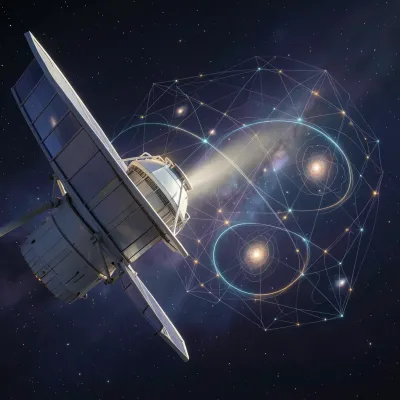
"Mapping the Invisible" provides a comprehensive overview of how space telescopes are instrumental in unveiling the mysteries of the dark universe, which is composed primarily of dark matter and dark energy. The book begins by establishing the theoretical foundations, from Einstein's general relativity to the ΛCDM model, highlighting how gravity and cosmic expansion dictate the universe's structure and evolution. It then details why space-based observatories are essential, emphasizing their freedom from atmospheric distortion, absorption, and glow, which enables superior stability, sharpness, and wavelength access for precise cosmological measurements.
The core of the book delves into the specific observational techniques enabled by space telescopes. It explains how precision photometry and spectroscopy standardize Type Ia supernovae, which served as the initial evidence for cosmic acceleration driven by dark energy. Weak gravitational lensing, the subtle distortion of distant galaxy shapes by intervening mass, is thoroughly discussed as the primary method for mapping dark matter directly, independent of its luminous tracers. The book also covers galaxy clustering and baryon acoustic oscillations as standard rulers for measuring cosmic distances, and the use of galaxy clusters as cosmic laboratories, weighing them through lensing, X-ray emission, and the Sunyaev–Zel’dovich effect. A significant portion is dedicated to the Cosmic Microwave Background (CMB), detailing how its temperature anisotropies reveal the early universe's composition and geometry, and how CMB polarization, particularly B-modes, offers insights into primordial gravitational waves and reionization, with gravitational lensing of the CMB tying early and late-time mass distributions.
Crucially, the text emphasizes the rigorous methodologies required to translate raw data into robust cosmological conclusions. Chapters cover the intricate processes of survey design—balancing field size, depth, cadence, and dithering—and the journey from raw telemetry through complex pipelines for calibration and validation. The critical role of simulations and "mock skies" for forward modeling and stress-testing analysis pipelines against systematic errors is highlighted, as is the increasing integration of machine learning for tasks like image cleaning, shape measurement, and photometric redshift estimation. The book concludes by looking ahead to upcoming missions like Euclid, Roman, JWST, and LiteBIRD, underscoring their multi-probe strategies and the concerted effort to achieve unprecedented precision in understanding dark energy, dark matter, and the fundamental structure of the cosmos.
What You'll Find Inside:
- Space telescopes provide stable, diffraction-limited imaging and low backgrounds essential for measuring weak gravitational lensing shear and mapping dark matter across cosmic time.
- Type Ia supernovae serve as standardized candles; space-based UV/optical photometry enables precise light-curve calibration and dust correction, revealing the accelerating expansion driven by dark energy.
- Cosmic microwave background temperature and polarization anisotropies, especially lensing-induced B-modes, act as a high-redshift anchor for cosmological models and trace the growth of structure.
- Combining probes—weak lensing, supernovae, baryon acoustic oscillations, and CMB—breaks degeneracies between expansion history and structure growth, tightening constraints on dark energy and dark matter.
- Robust cosmological inference relies on meticulous survey design, end-to-end calibration, forward‑modeled simulations, and systematic error control to turn faint signals into trustworthy parameter estimates.
Who's It For:
This book is aimed at advanced undergraduate and graduate students in physics or astronomy, as well as informed enthusiasts with a solid foundation in mechanics, electromagnetism, and probability. Readers should be comfortable with basic calculus and introductory concepts in general relativity and statistics, as the text builds on these to explore space‑based techniques for probing dark matter and dark energy. It will also benefit early‑career researchers seeking a comprehensive, self‑contained reference on the observational and analytical tools used in modern dark‑universe cosmology.
Table of Contents:
- Introduction
- Chapter 1 The Dark Universe: An Overview
- Chapter 2 Gravity and the Expanding Cosmos: From Einstein to ΛCDM
- Chapter 3 Why Space? The Case for Observatories Above the Atmosphere
- Chapter 4 Windows on the Sky: Wavelengths, Detectors, and Optics
- Chapter 5 Precision Photometry and Spectroscopy from Space
- Chapter 6 Astrometry and the Time-Domain Universe
- Chapter 7 Distances and Redshifts: From Standard Candles to Standard Rulers
- Chapter 8 Type Ia Supernovae and the Discovery of Cosmic Acceleration
- Chapter 9 Supernova Cosmology: Calibration, Selection Effects, and Systematics
- Chapter 10 Gravitational Lensing Essentials: Deflection, Shear, and Magnification
- Chapter 11 Weak Lensing and Cosmic Shear: Mapping Mass Without Light
- Chapter 12 Shapes, PSFs, and Alignments: The Art of Shear Measurement
- Chapter 13 Strong Lensing and Time Delays: Natural Telescopes and Cosmography
- Chapter 14 Galaxy Clustering and Baryon Acoustic Oscillations from Space
- Chapter 15 Galaxy Clusters: Lensing, Counts, and Mass Calibration
- Chapter 16 The Cosmic Microwave Background: Temperature Anisotropies
- Chapter 17 CMB Polarization, Lensing, and Reionization
- Chapter 18 Cross-Correlations and Multi-Probe Cosmology
- Chapter 19 Survey Design: Footprints, Depth, Dither, and Cadence
- Chapter 20 From Raw Frames to Catalogs: Pipelines, Calibration, and Validation
- Chapter 21 Simulations and Mock Skies: Forward Modeling the Universe
- Chapter 22 Inference Engines: Bayesian Methods and Model Comparison
- Chapter 23 Machine Learning for the Dark Universe
- Chapter 24 Systematics, Stress Tests, and Robust Conclusions
- Chapter 25 The Road Ahead: Euclid, Roman, JWST, LiteBIRD, and Beyond
Author:
Published By:
Date Published:
May 3, 2026
Type:
Nonfiction
Language:
English
Word Count:
64,545 words
Reading Time:
4 hours 31 minutes
Sample:
Order:
Order Mapping the Invisible: Space Telescopes and the Dark Universe (Hardcover) on MixCache.com:
Buy NowPrint copy is made to order and ships worldwide. Includes the ebook free, ready to read instantly.
$5 account credit for all new MixCache.com accounts, usable toward any ebook purchase!*


