
Browse by Category
Fiction
- Action & Adventure
- African American
- Anthologies
- Children's Fiction
- Classics
- Comics & Graphic Novels
- Coming of Age
- Contemporary
- Cultural & Regional
- Drama
- Erotica
- Fantasy
- General
- Historical Fiction
- Horror
- Humor & Satire
- Literary Fiction
- Mystery, Thriller & Suspense
- Poetry
- Religious & Inspirational
- Romance
- Science Fiction
- Short Stories
- War & Military
- Westerns
- Women's Fiction
- Young Adult
Non-Fiction
- Antiques & Collectibles
- Arts & Photography
- Biographies & Memoirs
- Business & Money
- Children's Non-Fiction
-
Computers & Technology
- Artificial Intelligence
- Computer Science
- Cybersecurity & Cryptography
- Data Science & Analytics
- Databases & Big Data
- Game Development & Design
- General
- Hardware & DIY
- Mobile App Development
- Networking & Cloud Computing
- Operating Systems
- Programming
- Robotics
- Software
- Software Engineering
- User Experience (UX) & Design
- Web Development & Design
- Cooking, Food & Wine
- Crafts, Hobbies & Home
- Education & Teaching
- Engineering
- General
- Health, Fitness & Dieting
-
History
- African History
- African History - North Africa
- African History - Sub-Saharan Africa
- American History
- American History - 20th Century
- American History - Civil War
- American History - Colonial Period
- Ancient History
- Asian History
- Asian History - China
- Asian History - India
- Asian History - Japan
- Asian History - Southeast Asia
- European History
- European History - Ancient Greece
- European History - Ancient Rome
- European History - Medieval
- European History - Modern
- European History - Renaissance
- General
- Middle Eastern History
- Military History
- Military History - Aviation
- Military History - Naval
- Social & Cultural History
- World History
- Humor & Entertainment
- Industrial Technology
- Language Learning
- Law
- LGBTQ+ Non-Fiction
- Literary Criticism
- Medical Books
- Parenting & Relationships
- Philosophy
- Politics & Social Sciences
- Reference
- Religion & Spirituality
-
Science & Math
- Agricultural Sciences
- Astronomy & Space Science
- Behavioral Sciences
- Biological Sciences
- Botany & Plant Science
- Chemistry
- Earth Sciences
- Engineering - Chemical
- Engineering - Civil
- Engineering - Electrical
- Engineering - Mechanical
- Environment
- General
- Geology
- Mathematics
- Nature & Ecology
- Oceanography
- Paleontology
- Physics
- Statistics
- Self-Help
- Sports & Outdoors
- Study Aids
- Sustainability & Green Living
- Textbooks
- Transportation
- Travel
- True Crime
- Urban Planning & Development
- Veterinary Medicine
- Writing & Publishing
Jump to Section
MixCache.com Total Access
Unlimited reading and audiobooks for every book published by MixCache.com.
Included titles carry the MTA badge.
Learn more →
Inca to Aztec: Dynasties of the Americas before Columbus
MTA
Political organization, imperial rule, and succession in pre-Columbian civilizations
About this book:
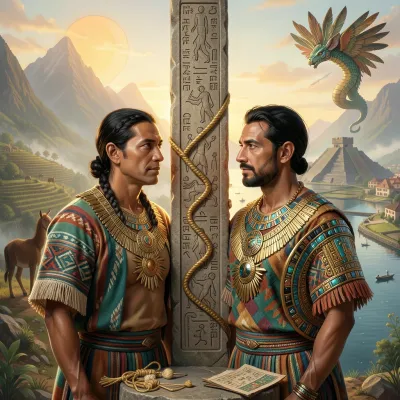
*Inca to Aztec: Dynasties of the Americas before Columbus* explores the sophisticated political, economic, and ritual structures of pre-Columbian civilizations, focusing on how empires like the Inca and Aztec, alongside the Maya, Tarascans, Mixtecs, and Zapotecs, established and maintained authority. The book emphasizes that these polities were not isolated experiments but shared a complex "repertoire of statecraft" that utilized engineered landscapes, standardized architecture, and intricate road networks to project power. By triangulating archaeological evidence, indigenous codices, and colonial chronicles, the text reconstructs how dynasties managed diverse ecological zones, from the vertical archipelagos of the Andes to the hydraulic systems of the Mexican basin, to ensure resource stability and political integration.
Central to the book’s analysis is the concept of sacral kingship, where rulers derived legitimacy by positioning themselves at the axis of cosmic and agricultural cycles. This authority was manifested through public performances of ritual and sacrifice, the use of specialized regalia produced by state-monopolized artisans, and the implementation of complex calendars that synchronized social labor with celestial events. Succession was rarely a matter of simple primogeniture; instead, it was a negotiated process involving military merit, oracular consultation, and strategic marriage alliances that turned royal households into diplomatic hubs. Women, particularly the Inca *Coya* and Maya queens, played essential structural roles in maintaining these lineages and managing the economic resources that supported the court.
The political economy of these empires rested on the mobilization of labor and the extraction of tribute, managed through sophisticated record-keeping tools like the Inca *quipu* and Aztec pictorial ledgers. Systems of redistribution and state-sponsored feasting turned economic extraction into a form of social and religious communion, binding subjects to the center through perceived reciprocity. Frontier management further illustrates the pragmatism of pre-Columbian rule, as empires employed buffer zones, vassalage, and the strategic relocation of populations to secure borders. Even as these states faced internal crises such as succession wars, environmental stress, and the arrival of early pathogens, they demonstrated significant resilience through adaptive governance and the reuse of imperial precedents from earlier cultures like Teotihuacan and Wari.
Ultimately, the book provides a comparative framework for understanding how indigenous American states solved universal problems of governance—such as distance, diversity, and the transition of power—without European institutional models. By examining the interplay of infrastructure, iconography, and ideology, the text argues that pre-Columbian authority was built into the very ground through monumental urban planning and sacred geography. These civilizations created durable, sophisticated regimes that turned landscapes into political arguments, leaving a legacy of statecraft that continued to shape the social and cultural fabric of the Americas long after the arrival of Europeans.
What You'll Find Inside:
- The book shows how Andean verticality and Mesoamerican environmental diversity directly influenced political structures, from Inca road networks to Aztec chinampa agriculture.
- It analyzes sacral kingship and ritual as core tools of governance, demonstrating how myths, ceremonies, and regalia reinforced dynastic legitimacy across civilizations.
- Comparative chapters detail administrative innovations such as the Inca mit'a labor system, Aztec tribute and pochteca trade, and provincial intermediaries like kurakas and calpixque.
- Succession, marriage politics, and gendered power are examined as negotiated processes that balanced heredity, capability, and alliance-building to maintain dynastic continuity.
- The final sections explore crisis resilience on the eve of European contact, highlighting how adaptation, infrastructure, and ideological flexibility shaped Indigenous responses to internal and external pressures.
Who's It For:
This book is ideal for undergraduate and graduate students in history, anthropology, archaeology, or Latin American studies, as well as scholars interested in comparative empire and Indigenous governance. It also serves general readers seeking a deep, evidence‑based understanding of how pre‑Columbian dynasties organized power, ritual, and economy before 1492.
Table of Contents:
- Introduction
- Chapter 1 Landscapes of Power: Andes and Mesoamerica in Comparative Perspective
- Chapter 2 Sources and Methods: Archaeology, Codices, and Chronicles
- Chapter 3 Founding Myths and Dynastic Legitimacy
- Chapter 4 Capitals and Courts: Cuzco, Tenochtitlan, and Maya Seats
- Chapter 5 Inca Statecraft: From Cuzco Kingdom to Tahuantinsuyu
- Chapter 6 The Aztec Triple Alliance: Building Hegemony in the Basin
- Chapter 7 Maya Kingship: Classic Legacies and Postclassic Reconfigurations
- Chapter 8 The Tarascan (Purépecha) Empire: Metals, Fortresses, and Rule
- Chapter 9 Mixtec and Zapotec Lordships: Genealogies in the Codices
- Chapter 10 Teotihuacan and Toltec: Imperial Precedents and Memory
- Chapter 11 Wari and Tiwanaku: Andean Templates of Empire
- Chapter 12 Chimor and the North Coast Kingdoms: Labor, Water, and Power
- Chapter 13 Provincial Administration: Kurakas, Calpixque, and Local Elites
- Chapter 14 Tribute, Tax, and Redistribution: The Political Economy of Rule
- Chapter 15 Roads, Markets, and Messengers: Qhapaq Ñan and Pochteca
- Chapter 16 Ritual, Sacrifice, and Sacral Kingship
- Chapter 17 Warfare, Diplomacy, and the Making of Subjects
- Chapter 18 Succession and Marriage Politics: Heirs, Alliances, and Rivalries
- Chapter 19 Artisans, Regalia, and the Iconography of Royal Authority
- Chapter 20 Calendars, Oracles, and Political Time
- Chapter 21 Frontier Management: Buffer Zones, Vassals, and Revolt
- Chapter 22 Cities, Monuments, and Spatial Ideology
- Chapter 23 Gendered Power: Queens, Coya, and Parallel Descent
- Chapter 24 Crisis and Resilience on the Eve of Contact
- Chapter 25 Comparative Lessons: Dynastic Governance across the Americas
Author:
Published By:
Date Published:
May 3, 2026
Type:
Nonfiction
Language:
English
Word Count:
67,351 words
Reading Time:
4 hours 43 minutes
Sample:
MixCache.com Total Access
Get unlimited access to this book + all books published by MixCache.com for $11.99/month
Subscribe to MTAOr purchase this book individually below
Order:
Buy the Inca to Aztec: Dynasties of the Americas before Columbus ebook on MixCache.com:
Buy Now
Full ebook will be available immediately
- read online or download as a PDF file.
$5 account credit for all new MixCache.com accounts, usable toward any ebook purchase!*





Ratings & Reviews
Ask Questions About This Book
Have a question about the content? Ask our AI assistant!
Start by asking a question about "Inca to Aztec: Dynasties of the Americas before Columbus"
Example: "Does this book mention William Shakespeare?"
Thinking...