
Browse by Category
Fiction
- Action & Adventure
- African American
- Anthologies
- Children's Fiction
- Classics
- Comics & Graphic Novels
- Coming of Age
- Contemporary
- Cultural & Regional
- Drama
- Erotica
- Fantasy
- General
- Historical Fiction
- Horror
- Humor & Satire
- Literary Fiction
- Mystery, Thriller & Suspense
- Poetry
- Religious & Inspirational
- Romance
- Science Fiction
- Short Stories
- War & Military
- Westerns
- Women's Fiction
- Young Adult
Non-Fiction
- Antiques & Collectibles
- Arts & Photography
- Biographies & Memoirs
- Business & Money
- Children's Non-Fiction
-
Computers & Technology
- Artificial Intelligence
- Computer Science
- Cybersecurity & Cryptography
- Data Science & Analytics
- Databases & Big Data
- Game Development & Design
- General
- Hardware & DIY
- Mobile App Development
- Networking & Cloud Computing
- Operating Systems
- Programming
- Robotics
- Software
- Software Engineering
- User Experience (UX) & Design
- Web Development & Design
- Cooking, Food & Wine
- Crafts, Hobbies & Home
- Education & Teaching
- Engineering
- General
- Health, Fitness & Dieting
-
History
- African History
- African History - North Africa
- African History - Sub-Saharan Africa
- American History
- American History - 20th Century
- American History - Civil War
- American History - Colonial Period
- Ancient History
- Asian History
- Asian History - China
- Asian History - India
- Asian History - Japan
- Asian History - Southeast Asia
- European History
- European History - Ancient Greece
- European History - Ancient Rome
- European History - Medieval
- European History - Modern
- European History - Renaissance
- General
- Middle Eastern History
- Military History
- Military History - Aviation
- Military History - Naval
- Social & Cultural History
- World History
- Humor & Entertainment
- Industrial Technology
- Language Learning
- Law
- LGBTQ+ Non-Fiction
- Literary Criticism
- Medical Books
- Parenting & Relationships
- Philosophy
- Politics & Social Sciences
- Reference
- Religion & Spirituality
-
Science & Math
- Agricultural Sciences
- Astronomy & Space Science
- Behavioral Sciences
- Biological Sciences
- Botany & Plant Science
- Chemistry
- Earth Sciences
- Engineering - Chemical
- Engineering - Civil
- Engineering - Electrical
- Engineering - Mechanical
- Environment
- General
- Geology
- Mathematics
- Nature & Ecology
- Oceanography
- Paleontology
- Physics
- Statistics
- Self-Help
- Sports & Outdoors
- Study Aids
- Sustainability & Green Living
- Textbooks
- Transportation
- Travel
- True Crime
- Urban Planning & Development
- Veterinary Medicine
- Writing & Publishing
Jump to Section

Want unlimited access to all books published by MixCache.com (plus their audiobooks)? Try MixCache.com Total Access. Look for the MTA badge on book covers to identify included titles.
Access to infinite ebooks: Don't see the book you want? Suggest it and we'll create it (free!) for you from scratch with our powerful AI book writer. Then read it with MTA - besides profiting from any sales it makes!
Swords and Crowns: Military Power and the Making of Dynasties
MTA
Armies, elite troops, and warfare as engines of dynastic expansion and survival
About this book:
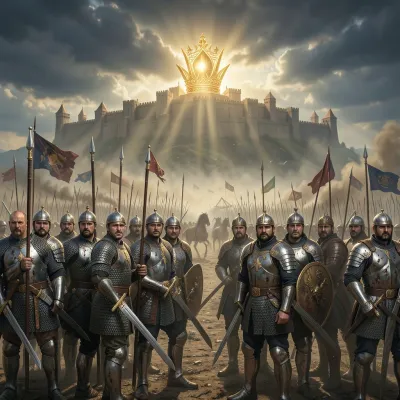
"Swords and Crowns: Military Power and the Making of Dynasties" examines how dynasties historically established, expanded, and maintained their power through the strategic organization and deployment of military force, intertwined with fiscal management and political legitimacy. The book argues that armies and elite troops are not merely instruments of conquest, but systemic engines that shape political order, social hierarchy, and economic strategy. When rulers effectively align military organization with credible revenue and persuasive legitimacy, their regimes endure; when this alignment falters, even victories can lead to decline.
The author develops a framework linking military recruitment, training, technology, and tactics to broader statecraft, emphasizing the role of patronage systems like timar, iqta, stipends, and spoils in binding soldiers to sovereigns. The book highlights how the adoption of new military technologies, particularly gunpowder, amplified existing fiscal and logistical constraints, favoring states that could effectively finance and integrate these innovations. Legitimacy and internal cohesion, cultivated through courts, rituals, and the narrative of victory, are presented as crucial for sustaining power beyond mere coercion, acting as counterbalances to the inherent dangers posed by powerful military elites.
The core arguments are tested through four diverse case studies: the Ottoman Empire, the Mamluk Sultanate, the Songhai Empire, and Tokugawa Japan. The Ottomans exemplify how frontier expansion transitioned into sophisticated imperial administration through systems like the devshirme and timar, eventually facing fiscal strain and internal cohesion challenges. The Mamluks showcase a unique military market based on slave-soldiers and iqta-funded households, demonstrating both formidable power and vulnerability to technological conservatism and factionalism. Songhai illustrates the strength of cavalry combined with riverine logistics, and its eventual limits against gunpowder weapons. Tokugawa Japan provides a compelling example of domesticating a warrior aristocracy through stipends, bureaucracy, and castle towns, turning instruments of war into tools of peaceful governance.
Ultimately, the book concludes that dynastic survival hinges on a constant, delicate balance: a ruler must empower military elites enough to be effective, yet control them sufficiently to prevent internal challenges. Fiscal ingenuity is as vital as military prowess, as armies are only as strong as the treasuries that support them. While technology reshapes the landscape of warfare, its adoption is always filtered through existing social, political, and economic structures. The most enduring dynasties are those capable of continuous adaptation, blending tradition with innovation, and managing the inherent paradox that the very military power built to secure the crown can also be the force that ultimately unravels it.
What You'll Find Inside:
- Military power operates as an integrated system requiring alignment between recruitment, training, payment, technology, fiscal capacity, and political legitimacy for dynastic survival.
- Elite military corps represent both a dynasty's greatest strength and most dangerous vulnerability, necessitating constant management to prevent them from becoming autonomous threats to the throne.
- The coercion-extraction cycle - where military success enables revenue extraction that funds further military power - is a fundamental pattern across all case studies of dynastic rise and fall.
- Technological adoption in warfare was shaped by fiscal constraints, administrative capacity, and social hierarchies, with dynasties failing when innovation outpaced their ability to pay for and organize new weapons.
- Comparative analysis of the Ottomans, Mamluks, Songhai, and Tokugawa Japan reveals diverse historical solutions to concentrating violence sustainably while maintaining internal cohesion and legitimacy.
Who's It For:
This book is ideal for students and scholars of military history, imperial studies, and premodern state formation seeking to understand the interconnected dynamics of military organization, fiscal systems, and political legitimacy. It offers valuable comparative insights for researchers examining empire building across different regions and historical periods. The theoretical framework also provides relevant lessons for policymakers and strategists interested in historical approaches to sustaining military power through institutional adaptation rather than relying solely on battlefield prowess.
Author:
Published By:
Date Published:
May 2, 2026
Type:
Nonfiction
Language:
English
Word Count:
61,726 words
Reading Time:
4 hours 19 minutes
Sample:
Order:
Order Swords and Crowns: Military Power and the Making of Dynasties (Paperback) on MixCache.com:
Buy NowPrint copy is made to order and ships worldwide. Includes the ebook free, ready to read instantly.
$5 account credit for all new MixCache.com accounts, usable toward any ebook purchase!*


