Browse by Category
Fiction
- Action & Adventure
- African American
- Anthologies
- Children's Fiction
- Classics
- Comics & Graphic Novels
- Coming of Age
- Contemporary
- Cultural & Regional
- Drama
- Erotica
- Fantasy
- General
- Historical Fiction
- Horror
- Humor & Satire
- Literary Fiction
- Mystery, Thriller & Suspense
- Poetry
- Religious & Inspirational
- Romance
- Science Fiction
- Short Stories
- War & Military
- Westerns
- Women's Fiction
- Young Adult
Non-Fiction
- Antiques & Collectibles
- Arts & Photography
- Biographies & Memoirs
- Business & Money
- Children's Non-Fiction
-
Computers & Technology
- Artificial Intelligence
- Computer Science
- Cybersecurity & Cryptography
- Data Science & Analytics
- Databases & Big Data
- Game Development & Design
- General
- Hardware & DIY
- Mobile App Development
- Networking & Cloud Computing
- Operating Systems
- Programming
- Robotics
- Software
- Software Engineering
- User Experience (UX) & Design
- Web Development & Design
- Cooking, Food & Wine
- Crafts, Hobbies & Home
- Education & Teaching
- Engineering
- General
- Health, Fitness & Dieting
-
History
- African History
- African History - North Africa
- African History - Sub-Saharan Africa
- American History
- American History - 20th Century
- American History - Civil War
- American History - Colonial Period
- Ancient History
- Asian History
- Asian History - China
- Asian History - India
- Asian History - Japan
- Asian History - Southeast Asia
- European History
- European History - Ancient Greece
- European History - Ancient Rome
- European History - Medieval
- European History - Modern
- European History - Renaissance
- General
- Middle Eastern History
- Military History
- Military History - Aviation
- Military History - Naval
- Social & Cultural History
- World History
- Humor & Entertainment
- Industrial Technology
- Language Learning
- Law
- LGBTQ+ Non-Fiction
- Literary Criticism
- Medical Books
- Parenting & Relationships
- Philosophy
- Politics & Social Sciences
- Reference
- Religion & Spirituality
-
Science & Math
- Agricultural Sciences
- Astronomy & Space Science
- Behavioral Sciences
- Biological Sciences
- Botany & Plant Science
- Chemistry
- Earth Sciences
- Engineering - Chemical
- Engineering - Civil
- Engineering - Electrical
- Engineering - Mechanical
- Environment
- General
- Geology
- Mathematics
- Nature & Ecology
- Oceanography
- Paleontology
- Physics
- Statistics
- Self-Help
- Sports & Outdoors
- Study Aids
- Sustainability & Green Living
- Textbooks
- Transportation
- Travel
- True Crime
- Urban Planning & Development
- Veterinary Medicine
- Writing & Publishing
Jump to Section
MixCache.com Total Access
Unlimited reading and audiobooks for every book published by MixCache.com.
Included titles carry the MTA badge.
Learn more →
Women in the Revolution and the USSR
MTA
Gender, Labor, and Family from 1905 to Perestroika
About this book:
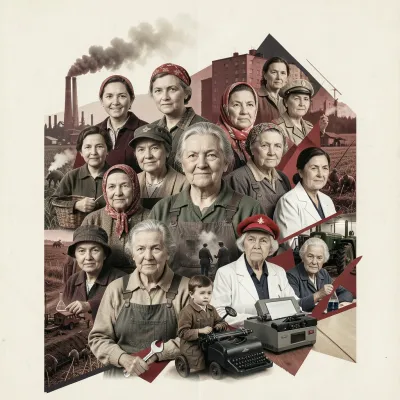
This book provides a comprehensive social and political-economic history of women in the Soviet Union, tracing the trajectory of gender relations from the 1905 Revolution to the collapse of the USSR in 1991. It examines the central paradox of the Soviet project: a state that constitutionally enshrined gender equality and mobilized women as indispensable workers and soldiers, yet simultaneously relied on their unpaid domestic labor to sustain the national economy. By exploring the "double burden"—the expectation that women excel in both professional production and household reproduction—the text illustrates how state policies regarding labor, family law, and housing often reinforced traditional hierarchies even as they opened new doors for female education and professionalization.
The narrative is structured chronologically, beginning with the radical legal experiments of the 1920s, such as the legalization of abortion and "divorce on demand," which sought to dismantle patriarchal imperial structures. This early idealism shifted during the 1930s "Great Retreat," when the state adopted pronatalist and maternalist policies to stabilize the social order during the upheavals of industrialization and collectivization. The book highlights the pivotal role of women during the Great Patriotic War, where they served in unprecedented combat and industrial roles, only to face a complicated demobilization process that attempted to return them to domestic life while maintaining their participation in the postwar reconstruction.
Throughout the later decades, the book analyzes the impact of the Khrushchev "Thaw" and the Brezhnev era of "Stagnation" on the lived experience of Soviet women. It details the expansion of the service sector and professions like medicine and science, which became feminized yet remained undervalued. A significant focus is placed on the "informal economy" and social networks; as state services and consumer supplies faltered, women utilized "blat" (favors) and neighborly solidarity to manage chronic shortages and the "crisis of care." The text also emphasizes that "Soviet womanhood" was not a monolith, exploring the distinct cultural and national negotiations faced by women in Central Asia, the Baltics, and other peripheries.
The final chapters chronicle the unraveling of the Soviet gender contract during Perestroika. As glasnost allowed for the candid discussion of social failures, the economic restructuring led to the re-privatization of care, shifting the costs of a collapsing welfare state onto individual women. By 1991, the promise of state-sponsored emancipation vanished alongside the Union, leaving a legacy of professional achievement tempered by systemic exhaustion. Ultimately, the book argues that the Soviet experiment cannot be understood without placing women’s labor—both seen and unseen—at the structural core of its development and eventual decline.
What You'll Find Inside:
- The Soviet emancipation paradox: state policies created legal equality and workforce opportunities while simultaneously reinforcing the double burden of paid labor and unpaid domestic work through occupational segregation and pronatalist reversals.
- Women's labor was structurally essential to Soviet industrialization, wartime mobilization, and economic survival, yet they remained concentrated in lower-wage sectors with limited access to advancement despite their critical contributions.
- Policy swung between emancipatory experiments (1920s legal reforms, abortion access) and conservative retreats (1936 pronatalist turn, postwar maternalism), forcing women to constantly negotiate between state expectations and lived realities.
- Women developed sophisticated informal networks (blat, kin exchanges, mutual aid) to cope with chronic shortages, bureaucratic gaps, and the double burden, making these parallel systems vital for household survival and social continuity.
- Experiences varied significantly by region, nationality, class, and religion—from urban factory workers to Central Asian women navigating the Hujum campaign—showing how state policies intersected with local customs and created uneven outcomes across the USSR.
Who's It For:
This book is ideal for students and scholars of Soviet/Russian history, gender studies, and women's history who seek a nuanced analysis of how state policies shaped women's lives across decades of revolution, war, and reform. It will particularly benefit researchers interested in socialist labor systems, family policy, and the intersection of politics with everyday life, as well as readers looking to understand the lived consequences of emancipation promises in a multiethnic state. Those studying comparative gender history or the social history of 20th-century Eurasia will find its detailed examination of regional variations and informal economies especially valuable.
Table of Contents:
- Introduction
- Chapter 1 Sparks of 1905: Gender and Protest in a Late Empire
- Chapter 2 War, Collapse, and 1917: Women in the February and October Revolutions
- Chapter 3 Making a New Order: Zhenotdel, Law, and the 1918 Family Code
- Chapter 4 Love, Marriage, and Abortion: Radical Social Policy in the 1920s
- Chapter 5 Markets and Morality under NEP: Wage Work, Informal Trade, and Social Welfare
- Chapter 6 “Emancipation” in the East: The Hujum and Muslim Women of Central Asia (1927–1930)
- Chapter 7 Collectivization and Everyday Peasant Life: Women on the Kolkhoz
- Chapter 8 Factories, Shock Work, and Stakhanovites: Gendering Industrialization
- Chapter 9 The 1936 Turn: Pronatalism, Maternalism, and the Recasting of the Family
- Chapter 10 Housing, Communal Living, and Domestic Labor in the 1930s
- Chapter 11 Total War, Total Mobilization: Women at the Front, 1941–1945
- Chapter 12 The Home Front: Evacuation, Scarcity, and Factory Floors in Wartime
- Chapter 13 Demobilization and Reconstruction: Gender Settlements after 1945
- Chapter 14 Between De‑Stalinization and Reform: The 1955 Abortion Law and Reproductive Health
- Chapter 15 The Thaw at Home: Apartments, Appliances, and Childcare
- Chapter 16 Professions and Prestige: Women in Science, Medicine, and the Arts
- Chapter 17 Labor Protection or Discrimination? Pay, Norms, and the Double Burden
- Chapter 18 Rural Women after Collectivization: Labor, Welfare, and Seasonal Migration
- Chapter 19 Consumption, Shortages, and the Shadow Economy: Housewives and Hustles
- Chapter 20 Education and Youth: Pioneers, Komsomol, and Changing Aspirations
- Chapter 21 Difference within Unity: Nationality, Periphery, and Soviet Internationalism
- Chapter 22 Dissent, Debate, and the Limits of Feminism: 1960s–1970s
- Chapter 23 Everyday Life under Late Socialism: Care, Friendship, and Informal Networks
- Chapter 24 Crisis of the 1980s: Work, Welfare, and the Re‑Privatization of Care
- Chapter 25 Perestroika and the Unraveling, 1985–1991
Author:
Published By:
Date Published:
May 2, 2026
Type:
Nonfiction
Language:
English
Word Count:
67,765 words
Reading Time:
4 hours 45 minutes
Sample:
Order:
Order Women in the Revolution and the USSR (Hardcover) on MixCache.com:
Buy NowPrint copy is made to order and ships worldwide. Includes the ebook free, ready to read instantly.
$5 account credit for all new MixCache.com accounts, usable toward any ebook purchase!*