Browse by Category
Fiction
- Action & Adventure
- African American
- Anthologies
- Children's Fiction
- Classics
- Comics & Graphic Novels
- Coming of Age
- Contemporary
- Cultural & Regional
- Drama
- Erotica
- Fantasy
- General
- Historical Fiction
- Horror
- Humor & Satire
- Literary Fiction
- Mystery, Thriller & Suspense
- Poetry
- Religious & Inspirational
- Romance
- Science Fiction
- Short Stories
- War & Military
- Westerns
- Women's Fiction
- Young Adult
Non-Fiction
- Antiques & Collectibles
- Arts & Photography
- Biographies & Memoirs
- Business & Money
- Children's Non-Fiction
-
Computers & Technology
- Artificial Intelligence
- Computer Science
- Cybersecurity & Cryptography
- Data Science & Analytics
- Databases & Big Data
- Game Development & Design
- General
- Hardware & DIY
- Mobile App Development
- Networking & Cloud Computing
- Operating Systems
- Programming
- Robotics
- Software
- Software Engineering
- User Experience (UX) & Design
- Web Development & Design
- Cooking, Food & Wine
- Crafts, Hobbies & Home
- Education & Teaching
- Engineering
- General
- Health, Fitness & Dieting
-
History
- African History
- African History - North Africa
- African History - Sub-Saharan Africa
- American History
- American History - 20th Century
- American History - Civil War
- American History - Colonial Period
- Ancient History
- Asian History
- Asian History - China
- Asian History - India
- Asian History - Japan
- Asian History - Southeast Asia
- European History
- European History - Ancient Greece
- European History - Ancient Rome
- European History - Medieval
- European History - Modern
- European History - Renaissance
- General
- Middle Eastern History
- Military History
- Military History - Aviation
- Military History - Naval
- Social & Cultural History
- World History
- Humor & Entertainment
- Industrial Technology
- Language Learning
- Law
- LGBTQ+ Non-Fiction
- Literary Criticism
- Medical Books
- Parenting & Relationships
- Philosophy
- Politics & Social Sciences
- Reference
- Religion & Spirituality
-
Science & Math
- Agricultural Sciences
- Astronomy & Space Science
- Behavioral Sciences
- Biological Sciences
- Botany & Plant Science
- Chemistry
- Earth Sciences
- Engineering - Chemical
- Engineering - Civil
- Engineering - Electrical
- Engineering - Mechanical
- Environment
- General
- Geology
- Mathematics
- Nature & Ecology
- Oceanography
- Paleontology
- Physics
- Statistics
- Self-Help
- Sports & Outdoors
- Study Aids
- Sustainability & Green Living
- Textbooks
- Transportation
- Travel
- True Crime
- Urban Planning & Development
- Veterinary Medicine
- Writing & Publishing
Jump to Section
MixCache.com Total Access
Unlimited reading and audiobooks for every book published by MixCache.com.
Included titles carry the MTA badge.
Learn more →
The Soviet Military-Industrial Complex
MTA
Defense, Industry, and the Economy in Cold War Strategy
About this book:
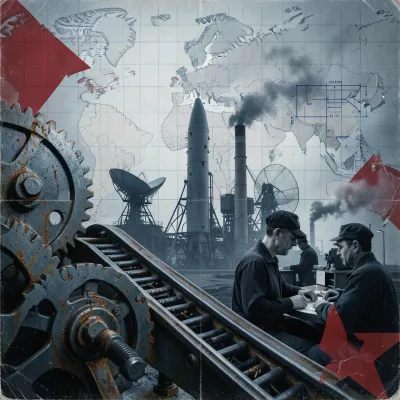
The Soviet military-industrial complex was a sprawling, "permanent mobilization" system that prioritized military production over civilian welfare for seven decades. Forged in the fires of the Russian Civil War and crash industrialization, the system relied on a unique command architecture where the State Planning Committee (Gosplan), the Military-Industrial Commission (VPK), and powerful industrial ministries translated strategic requirements into rigid production targets. By isolating talent in secretive "Design Bureaus" (OKBs) and closed cities, the state successfully produced world-class weaponry, including nuclear arsenals and space-launch vehicles, even as the broader economy struggled with chronic shortages and technical backwardness.
This "deterrence economy" operated on a logic of quantity and ruggedness, often substituting mass for the high-precision electronics and computing where the Soviets lagged behind the West. Military production enjoyed absolute priority, siphoning off the best materials, machine tools, and skilled labor, which created a bifurcated society: a privileged, highly trained defense elite living in comfortable enclaves, and a civilian population facing stagnant living standards. Administrative pricing and hidden budgets masked the astronomical opportunity costs of this arrangement, resulting in an industrial base that was formidable in its output but structurally inefficient and resistant to innovation outside of narrow military silos.
The 1980s brought these systemic contradictions to a breaking point as the war in Afghanistan and the high-tech challenge of the U.S. Strategic Defense Initiative (SDI) exposed the limits of the Soviet model. Mikhail Gorbachev’s attempts at "Perestroika" and the conversion of defense plants to civilian use largely failed, as the specialized, secretive nature of the complex proved incompatible with market-oriented reforms. Following the 1991 collapse, the complex splintered across successor states, yet its core remains the backbone of the modern Russian state—a legacy of centralized power and strategic production that continues to prioritize the arsenal over the market.
What You'll Find Inside:
- The institutional architecture of Soviet military power: how Gosplan, the VPK, industrial ministries, and design bureaus (OKBs) formed a command structure that translated strategic vision into tanks, planes, and missiles through planning, secrecy, and privileged access to resources.
- The mechanics of Soviet defense planning: how the State Defense Order, production targets, and indicators converted strategic requirements into shop-floor schedules, often prioritizing quantity over quality and creating a culture of plan fulfillment over battlefield effectiveness.
- Sector-specific evolution and limitations: detailed analysis of nuclear weapons, missiles/space, aviation, shipbuilding, armor, and electronics—showing where the USSR achieved parity through brute-force production and where it lagged in precision, electronics, and integration.
- The dual-use dilemma and systemic distortions: how defense priorities reshaped Soviet geography into defense corridors and monotowns, diverted top talent and machine tools from civilian sectors, and created opportunity costs that weakened the broader economy despite military achievements.
- From mobilization to legacy: tracing the complex's evolution from WWII evacuation efforts through Cold War stability, 1980s technological strains, Perestroika conversion attempts, and the enduring continuities and ruptures in the post-Soviet defense industrial base.
Who's It For:
This book is essential reading for historians of the Soviet Union and Cold War, scholars of political economy and defense industrial policy, and researchers interested in how command economies innovate under strategic pressure. It will particularly benefit professionals in defense acquisition, military strategy, and technology policy who seek to understand the interplay between planning, production, and innovation in authoritarian systems, as well as graduate students studying industrial organization, technological lag, and the conversion of military industries to civilian use.
Table of Contents:
- Introduction
- Chapter 1 Forging a War Economy, 1917–1941
- Chapter 2 Total War and Total Mobilization, 1941–1945
- Chapter 3 From Demobilization to Confrontation, 1945–1953
- Chapter 4 Building the Command Architecture: Gosplan, the VPK, and the Ministries
- Chapter 5 The Design Bureau State: OKBs, Chief Designers, and Innovation
- Chapter 6 Planning the Arsenal: Targets, Indicators, and the State Defense Order
- Chapter 7 Science Behind the Wire: Institutes, Closed Cities, and Secrecy
- Chapter 8 The Atomic Project and the Deterrence Economy
- Chapter 9 Rockets, Space, and the Missile-Industrial Revolution
- Chapter 10 Wings of the Union: Aviation and Aerospace Production
- Chapter 11 Steel and Salt Water: Shipbuilding and the Submarine Complex
- Chapter 12 Armor and Artillery: Tanks, Guns, and Ground Power
- Chapter 13 Circuits and Shortages: Electronics, Computing, and Microelectronics
- Chapter 14 Dual-Use Dilemmas: Civilian Spillovers and Opportunity Costs
- Chapter 15 The Geography of Defense: Company Towns, Monotowns, and Logistics
- Chapter 16 People of the Complex: Labor, Training, and Professional Culture
- Chapter 17 Counting the Uncounted: Budgets, Prices, and Hidden Accounts
- Chapter 18 Buying, Borrowing, and Stealing: Foreign Trade and Technology Transfer
- Chapter 19 Allies and Assemblers: CMEA, Warsaw Pact, and Socialist Integration
- Chapter 20 Doctrine Meets Production: Strategy, Threats, and Force Structure
- Chapter 21 Reforming Without Reform: Khrushchev’s Experiments and Their Limits
- Chapter 22 The Brezhnev Bargain: Stability, Stagnation, and Military Primacy
- Chapter 23 The 1980s Tech Race: SDI, Afghanistan, and Systemic Strains
- Chapter 24 Perestroika and Conversion: Unraveling the Defense-Industrial Order
- Chapter 25 Legacies After 1991: Continuities, Ruptures, and the New Russia
Author:
Published By:
Date Published:
May 2, 2026
Type:
Nonfiction
Language:
English
Word Count:
61,733 words
Reading Time:
4 hours 19 minutes
Sample:
Order:
Order The Soviet Military-Industrial Complex (Hardcover) on MixCache.com:
Buy NowPrint copy is made to order and ships worldwide. Includes the ebook free, ready to read instantly.
$5 account credit for all new MixCache.com accounts, usable toward any ebook purchase!*