
Browse by Category
Fiction
- Action & Adventure
- African American
- Anthologies
- Children's Fiction
- Classics
- Comics & Graphic Novels
- Coming of Age
- Contemporary
- Cultural & Regional
- Drama
- Erotica
- Fantasy
- General
- Historical Fiction
- Horror
- Humor & Satire
- Literary Fiction
- Mystery, Thriller & Suspense
- Poetry
- Religious & Inspirational
- Romance
- Science Fiction
- Short Stories
- War & Military
- Westerns
- Women's Fiction
- Young Adult
Non-Fiction
- Antiques & Collectibles
- Arts & Photography
- Biographies & Memoirs
- Business & Money
- Children's Non-Fiction
-
Computers & Technology
- Artificial Intelligence
- Computer Science
- Cybersecurity & Cryptography
- Data Science & Analytics
- Databases & Big Data
- Game Development & Design
- General
- Hardware & DIY
- Mobile App Development
- Networking & Cloud Computing
- Operating Systems
- Programming
- Robotics
- Software
- Software Engineering
- User Experience (UX) & Design
- Web Development & Design
- Cooking, Food & Wine
- Crafts, Hobbies & Home
- Education & Teaching
- Engineering
- General
- Health, Fitness & Dieting
-
History
- African History
- African History - North Africa
- African History - Sub-Saharan Africa
- American History
- American History - 20th Century
- American History - Civil War
- American History - Colonial Period
- Ancient History
- Asian History
- Asian History - China
- Asian History - India
- Asian History - Japan
- Asian History - Southeast Asia
- European History
- European History - Ancient Greece
- European History - Ancient Rome
- European History - Medieval
- European History - Modern
- European History - Renaissance
- General
- Middle Eastern History
- Military History
- Military History - Aviation
- Military History - Naval
- Social & Cultural History
- World History
- Humor & Entertainment
- Industrial Technology
- Language Learning
- Law
- LGBTQ+ Non-Fiction
- Literary Criticism
- Medical Books
- Parenting & Relationships
- Philosophy
- Politics & Social Sciences
- Reference
- Religion & Spirituality
-
Science & Math
- Agricultural Sciences
- Astronomy & Space Science
- Behavioral Sciences
- Biological Sciences
- Botany & Plant Science
- Chemistry
- Earth Sciences
- Engineering - Chemical
- Engineering - Civil
- Engineering - Electrical
- Engineering - Mechanical
- Environment
- General
- Geology
- Mathematics
- Nature & Ecology
- Oceanography
- Paleontology
- Physics
- Statistics
- Self-Help
- Sports & Outdoors
- Study Aids
- Sustainability & Green Living
- Textbooks
- Transportation
- Travel
- True Crime
- Urban Planning & Development
- Veterinary Medicine
- Writing & Publishing
Jump to Section
MixCache.com Total Access
Unlimited reading and audiobooks for every book published by MixCache.com.
Included titles carry the MTA badge.
Learn more →
Persia in Transition: The Making of Modern Iran, 1900–2020
MTA
A political and social history tracing Iran's transformation through monarchy, revolution, and the Islamic Republic
About this book:
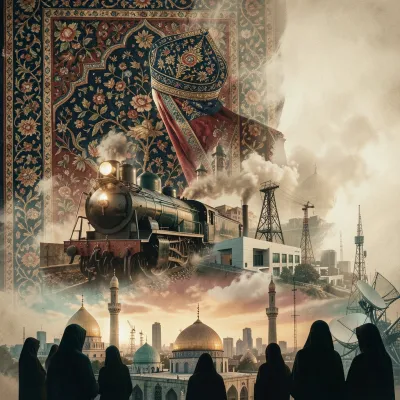
"Persia in Transition: The Making of Modern Iran, 1900–2020" chronicles Iran's tumultuous journey from the Qajar dynasty's decline to the early 2020s, exploring the interplay between state and society through periods of monarchy, revolution, and the Islamic Republic. The book details the early 20th-century struggles against foreign influence and fiscal crisis, leading to the Constitutional Revolution of 1905-1911, which introduced concepts of law and representation but ultimately succumbed to internal fragmentation and external pressures during and after World War I. This era paved the way for Reza Khan's 1921 coup and the subsequent establishment of the Pahlavi state, which prioritized centralization, secularization, and military strength, fundamentally reshaping Iranian society and infrastructure under Reza Shah's nation-building project (1926-1941).
The narrative continues through the Allied occupation during World War II, which weakened the Pahlavi state and introduced Mohammad Reza Shah to a complex political landscape. The 1950s were defined by the Mossadegh experiment of oil nationalization, a popular but ultimately failed attempt to reclaim national resources, culminating in the 1953 coup that consolidated the Shah's autocratic rule with foreign backing. The subsequent decades saw the implementation of the "White Revolution" (1963-1973), a top-down modernization program focusing on land reform, education, and industrialization, alongside the expansion of a pervasive security state embodied by SAVAK. This rapid transformation, however, generated significant social unrest, economic inequality, and ideological ferment among diverse groups, including Islamists, leftists, and intellectuals, laying the groundwork for the 1979 revolution.
The 1979 Revolution dismantled the Pahlavi monarchy and led to the establishment of the Islamic Republic, a hybrid system fusing republican institutions with clerical authority. The initial years were marked by intense factionalism, the defining American hostage crisis, and the devastating Iran–Iraq War (1980–1988), which further militarized society and solidified the power of the Revolutionary Guards. Post-Khomeini (1989-1997), Iran entered a period of reconstruction and cautious liberalization under President Rafsanjani, followed by the reformist movement under President Khatami (1997-2005), which fostered civil society and cultural openness but faced strong conservative resistance. The populist Ahmadinejad years (2005-2013) were characterized by renewed confrontation over the nuclear program, crippling international sanctions, and the significant Green Movement protests of 2009-2011, which highlighted deep divisions within Iranian society.
The book concludes by examining the Rouhani-Zarif era (2013-2016), marked by diplomacy and the Joint Comprehensive Plan of Action (JCPOA), which offered a brief respite from isolation before the return of "maximum pressure" sanctions (2017-2020) and renewed protests. Throughout these chapters, the book consistently explores overarching social changes such as urbanization, migration, the evolving roles of women and youth, and the complex relationship between religion, law, and authority. It also analyzes the transformative impact of culture, media, technology, and the Iranian diaspora, showcasing how global dynamics repeatedly shaped Iran's domestic struggles over sovereignty, justice, and its identity in the modern world.
What You'll Find Inside:
- Traces Iran's century-long transformation from Qajar decline through constitutionalism, Pahlavi modernization, the 1979 revolution, and the Islamic Republic's evolution to 2020.
- Examines pivotal moments like oil nationalization, the 1953 coup, the White Revolution, and the Iran-Iraq War that reshaped Iran's political trajectory and state-society relations.
- Analyzes how oil wealth, foreign intervention, and geopolitical pressures repeatedly influenced domestic politics, creating cycles of reform, repression, and resistance.
- Explores the enduring tension between modernization/secularization and religious/traditional authority, from Reza Shah's reforms to the Islamic Republic's clerical governance.
- Connects high politics with social history, showing how urbanization, education, women's roles, youth culture, and everyday life were transformed by and responded to political changes.
Who's It For:
This book is ideal for students and scholars of Middle Eastern studies, Iranian history, political science, and international relations seeking a comprehensive understanding of Iran's modern evolution. It will also benefit policymakers, journalists, and professionals working on Iran-related issues who need historical context for current events. General readers with an interest in revolutionary movements, state-building, or the interplay of religion and politics will find the narrative accessible and insightful.
Table of Contents:
- Introduction
- Chapter 1 Qajar Decline and the Road to Constitutionalism, 1900–1905
- Chapter 2 The Constitutional Revolution and Its Aftermath, 1905–1911
- Chapter 3 Fragmentation, Foreign Influence, and the Rise of the Cossack Officer, 1911–1921
- Chapter 4 Reza Khan’s Coup and the Birth of the Pahlavi State, 1921–1926
- Chapter 5 Reza Shah’s Nation-Building: Centralization, Secularization, and Control, 1926–1941
- Chapter 6 Allied Occupation and a Young Monarch: The Making of Mohammad Reza Shah, 1941–1951
- Chapter 7 Oil Nationalization and the Mossadegh Experiment, 1951–1953
- Chapter 8 The 1953 Coup and Consolidation of Monarchy, 1953–1963
- Chapter 9 The White Revolution: Reform from Above and Social Unrest, 1963–1973
- Chapter 10 Security State and Society: SAVAK, Urbanization, and Migration, 1960s–1970s
- Chapter 11 Islamism, Intellectual Currents, and Revolutionary Thought, 1960s–1977
- Chapter 12 Crisis and Collapse of the Pahlavi Order, 1977–1979
- Chapter 13 Revolution Triumphant: 1979 and the Remaking of Power
- Chapter 14 From Referendum to Republic: Factionalism, Hostage Crisis, and Institutional Foundations, 1979–1981
- Chapter 15 War and State Formation: The Iran–Iraq War, 1980–1988
- Chapter 16 After Khomeini: Reconstruction, Liberalization, and Social Negotiation, 1989–1997
- Chapter 17 Reformism and Civil Society under Khatami, 1997–2005
- Chapter 18 Populism, Nuclear Dispute, and the Ahmadinejad Years, 2005–2013
- Chapter 19 The Green Movement and the Politics of Contested Elections, 2009–2011
- Chapter 20 Sanctions and Everyday Life: Coping, Corruption, and Resilience, 1990s–2010s
- Chapter 21 Diplomacy and Detente: Rouhani, Zarif, and the JCPOA, 2013–2016
- Chapter 22 From Opening to Isolation: Protests, Maximum Pressure, and Regional Tensions, 2017–2020
- Chapter 23 Women, Youth, and the Family: Demography and Social Change, 1900–2020
- Chapter 24 Religion, Law, and Authority: The Ulama and the Institutions of the Islamic Republic
- Chapter 25 Culture, Media, and Global Iran: Cinema, Technology, Diaspora, and Soft Power
Author:
Published By:
Date Published:
May 1, 2026
Type:
Nonfiction
Language:
English
Word Count:
66,586 words
Reading Time:
4 hours 40 minutes
Sample:
MixCache.com Total Access
Get unlimited access to this book + all books published by MixCache.com for $11.99/month
Subscribe to MTAOr purchase this book individually below
Order:
Buy the Persia in Transition: The Making of Modern Iran, 1900–2020 ebook on MixCache.com:
Buy Now
Full ebook will be available immediately
- read online or download as a PDF file.
$5 account credit for all new MixCache.com accounts, usable toward any ebook purchase!*



Ratings & Reviews
Ask Questions About This Book
Have a question about the content? Ask our AI assistant!
Start by asking a question about "Persia in Transition: The Making of Modern Iran, 1900–2020"
Example: "Does this book mention William Shakespeare?"
Thinking...