
Browse by Category
Fiction
- Action & Adventure
- African American
- Anthologies
- Children's Fiction
- Classics
- Comics & Graphic Novels
- Coming of Age
- Contemporary
- Cultural & Regional
- Drama
- Erotica
- Fantasy
- General
- Historical Fiction
- Horror
- Humor & Satire
- Literary Fiction
- Mystery, Thriller & Suspense
- Poetry
- Religious & Inspirational
- Romance
- Science Fiction
- Short Stories
- War & Military
- Westerns
- Women's Fiction
- Young Adult
Non-Fiction
- Antiques & Collectibles
- Arts & Photography
- Biographies & Memoirs
- Business & Money
- Children's Non-Fiction
-
Computers & Technology
- Artificial Intelligence
- Computer Science
- Cybersecurity & Cryptography
- Data Science & Analytics
- Databases & Big Data
- Game Development & Design
- General
- Hardware & DIY
- Mobile App Development
- Networking & Cloud Computing
- Operating Systems
- Programming
- Robotics
- Software
- Software Engineering
- User Experience (UX) & Design
- Web Development & Design
- Cooking, Food & Wine
- Crafts, Hobbies & Home
- Education & Teaching
- Engineering
- General
- Health, Fitness & Dieting
-
History
- African History
- African History - North Africa
- African History - Sub-Saharan Africa
- American History
- American History - 20th Century
- American History - Civil War
- American History - Colonial Period
- Ancient History
- Asian History
- Asian History - China
- Asian History - India
- Asian History - Japan
- Asian History - Southeast Asia
- European History
- European History - Ancient Greece
- European History - Ancient Rome
- European History - Medieval
- European History - Modern
- European History - Renaissance
- General
- Middle Eastern History
- Military History
- Military History - Aviation
- Military History - Naval
- Social & Cultural History
- World History
- Humor & Entertainment
- Industrial Technology
- Language Learning
- Law
- LGBTQ+ Non-Fiction
- Literary Criticism
- Medical Books
- Parenting & Relationships
- Philosophy
- Politics & Social Sciences
- Reference
- Religion & Spirituality
-
Science & Math
- Agricultural Sciences
- Astronomy & Space Science
- Behavioral Sciences
- Biological Sciences
- Botany & Plant Science
- Chemistry
- Earth Sciences
- Engineering - Chemical
- Engineering - Civil
- Engineering - Electrical
- Engineering - Mechanical
- Environment
- General
- Geology
- Mathematics
- Nature & Ecology
- Oceanography
- Paleontology
- Physics
- Statistics
- Self-Help
- Sports & Outdoors
- Study Aids
- Sustainability & Green Living
- Textbooks
- Transportation
- Travel
- True Crime
- Urban Planning & Development
- Veterinary Medicine
- Writing & Publishing
Jump to Section
MixCache.com Total Access
Unlimited reading and audiobooks for every book published by MixCache.com.
Included titles carry the MTA badge.
Learn more →
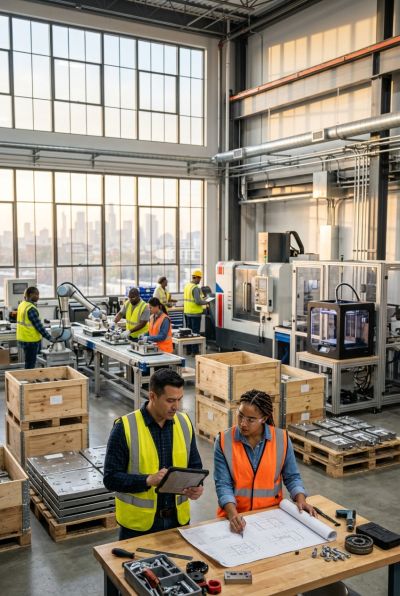
Automation and the Factory of the Future: From Assembly Lines to Intelligent Manufacturing
MTA
A practical history of manufacturing automation, robotics, and the evolution of production systems
About this book:

*Automation and the Factory of the Future* provides a comprehensive technical and managerial history of manufacturing, tracing its evolution from manual craft to autonomous, self-optimizing systems. The book begins by examining the shift from the artisan model to the rigid efficiency of the Henry Ford assembly line, later refined by the Toyota Production System’s focus on lean manufacturing and waste reduction. This historical foundation sets the stage for the introduction of programmable logic controllers (PLCs), robotics, and sensors, which transitioned factories from mechanical repetition to flexible, software-driven logic.
The text delves deeply into the modern "software stack" of the factory, explaining the critical roles of SCADA, DCS, and MES in orchestrating production. It highlights the convergence of Operational Technology (OT) and Information Technology (IT), emphasizing that modern manufacturing relies on a robust nervous system of industrial networks, data historians, and edge computing. The author argues that data is now a primary asset, requiring disciplined governance and analytics to transform raw signals into actionable insights for quality control and maintenance.
A significant portion of the book is dedicated to the human and strategic elements of automation. It addresses the necessity of functional safety standards, the growing threat of cybersecurity in interconnected plants, and the ergonomics of human-robot collaboration. The author stresses that successful automation is not merely a technical achievement but a change management challenge, requiring a roadmap for upskilling the workforce and aligning financial models (ROI and TCO) with long-term strategic goals like sustainability and net-zero emissions.
The final chapters look toward the "next horizon" of Industry 4.0, where Artificial Intelligence, digital twins, and additive manufacturing enable mass customization and resilient global supply chains. The book concludes that the factory of the future is a "learning organism" that utilizes a cloud-to-edge architecture to close the loop between design and execution. Ultimately, the text posits that while machines handle routine optimization, the most successful factories remain those that integrate advanced technology with human judgment and disciplined operational standards.
What You'll Find Inside:
- Traces the historical evolution of manufacturing, from early craft production and the rise of mass production to the birth of automation with relays and PLCs.
- Explores foundational technologies and methodologies, including robotics, lean/JIT principles, sensors/actuators, and the IT/OT software stack (SCADA, DCS, MES).
- Details the modern shift to intelligent systems, covering the Industrial Internet of Things (IIoT), edge computing, data historians, digital twins, and AI-driven optimization.
- Emphasizes critical enabling factors for the future factory, such as human-robot collaboration, functional safety, cybersecurity, and workforce transformation.
- Provides practical guidance on implementation, including economic models for ROI, project roadmaps from pilot to scale, and real-world case studies from automotive, electronics, process, and food industries.
Who's It For:
This book is essential for manufacturing managers, plant engineers, and operations leaders tasked with modernizing production systems. It also serves as a comprehensive resource for industrial engineers, systems integrators, and technical staff who need to understand the full stack of modern automation—from PLCs and robotics to AI and cybersecurity. Business leaders and strategists planning digital transformation initiatives in an industrial context will find the frameworks on ROI, change management, and supply chain resilience particularly valuable.
Table of Contents:
- Introduction
- Chapter 1 From Craft to Line: The Rise of Mass Production
- Chapter 2 The Birth of Automation: Relays, PLCs, and Control Theory
- Chapter 3 Lean, JIT, and the Toyota Production System
- Chapter 4 Robotics Enters the Line: From Unimate to Cobots
- Chapter 5 Sensors, Actuators, and Mechatronics Foundations
- Chapter 6 Industrial Networks: From Fieldbus to Ethernet
- Chapter 7 SCADA, DCS, and MES: The Software Stack of the Factory
- Chapter 8 Data Historians and Analytics: Turning Signals into Insight
- Chapter 9 The Industrial Internet of Things and Edge Computing
- Chapter 10 Digital Twins and Simulation for Design and Operations
- Chapter 11 AI in Manufacturing: Vision, Learning, and Optimization
- Chapter 12 Human–Robot Collaboration and Ergonomics
- Chapter 13 Safety, Standards, and Functional Safety Engineering
- Chapter 14 Cybersecurity for Operational Technology
- Chapter 15 Quality by Design: SPC, Six Sigma, and Traceability
- Chapter 16 Additive Manufacturing and Flexible Cells
- Chapter 17 Autonomous Material Handling and Intralogistics
- Chapter 18 Energy, Sustainability, and the Net‑Zero Factory
- Chapter 19 Workforce Transformation: Skills, Training, and Change Management
- Chapter 20 The Economics of Automation: Cost Models and ROI
- Chapter 21 Implementation Roadmaps: From Pilot to Scale
- Chapter 22 Case Studies I: Automotive and Electronics
- Chapter 23 Case Studies II: Process Industries and Food & Beverage
- Chapter 24 Global Supply Chains, Resilience, and Geopolitics
- Chapter 25 The Next Horizon: Self‑Optimizing, Cloud‑to‑Edge Manufacturing
Author:
Published By:
Date Published:
January 9, 2026
Type:
Nonfiction
Language:
English
Word Count:
94,500 words
Reading Time:
6 hours 37 minutes
Sample:
MixCache.com Total Access
Get unlimited access to this book + all books published by MixCache.com for $11.99/month
Subscribe to MTAOr purchase this book individually below
Order:
Buy the Automation and the Factory of the Future: From Assembly Lines to Intelligent Manufacturing ebook on MixCache.com:
Buy Now
Full ebook will be available immediately
- read online or download as a PDF file.
$5 account credit for all new MixCache.com accounts, usable toward any ebook purchase!*



Ratings & Reviews
Ask Questions About This Book
Have a question about the content? Ask our AI assistant!
Start by asking a question about "Automation and the Factory of the Future: From Assembly Lines to Intelligent Manufacturing"
Example: "Does this book mention William Shakespeare?"
Thinking...