
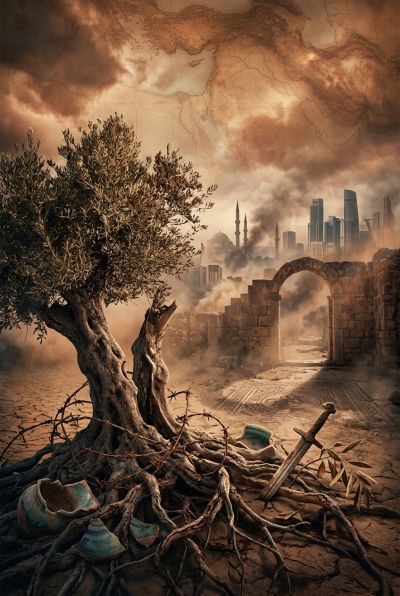
The Mongol envoys arrived at the gates of Baghdad in early 1258 with a demand as simple as it was absolute: surrender the city, or face annihilation. Inside the walls, Caliph al-Musta'sim, heir to a dynasty that had ruled the Islamic world for five centuries, dismissed them with the arrogance of a man who believed his title alone was a shield. He sent the envoys back empty-handed. Two weeks later, the city that had been the intellectual and spiritual heart of Islam ceased to exist.
The Ultimatum and the Caliph's Pride
Hulegu, grandson of Genghis Khan, had spent the previous two years clearing a path across Persia. His army had shattered the Nizari Ismaili state, the so-called Assassins, at their mountain fortress of Alamut. Now the Mongol war machine — disciplined, experienced, and utterly ruthless — encamped before the "City of Peace." Baghdad in 1258 was a shadow of its former glory, its caliphs long since reduced to figureheads by Turkish and Persian warlords. But the symbolism remained potent. The Abbasid Caliph was still the Commander of the Faithful in name, and the city's libraries, especially the House of Wisdom, held centuries of Greek, Persian, and Arabic learning.
Al-Musta'sim's refusal was not merely pride; it was delusion. His advisors assured him that the Muslim world would rally to defend the Caliphate. No army came. The Mamluks in Egypt were distant; the Ayyubids in Syria were fragmented. The Caliph's own forces were a patchwork of unreliable mercenaries and city militia. When Hulegu's siege engines began pounding the walls in January, the outcome was never in doubt.
The Siege and the Slaughter
The siege lasted barely two weeks. On February 10, the Mongols breached the walls. What followed was not a sack in the conventional sense but a systematic erasure. For seven days, Hulegu's troops moved through the city with methodical brutality. They burned palaces, mosques, and markets. They killed without distinction — scholars, merchants, women, children. Contemporary accounts, though inevitably imprecise, speak of hundreds of thousands dead; some chroniclers claim over a million. The stench of corpses was so great that Hulegu eventually moved his camp upwind.
The Caliph and his family were dragged before the conqueror. Hulegu, according to the Persian historian Ata-Malik Juvayni, who accompanied the expedition, berated al-Musta'sim for his folly. He reportedly locked the Caliph in a treasure vault without food or water, telling him to eat his gold. But the most infamous episode came afterward. Mongol custom forbade spilling royal blood on the earth. So al-Musta'sim was rolled inside a carpet, and horses were driven over him until he was crushed to death. His sons were executed summarily. The Abbasid line, which had begun with the Prophet's uncle in 750, ended in a dusty courtyard.
The Death of Knowledge
If the slaughter was horrific, the cultural vandalism was unprecedented. The House of Wisdom, the great academy founded by Caliph al-Ma'mun in the ninth century, was the primary target. Its collections — manuscripts on mathematics, astronomy, medicine, philosophy, and poetry, translated from Greek, Syriac, Persian, and Sanskrit — were hauled to the Tigris. The books were so numerous that they formed a bridge across the river. The water ran black with ink for days. Other libraries, including the royal archives and dozens of mosque collections, suffered the same fate. Irreplaceable works of Aristotle, Galen, Euclid, and countless Arab scholars vanished. The intellectual infrastructure of a civilization was dumped into a river.
Hulegu's Christian wife, Doquz Khatun, is said to have pleaded for the lives of Baghdad's Christians, and they were largely spared. The city's Shia population also found a measure of protection. But the Sunni Muslim majority, the bearers of the Abbasid legacy, bore the full weight of the Mongol fury. When the killing finally stopped, Baghdad was a necropolis. The irrigation canals that had sustained the surrounding agriculture were destroyed or neglected; the city's population, once perhaps a million, would not recover for centuries.
The Caliph's End and the Aftermath
The fall of Baghdad sent shockwaves across the Islamic world. In Cairo, the Mamluk Sultan Qutuz declared a new Abbasid Caliph — a puppet, but a symbol of continuity. The Mongol advance, however, did not halt. Hulegu withdrew most of his army to Azerbaijan after learning of the Great Khan's death, leaving a smaller force under his general Kitbuqa to hold Syria. In September 1260, at the Spring of Goliath — Ain Jalut — the Mamluks annihilated that army. It was the first decisive defeat the Mongols had suffered in open battle, and it marked the high-water mark of their western expansion.
Baghdad itself never regained its former status. The Ilkhanate, the Mongol state Hulegu founded in Persia, eventually converted to Islam and patronized a new flowering of Persian culture. But the Abbasid Caliphate was gone, and with it the last pretense of a unified Islamic polity. The center of gravity shifted irrevocably to Cairo, and later to Istanbul. The Tigris eventually ran clear again, but the ink of the House of Wisdom had stained the riverbed — and the memory of the Muslim world — forever.
This is one episode in a much longer story. For the full account of the mongol sack of baghdad in 1258, read “There Cannot Be Peace” by Elias Marlowe on MixCache.com.
Please log in or create an account to leave a comment.
No comments yet. Be the first to say something.