
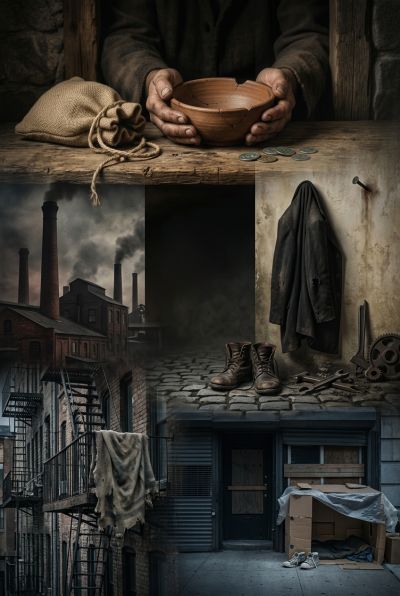
In the summer of 1348, a Genoese fleet limped into the Sicilian port of Messina. The townspeople who gathered at the docks found most of the sailors dead or dying, their bodies swollen with black boils that wept blood and pus. The authorities ordered the ships out of the harbor, but the contagion had already slipped ashore. Within five years, the bacterium Yersinia pestis had swept across the continent, killing between a third and a half of Europe's eighty million people. Entire villages vanished. Crops rotted in the fields. In Florence, the chronicler Giovanni Villani wrote that a third of the world had perished before he too succumbed. The scale of the dying shattered the medieval sense of a just cosmos: parents abandoned sick children, husbands fled wives, and the social bonds that held the feudal order together simply snapped.
The Great Reversal
When the first great wave finally subsided around 1351, the survivors emerged into a silent, strangely empty world. But as the shock wore off, a revolutionary reality dawned. For centuries, Europe had suffered from a surplus of humanity. Labor was cheap, land was dear, and lords could demand crushing rents and unpaid labor services knowing another desperate family always waited to take a failing tenant's place. The plague inverted that equation overnight. With the population halved, labor became the scarce commodity. A farm worker who had earned two pence a day before the pestilence could now demand eight, plus food. Peasants refused the old rents, threatened to abandon their holdings for better offers, and began voting with their feet — illegally leaving their ancestral manors for estates that paid wages instead of demanding servile labor.
The chronicler Henry Knighton complained that laborers had grown "arrogant and hostile," ignoring royal commands to accept pre-plague wages. They began dressing in finer clothes and demanding better ale. The Statute of Diet and Apparel of 1363 tried to legislate what each social rank could wear and eat, a sure sign the old boundaries were dissolving. For roughly a century, from 1350 to 1450, ordinary laborers in Western Europe experienced a rise in living standards that would not be seen again for hundreds of years. Real wages were high, rents were low, and archaeological evidence shows people grew taller and healthier than their pre-plague ancestors.
The Counter-Revolution
The ruling classes responded with fear and outrage. Landowners saw their incomes shrink as labor costs soared. In 1349, while the plague still raged, King Edward III issued the Ordinance of Labourers, followed two years later by the Statute of Labourers of 1351 — a landmark attempt to legislate against supply and demand. The law fixed all wages at 1346 levels, made it a crime for any able-bodied person to refuse work, and forbade laborers from leaving their parish in search of better pay. Employers who offered higher wages faced fines. Similar wage-control laws spread across France, Castile, Aragon, and Portugal, a coordinated effort by the international elite to roll back the economic gains of the poor.
The laws failed spectacularly. Employers themselves broke them routinely — a lord desperate to harvest before rain would not quibble over a few extra pennies. A vast black market in labor emerged, with payments in kind circumventing the caps. The primary effect was not wage suppression but a deep, lasting resentment. The common people saw the statutes for what they were: class legislation designed to rob them of the benefits that fate had bestowed. This simmering anger, combined with raised expectations and a newfound sense of self-worth, created a volatile social brew.
The March on London
The explosion came in 1381. The immediate trigger was a series of poll taxes to finance the war with France, but the fuel was decades of discontent over the Statute of Labourers and attempts by some lords to reimpose serfdom. Tens of thousands of commoners from Kent and Essex marched on London, led by Wat Tyler and the radical priest John Ball. Ball's sermon to the rebel army captured the new egalitarian spirit: "When Adam delved and Eve span, / Who was then the gentleman?" The rebels demanded the complete abolition of serfdom, an end to unpaid labor services, the repeal of the labor laws, and the seizure of church wealth.
For a few terrifying days, the rebels controlled London. They executed the Archbishop of Canterbury and the King's Treasurer, and forced the fourteen-year-old Richard II to negotiate with them directly at Mile End and Smithfield. The young king granted charters of manumission and promised reforms. But at Smithfield, the Lord Mayor of London killed Wat Tyler in a scuffle. Richard rode forward alone, declaring himself the rebels' captain, and led them away from the city. The revolt was crushed with brutality; its leaders were executed, the charters revoked.
The Long Shadow
Yet the poll tax was abandoned, and the attempt to enforce serfdom was largely given up as a lost cause. The Black Death had not abolished poverty, but it had fatally wounded the institution of serfdom and given the common laborer a taste of economic power that would not be forgotten. For a century, the "golden age of the laborer" persisted — a period when the poor ate meat and drank ale in quantities unimaginable before 1347. The great demographic catastrophe had, paradoxically, broken the Malthusian trap. The peasants who survived the plague, and their descendants, had rewritten the terms of their servitude with their feet, their fists, and the sheer leverage of their scarcity.
This is one episode in a much longer story. For the full account of the history of poverty, read “A History of Poverty” by Ronald Schultz on MixCache.com.
Please log in or create an account to leave a comment.
No comments yet. Be the first to say something.