
The first sign came in July 2015, when five people in Seattle fell ill with E. coli O157:H7 after eating at a Chipotle. It was the kind of isolated incident that happens in the restaurant business — regrettable, manageable, forgettable. Then August brought a norovirus outbreak at a Simi Valley, California location that sickened more than 200 customers and employees. Still, the company brushed it off as growing pains.
October changed everything. Health officials in Oregon and Washington announced a multi-state E. coli O26 outbreak linked to Chipotle restaurants. Dozens fell ill. Several were hospitalized. The Centers for Disease Control and Prevention confirmed the connection. Within weeks, the outbreak had spread to California, Minnesota, New York, Ohio, Massachusetts, and Maryland. Chipotle closed 43 restaurants across Oregon and Washington as a precaution. Its stock, which had been a Wall Street darling, began a free fall that would eventually erase billions in market value.
Just as the company scrambled to contain the E. coli crisis, December delivered a final blow: a norovirus outbreak at a Boston Chipotle sickened 140 Boston College students. Two separate pathogens. Multiple states. Hundreds of victims. The narrative flipped overnight — from "Food With Integrity" to "Food With Illness."
The Perfect Storm
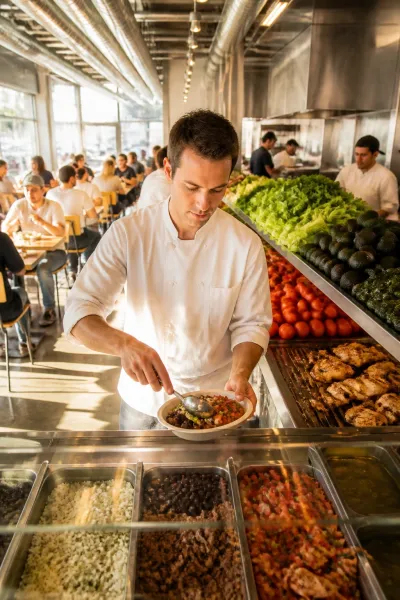
Chipotle's vulnerability wasn't bad luck. It was structural. The company's founding ethos — fresh, minimally processed ingredients prepared in-house using classic cooking techniques — was exactly what made it dangerous at scale. Unlike traditional fast-food chains that rely on frozen, pre-cooked, centrally processed components with built-in kill steps, Chipotle's model meant raw produce and meats were handled, chopped, and assembled in thousands of individual kitchens every day. A single contaminated ingredient — cilantro, tomatoes, lettuce — could fan out across the system before anyone noticed.
The company had built its supply chain on relationships with smaller, ethically aligned farms. That commitment to "naturally raised" meats and local produce created a fragmented network that was harder to audit and control than the industrial pipelines feeding McDonald's or Taco Bell. Chipotle had no centralized produce washing, no high-pressure processing, no standardized pathogen testing at the supplier level. The very transparency that attracted customers — open kitchens, visible prep — also meant every shortcut, every lapse, was on display.
Steve Ells, the classically trained chef who founded Chipotle in 1993, found himself cast as the villain in a public health drama. He appeared on national television to apologize. The company cooperated with investigators. But the response felt reactive, piecemeal. Sales plummeted. Same-store traffic dropped by double digits. Analysts downgraded the stock. The brand that had defined the fast-casual category now looked like its greatest cautionary tale.
The Reckoning
In February 2016, Chipotle did something unprecedented: it closed every single U.S. restaurant for several hours to hold a mandatory all-hands food safety meeting. Tens of thousands of employees gathered to review new protocols, watch training videos, and hear from leadership. It was a costly, symbolic gesture — a public penance meant to signal that the company understood the magnitude of its failure.
Behind the scenes, the overhaul was ruthless. Chipotle hired Dr. Mansour Samadpour, a prominent food safety microbiologist, to redesign its entire system from farm to fork. Every supplier was re-vetted. DNA-based testing was mandated for ingredients before they left farms. Centralized produce washing and sanitization were introduced for vulnerable items like cilantro and tomatoes. High-pressure processing — a non-thermal kill step that preserves freshness while eliminating pathogens — was added for certain raw ingredients. In restaurants, raw meat prep was physically separated from produce prep. Cooking temperatures were locked down with digital monitoring. A strict new sick-leave policy required employees to be symptom-free for 48 hours before returning to work.
The changes were expensive — tens of millions of dollars in new equipment, testing, labor, and lost revenue. But they worked. No major outbreaks followed. Slowly, painfully, customers returned. The stock stabilized, then climbed.
The Long Shadow
The crisis forced a leadership reckoning. Ells stepped down as CEO in 2017, making way for Brian Niccol, the former Taco Bell chief who would steer Chipotle into its digital, Chipotlane-driven next act. The company that emerged was more corporate, more data-driven, more cautious — and far safer. Its food safety systems became an industry benchmark, cited by regulators and copied by competitors.
Yet the 2015 outbreaks remain a ghost in the machine. Every new hire still learns the story during onboarding. Every supplier audit carries the weight of that year. The "Food With Integrity" promise survived, but it was baptized in a way no marketing campaign could achieve. Chipotle learned that integrity isn't just about sourcing — it's about systems. And that a single contaminated tomato can undo decades of trust.
This is one episode in a much longer story. For the full account of the history of Chipotle Mexican Grill, read “A History of Chipotle Mexican Grill” by Carl N. Parker on MixCache.com.
Please log in or create an account to leave a comment.
No comments yet. Be the first to say something.