
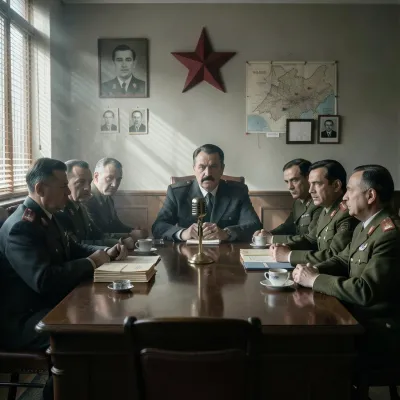
The evening of December 1, 1934, began like any other in the Smolny Institute, the former convent that housed the Leningrad party apparatus. Sergei Kirov, the charismatic regional boss and Politburo member, was at his desk preparing for a routine meeting. As he walked down a third-floor corridor, a single gunshot cracked the quiet. Kirov collapsed, struck in the back of the head. The gunman, a disgruntled former party member named Leonid Nikolaev, was seized on the spot. Within hours, the event that would become the Great Purge's founding myth had begun.
The Train to Leningrad
Stalin's reaction was immediate and theatrical. He boarded a train for Leningrad that night, accompanied by a retinue of Politburo colleagues and NKVD chief Genrikh Yagoda. The journey itself was a signal: the General Secretary was taking personal charge. In Leningrad, Stalin did not confine himself to receiving reports. He interrogated Nikolaev directly, and according to witnesses, oversaw the questioning of other suspects. The message radiated outward through the party hierarchy: this was not a crime to be solved by police procedure. It was a political rupture to be exploited by the highest authority.
The Decree That Killed Due Process
Before the train even returned to Moscow, the legal architecture of the purge was being erected. On December 1, the Presidium of the Central Executive Committee issued a decree that stripped away every procedural safeguard for "terrorist acts." Investigations were limited to ten days. Indictments followed instantly. Appeals and pardons were abolished. Death sentences were to be carried out without delay. The "Kirov Decree" turned the judiciary into a conveyor belt. Nikolaev and thirteen alleged accomplices were tried and executed within weeks. But the net widened with shocking speed. Dozens of former oppositionists — veterans of the Zinoviev-Kamenev faction — were arrested in Leningrad and Moscow, charged not with pulling triggers but with "moral complicity." Many were shot or dispatched to camps on the strength of that elastic phrase alone.
The Purge of a Power Base
Leningrad itself became the first laboratory. Kirov had cultivated a loyal following in the city, a potential rival power center. Now the entire regional party organization was scoured. Thousands were expelled or arrested. The Orgburo processed hundreds of personnel changes, installing only cadres vetted by Moscow. The NKVD, emboldened by the decree, moved with assembly-line efficiency. Interrogators used sleep deprivation, isolation, and threats against families to extract confessions that mapped an ever-expanding conspiracy. The personal secretariat in Moscow filtered the reports, ensuring Stalin saw a curated picture of progress. Meanwhile, the propaganda machine roared to life. Newspapers screamed headlines about "Trotskyite-Zinovievite terrorists." Mass rallies were staged across the country, demanding the execution of enemies the public had never heard of. The performance of outrage became a ritual of survival.
The Template for Terror
Kirov's murder did more than eliminate a popular rival. It provided the pretext, the legal framework, and the psychological template for the Great Purge. The inner circle — Molotov, Kaganovich, Voroshilov — competed to demonstrate vigilance, binding themselves irrevocably to the new logic. Patronage networks, once channels of mutual protection, inverted into webs of denunciation. The NKVD began compiling dossiers on military officers, planting the seeds of the 1937 military purge. Even economic policy shifted: Kirov had advocated concessions to the peasantry; his death silenced that debate. The decree's ten-day limit, its ban on appeals, its troika-style justice — all became standard operating procedure. When the mass operations of 1937–38 arrived, they did not emerge from chaos. They arrived on tracks laid in the days after a single shot in a Leningrad corridor.
The assassin's bullet killed one man. The state's response killed the possibility of limits. By the time the worst of the terror subsided, the Soviet Union had been rewired: a system where loyalty was the only currency, where procedure was a mask, and where a marginal note from the leader could still, years later, send a name from a list to a firing squad. The corridor in the Smolny was where the old rules broke, and the new ones were written in blood.
This is one episode in a much longer story. For the full account of the great purge, read “Stalin's Shadow Cabinet” by Terry Silva on MixCache.com.
Please log in or create an account to leave a comment.
No comments yet. Be the first to say something.