
On the evening of November 9, 1989, Günter Schabowski, a mid-level East German Politburo official, sat before a room of journalists in East Berlin. He held a sheet of paper he had not fully read. The government had decided to ease travel restrictions, but the details — when, how, for whom — were meant to be managed, controlled, phased. An Italian journalist, Riccardo Ehrman, asked when the new rules would take effect. Schabowski shuffled his papers, hesitated, and said: "As far as I know... effective immediately, without delay."
The words went out live on television. Within hours, thousands of East Berliners gathered at the checkpoints. Border guards, bewildered and without orders, faced a tide of people who believed the Wall was open. At Bornholmer Strasse, the commander gave the order to lift the barriers. A torrent of humanity poured into West Berlin. People danced on the concrete that had divided them for twenty-eight years. The Cold War had not ended, but its most potent symbol had been breached by a muddled sentence.
The diplomatic earthquake
The fall of the Wall was a moment of unalloyed joy. For the governments of Europe, it instantly resurrected the most formidable issue of the post-war era: the German Question. For four decades, the division of Germany had been the foundation of the continent's stability. A reunified Germany, with a population approaching 80 million and an economic might that would dwarf its neighbours, aroused deep-seated anxieties.
In London, Prime Minister Margaret Thatcher was openly hostile. She privately told aides that "we have beaten the Germans twice, and now they're back." In Paris, President François Mitterrand feared a united Germany would shift the European Community's centre of gravity eastwards and diminish French influence. Both initially hoped to slow the process, perhaps allowing a period of confederation between the two German states.
But the pace of events on the ground outstripped the cautious deliberations of diplomats. West German Chancellor Helmut Kohl recognised a historic, narrow window. Ignoring the hesitations of his allies, he seized the initiative. On November 28, 1989, without prior consultation with Paris, London, or Washington, he announced a "Ten-Point Plan" for German unification. The move alarmed his partners, who felt Kohl was embarking on a solo run, but it electrified the German public.
The Mitterrand-Kohl bargain
The key relationship, as so often in the Community's history, was the Franco-German one. Mitterrand realised he could not stop reunification; the German people's desire for self-determination was too powerful. Instead, he opted for a strategy of containment through integration. If Germany was to be united, it must be bound even more tightly into European structures.
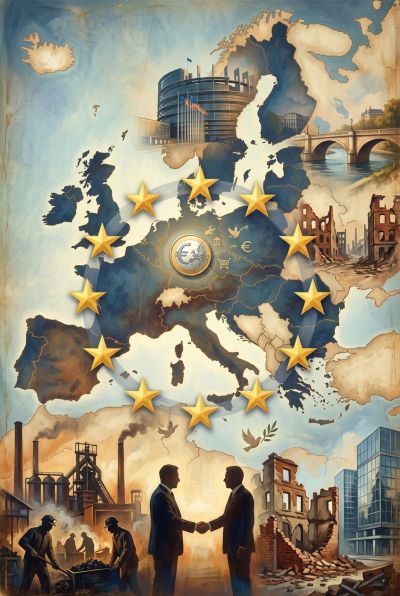
This led to a historic grand bargain, forged in intense meetings between Mitterrand and Kohl in late 1989 and early 1990. Mitterrand would give his political blessing to rapid German unification. In return, Kohl would commit the new, more powerful Germany to a massive leap forward in European integration: the creation of a full Economic and Monetary Union, complete with a single currency.
The logic was clear: the price for a German political union was a European monetary union. A single currency would mean sacrificing the Deutsche Mark, the potent symbol of West Germany's post-war economic success and the anchor of European monetary stability. It was the ultimate proof that the new Germany would be a European Germany, not a German Europe.
From Strasbourg to Moscow
This understanding was formalised at a tense European Council summit in Strasbourg in December 1989. Kohl, feeling as though he was on trial, withstood the concerns of his fellow leaders and secured their endorsement for German unity in the context of a commitment to deepen European integration.
With Europe on board, the final hurdle was securing the agreement of the four victorious Second World War powers — the United States, the Soviet Union, the United Kingdom, and France — who still held residual rights over Germany as a whole. This was achieved through the "Two Plus Four" negotiations, a diplomatic masterstroke that saw the two German states negotiate with the four powers. Despite British reservations and initial Soviet opposition, the process moved quickly, thanks largely to firm American support for a united Germany within NATO and the dire economic state of the Soviet Union, which Kohl helped to ease with generous financial assistance. On September 12, 1990, in Moscow, the six parties signed the Treaty on the Final Settlement with Respect to Germany, which renounced all Four-Power rights and restored full sovereignty to a united Germany.
Absorption without accession
Within the European Community, the process of incorporating the GDR was unique. It was not a normal accession. Instead, the legal mechanism chosen was Article 23 of the West German Basic Law, which allowed other German territories to accede to the Federal Republic. On October 3, 1990, the German Democratic Republic was dissolved, and its territory, reconstituted as five new federal states, was simply absorbed into the Federal Republic of Germany. Overnight, the European Community grew by 16 million people and a territory larger than Ireland, without a single page of accession negotiations. All Community law applied to the former East Germany from day one.
The cost of unity
The immediate economic consequences were brutal. A political decision was made to convert the nearly worthless East German Mark to the powerful Deutsche Mark at a one-to-one rate for wages and savings. This generous rate, intended to stem a mass exodus to the West, crippled what was left of East German industry, whose productivity was a fraction of the West's. Factories that were already uncompetitive were rendered instantly bankrupt. Industrial output collapsed, and unemployment soared. The cost of rebuilding the decrepit infrastructure and supporting the shattered economy of the new eastern states would be colossal, requiring massive financial transfers from the West totalling over a trillion euros in the years that followed. The European Community provided some assistance, but the overwhelming burden fell on German taxpayers.
A continent reshaped
The geopolitical earthquake of 1989-90 had completely reshaped the continent and irrevocably altered the European Community's path. An external shock of unimaginable proportions had forced the Community to confront its own future. The reunification of Germany, a development that many had feared would destabilise Europe, had instead become the primary engine for an unprecedented leap of faith. The bargain struck between Kohl and Mitterrand had set the agenda: the price of German unity would be a deeper, more political, and more binding European union. The Community of Twelve, which had been cautiously focused on completing its single market, now found itself on a fast track towards creating its own currency and a common foreign policy, transforming itself into an entirely new entity — the European Union.
This is one episode in a much longer story. For the full account of the fall of the Berlin Wall and German reunification, read “A History of the European Union” by Jean Dubois on MixCache.com.
Please log in or create an account to leave a comment.
No comments yet. Be the first to say something.