
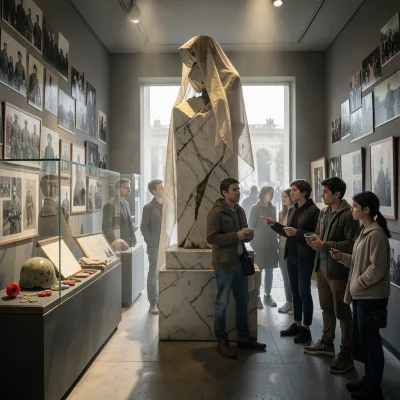
In a small park in Hamburg-Harburg, a twelve-meter column sheathed in soft lead rose from the ground in 1986. Its surface was unmarked at first, a blank dark skin waiting for something to happen. A plaque beside it explained the rules: anyone could approach, take a key or a stone, and scratch whatever they wished into the metal — names, dates, insults, prayers, rejections of forgetting. The artists, Jochen Gerz and Esther Shalev-Gerz, had designed the Monument Against Fascism not to stand forever but to disappear.
Over the next seven years, a hydraulic mechanism lowered the column in stages, a few inches at a time, each descent triggered by the accumulation of inscriptions. The more the public wrote, the deeper it sank. By 1993, the column had vanished entirely beneath the earth. Today, only a small square of lead sits flush with the pavement, an unremarkable patch that most pedestrians cross without noticing. The monument had literally buried itself.
A Monument That Refused to Stay Put
The Monument Against Fascism was the first and most radical of what scholars would later call counter-memorials — works designed not to consolidate public memory but to destabilize it. Traditional war memorials aspire to permanence: bronze soldiers frozen mid-stride, marble columns inscribed with names, granite walls meant to outlast the societies that built them. They project authority and certainty. The Hamburg column did the opposite. It demanded participation, then punished it by sinking. It refused to resolve into a single meaning. It insisted that the question of how a society should remember could never be settled.
The idea emerged from a specific German dilemma. By the 1980s, a generation born after the war was demanding a more honest reckoning with the Nazi past. The traditional monumental landscape — statues of soldiers, lists of the fallen, the implicit message that sacrifice had been noble and the cause just — felt to many like erasure dressed in stone. It excluded the victims of the Holocaust, the forced laborers, the political dissidents. It honored the very military tradition that had enabled genocide. A new form of remembrance was needed, one that would not let the public rest easy.
The Void as Memorial
Before the Hamburg column, artist Horst Hoheisel had tested a related idea in Kassel. In 1987, he created the Aschrott-Brunnen: an inverted replica of a fountain destroyed by the Nazis in 1939, buried underground and visible only as a ghostly negative space through glass panels in the pavement. The void left by destruction, Hoheisel argued, cannot be filled by reconstruction. The absence is the memorial.
Gerz and Shalev-Gerz took this further. Their column was not a static void but an active process. It turned the act of remembrance into a physical collaboration between the public and the mechanism. Every inscription added weight — metaphorical and literal — to the column's descent. The more people remembered, the closer the monument came to vanishing. When it finally disappeared, the work was complete: a memorial that had remembered itself out of existence.
Controversy and Afterlife
The project was not universally embraced. Some residents found the sinking column confusing or pointless. Others resented the implication that their acts of writing were complicit in the monument's disappearance. The municipal government that had funded it may have seen the work as less threatening than more confrontational forms of protest — a safe container for dissent. Yet the column's very ambiguity became its power. It forced visitors to ask what a memorial was for. Was it to console? To educate? To accuse? To disappear?
In the decades since, the counter-memorial tradition has proliferated. Gunter Demnig's Stolpersteine — brass plaques embedded in sidewalks outside the last homes of Nazi victims — distribute memory across the fabric of daily life. Peter Eisenman's field of 2,711 concrete stelae in Berlin disorients visitors with its undulating grid. The AIDS Memorial Quilt grows panel by panel, assembled and disassembled for each display. Each in its own way rejects the monumental claim to finality.
What Remains
The small lead square in Hamburg-Harburg does not look like much. No names, no dates, no explanatory text. It offers no narrative, no consolation, no lesson. It simply marks the spot where a monument once stood and where the public once wrote. In its refusal to signify, it signifies everything: that memory is not a destination but a practice; that the work of remembrance is never finished; that the most honest monument to a crime like fascism might be one that refuses to stand still.
This is one episode in a much longer story. For the full account of counter-memorials and the art of dissent, read “Museum of Memory: Memorialization, Monuments, and the Cultural Politics of War” by Rachel Spencer on MixCache.com.
Please log in or create an account to leave a comment.
No comments yet. Be the first to say something.