
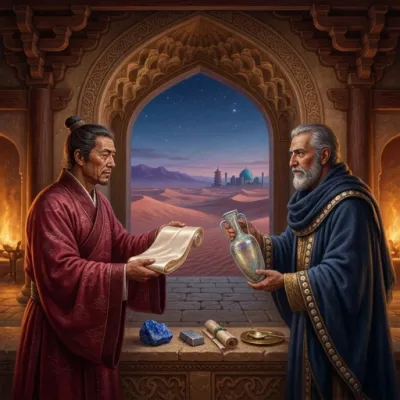
The death penalty waited for anyone caught with a single silkworm egg. For centuries, China had guarded the secret of sericulture with a ferocity that made the punishment explicit: exporting eggs, larvae, or mulberry seeds meant execution. The monopoly had turned silk into the world's most coveted fabric, filling Chinese coffers and drawing Roman gold eastward across the Silk Road. By the sixth century, the Byzantine Empire — heir to Rome's eastern half — still depended entirely on Persian intermediaries for the thread that clothed its emperors and adorned its churches.
Then two monks arrived at Constantinople with a proposition that sounded like madness.
A Secret Worth Killing For
The Chinese had cultivated Bombyx mori for millennia. Archaeological fragments push sericulture back 8,500 years. By the Han Dynasty, the industry was a state within a state: millions of mulberry trees, armies of women tending trays of voracious larvae, reeling houses where cocoons were steamed and filaments twisted into thread. The process was intricate, the knowledge dispersed across countless households, yet the empire held the line. No eggs left China. No mulberry seeds crossed the border.
Roman writers never saw the source. Pliny the Elder believed silk grew on trees like wool. Others imagined giant spiders spinning it in distant forests. The Parthians, then the Sasanians, controlled the overland routes and the markup. They unraveled Chinese bolts and rewove them, thinning the fabric, blending it with linen, obscuring its origin. By the time silk reached the Mediterranean, it had passed through so many hands that its price rivaled gold.
Justinian I, the Byzantine emperor who rebuilt Hagia Sophia and codified Roman law, hated the drain. His treasury bled specie to Persia for a fabric his own weavers could produce — if only they had the worm.
The Mission
Two Nestorian monks, already familiar with the Central Asian routes, appeared at court around 550 CE. They had lived in China, they said. They had seen the mulberry groves, the reeling houses, the very eggs the empire forbade to leave. They offered to bring them back.
Justinian agreed. The monks departed, traveling east through Sasanian territory, past the Pamirs, into the Tarim Basin, and onward to the Chinese heartland. The journey took years. They moved as pilgrims or merchants, indistinguishable from the caravans that crisscrossed the oasis cities — Kashgar, Khotan, Dunhuang — where Sogdian traders swapped languages like coin and monasteries dotted the desert fringe.
In China, they found what they sought. The eggs were tiny, hundreds to a gram, laid in neat rows on paper cards. The monks hollowed out bamboo staves — walking staffs, unremarkable to any inspector — and packed the eggs inside, cushioning them with straw. Mulberry seeds went in separate compartments. Then they turned west.
The Return
The eggs had to stay viable. Silkworm embryos survive only weeks without proper temperature; the monks would have known to keep the staves close to their bodies in cold passes, shaded in the desert heat. They crossed the same routes Zhang Qian had pioneered four centuries earlier, the same passes where the Xiongnu once raided, where the Tang would later station garrisons. They moved through Sogdiana, past Samarkand and Bukhara, through Sasanian Persia — where discovery meant not just death but diplomatic catastrophe — and finally to Constantinople.
They arrived. The eggs hatched. The larvae ate mulberry leaves. They spun.
The Monopoly Breaks
Byzantium established its own sericulture. Imperial workshops in Constantinople, Beirut, Antioch, and later Thebes and Corinth began producing silk that rivaled China's. The Sasanian stranglehold on the overland trade cracked. Persian merchants still carried Chinese silk, but now a rival supply existed west of their borders. Prices shifted. The drain of Byzantine gold slowed.
China's monopoly, enforced by execution for over a thousand years, had been broken by two men with hollow sticks.
What the Theft Changed
The theft did not end the Silk Road. Chinese silk remained prized for its quality, and the overland routes still carried spices, jade, ceramics, and ideas. But the economic geography tilted. Byzantium gained a strategic industry. The Sasanians lost leverage. Within a century, Arab armies would sweep through the region, and the center of silk production would shift again — to Damascus, to Baghdad, to Cairo, to Al-Andalus.
The monks' names are lost. Rustichello da Pisa would later record Marco Polo's travels in a Genoese prison; no such chronicler preserved the identities of the two Nestorians. Only their cargo mattered: a few grams of eggs, a handful of seeds, and the knowledge that no secret, however fiercely guarded, survives forever when the profit in stealing it is great enough.
This is one episode in a much longer story. For the full account of the Silk Road, read “The Silk Road: Trade Routes That Shaped Empires” by Johnny Ruiz on MixCache.com.
Please log in or create an account to leave a comment.
No comments yet. Be the first to say something.