
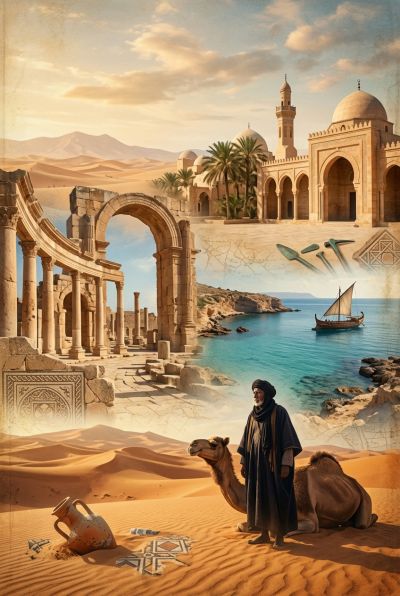
The desert wind had already erased their footprints by the time the argument began. On a featureless stretch of sand where the Gulf of Sirte bites into the North African coast, four men stood gasping — two from Carthage, two from Cyrene — each pair having run for days from their home cities. The agreement was simple: wherever they met, the border would fall. But the Carthaginian brothers, Philaeni by name, had covered ground that seemed impossible. The Greeks cried foul.
The Race That Drew a Line
By the late fourth century BC, the western Mediterranean had settled into a cold war between two civilizations that could not have been more different. Carthage, the Semitic merchant empire, controlled the coast westward from the Gulf of Sirte. Cyrene, the Greek agricultural colony, held the green plateau of the Jebel Akhdar to the east. Between them lay hundreds of miles of empty shoreline — no rivers, no mountains, nothing a surveyor could use. The two powers had skirmished for decades over the undefined frontier until, exhausted, they agreed to let feet decide what swords could not.
At a predetermined hour, the runners set out. The Greek pair moved at a measured pace, conserving strength for the long haul. The Philaeni brothers, driven by some mix of patriotism and desperation, sprinted. They ran until their lungs burned and their legs gave way, covering distance that defied belief. When the four men finally sighted each other, the meeting point lay deep in territory the Cyreneans considered their own.
The Greeks did not congratulate them. They accused the brothers of starting before the signal. The dispute escalated on that empty beach until the Cyreneans issued an ultimatum that belongs more to myth than diplomacy: if the Philaeni truly believed they had run fair, let them be buried alive at the spot. Only then would the border stand.
A Border Sealed in Bone
The brothers conferred. Then they accepted. Their fellow Carthaginians watched as the pit was dug, as the two men stepped in, as the sand rose over their knees, their chins, their upturned faces. No record survives of what they said in those final minutes. The Greeks kept their word: the border was fixed where the brothers died. Carthage marked the place with two great altars, the Arae Philaenorum, which stood for centuries as the most famous landmarks on the North African coast. Roman itineraries still noted them hundreds of years later. Travelers would pause at the altars, read the inscription, and understand that a frontier could be bought with more than treaties.
The story survived because it was too strange to forget. Sallust, the Roman historian, recorded it generations later, noting that the altars remained a wonder to those who saw them. The border they marked endured through the Punic Wars, the Roman conquest, the Vandal invasion, and the Arab arrival. It outlasted the cities that created it. Cyrene withered into ruins; Carthage was erased so thoroughly that its very site was lost. But the line drawn by two men who chose death over dishonor held.
The Weight of a Witness
What makes the episode resonate across millennia is not the geography but the psychology. The Philaeni brothers were not kings or generals. They were athletes, chosen for speed, thrust into a diplomatic crisis they had not made. Their decision to die rather than concede cheating suggests a culture where collective honor outweighed individual survival — a value system alien to modern sensibilities but familiar to anyone who has studied ancient Carthage. The Greeks, for their part, proposed a barbaric test but honored its outcome. Both sides treated the burial as a legal act, not a murder.
The altars became more than boundary markers. They were a warning and a promise: this line is real because men died for it. Later empires would build walls, dig ditches, plant pillars. The Romans would construct the Limes Tripolitanus, a network of forts and watchtowers stretching hundreds of kilometers. But no fortification carried the moral weight of two graves on a beach where the runners met.
When the Sand Reclaims the Line
The altars themselves are gone. Coastal erosion, earthquakes, and the quarrying of stone for later buildings erased them by the early Middle Ages. The exact location is debated; some scholars place them near modern Ras Lanuf, others farther west. The border they defined shifted too — Rome redrew it, the Arabs ignored it, the Ottomans and Italians imposed their own. Today the line between Libya's historical regions of Tripolitania and Cyrenaica runs not where the Philaeni fell but along administrative boundaries drawn in European conference rooms.
Yet the story persists in the place names. The Gulf of Sirte was once called the Gulf of the Altars. Medieval Arab geographers knew the frontier as Hadd al-Philaeni, the Limit of the Philaeni. Even now, when Libyans speak of the divide between west and east — a divide that has fueled civil wars, rival governments, and competing capitals — they are walking a path first measured by two men who ran until the ground swallowed them.
This is one episode in a much longer story. For the full account of the history of Libya, read “A History of Libya” by Omar Gheriani on MixCache.com.
Please log in or create an account to leave a comment.
No comments yet. Be the first to say something.