
Browse by Category
Fiction
- Action & Adventure
- African American
- Anthologies
- Children's Fiction
- Classics
- Comics & Graphic Novels
- Coming of Age
- Contemporary
- Cultural & Regional
- Drama
- Erotica
- Fantasy
- General
- Historical Fiction
- Horror
- Humor & Satire
- Literary Fiction
- Mystery, Thriller & Suspense
- Poetry
- Religious & Inspirational
- Romance
- Science Fiction
- Short Stories
- War & Military
- Westerns
- Women's Fiction
- Young Adult
Non-Fiction
- Antiques & Collectibles
- Arts & Photography
- Biographies & Memoirs
- Business & Money
- Children's Non-Fiction
-
Computers & Technology
- Artificial Intelligence
- Computer Science
- Cybersecurity & Cryptography
- Data Science & Analytics
- Databases & Big Data
- Game Development & Design
- General
- Hardware & DIY
- Mobile App Development
- Networking & Cloud Computing
- Operating Systems
- Programming
- Robotics
- Software
- Software Engineering
- User Experience (UX) & Design
- Web Development & Design
- Cooking, Food & Wine
- Crafts, Hobbies & Home
- Education & Teaching
- Engineering
- General
- Health, Fitness & Dieting
-
History
- African History
- African History - North Africa
- African History - Sub-Saharan Africa
- American History
- American History - 20th Century
- American History - Civil War
- American History - Colonial Period
- Ancient History
- Asian History
- Asian History - China
- Asian History - India
- Asian History - Japan
- Asian History - Southeast Asia
- European History
- European History - Ancient Greece
- European History - Ancient Rome
- European History - Medieval
- European History - Modern
- European History - Renaissance
- General
- Middle Eastern History
- Military History
- Military History - Aviation
- Military History - Naval
- Social & Cultural History
- World History
- Humor & Entertainment
- Industrial Technology
- Language Learning
- Law
- LGBTQ+ Non-Fiction
- Literary Criticism
- Medical Books
- Parenting & Relationships
- Philosophy
- Politics & Social Sciences
- Reference
- Religion & Spirituality
-
Science & Math
- Agricultural Sciences
- Astronomy & Space Science
- Behavioral Sciences
- Biological Sciences
- Botany & Plant Science
- Chemistry
- Earth Sciences
- Engineering - Chemical
- Engineering - Civil
- Engineering - Electrical
- Engineering - Mechanical
- Environment
- General
- Geology
- Mathematics
- Nature & Ecology
- Oceanography
- Paleontology
- Physics
- Statistics
- Self-Help
- Sports & Outdoors
- Study Aids
- Sustainability & Green Living
- Textbooks
- Transportation
- Travel
- True Crime
- Urban Planning & Development
- Veterinary Medicine
- Writing & Publishing
Jump to Section
MixCache.com Total Access
Unlimited reading and audiobooks for every book published by MixCache.com.
Included titles carry the MTA badge.
Learn more →A History of Libya
About this book:
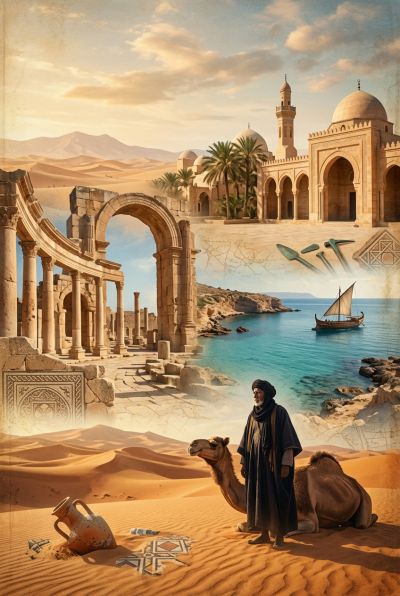
This comprehensive history invites readers to embark on a sweeping journey through Libya's remarkable past, from the verdant landscapes of the Green Sahara era to the complex realities of the 21st century. Readers will discover how this North African land, defined by the stark contrast between its Mediterranean coastline and vast Saharan desert, has served as a perpetual crossroads where civilizations have collided, merged, and left enduring imprints. Rather than presenting Libya as merely a modern headline of conflict, the book reveals a deep tapestry of human endeavor stretching back millennia, where indigenous Berber cultures laid foundations that persisted through waves of foreign influence.
Readers will explore the fascinating layers of ancient Libya, encountering the prehistoric rock art of the Acacus Mountains that chronicles a lost world of savannahs and wildlife, and learning about the indigenous Berber (Amazigh) peoples whose languages and traditions form the bedrock of Libyan identity. The narrative follows Phoenician traders establishing coastal outposts like Oea (Tripoli) and Sabratha, Greek colonists founding the pentapolis of Cyrene with its legendary silphium trade, and the Carthaginian shadow that transformed Tripolitania into a vital maritime province. The journey continues through Rome's golden age, where cities like Leptis Magna flourished as centers of agriculture and culture, producing an emperor in Septimius Severus, before examining the Vandal disruption and Byzantine reconquest that set the stage for the transformative Arab conquest.
The medieval and early modern periods come alive as readers trace Libya's integration into the Islamic world, witnessing the rise and fall of dynasties from the Aghlabids to the Fatimids, and understanding the profound impact of the Hilalian invasions that reshaped demographics and shifted power toward nomadic tribalism. The narrative details how the Libyan coast became a contested frontier between Spanish knights, Ottoman corsairs, and the infamous Barbary pirates, leading to the establishment of the Karamanli dynasty and the eventual clash with the young United States in the Barbary Wars. Readers will gain insight into the Italo-Turkish War that began Italian colonization, the fierce Senussi resistance, and the brutal Fascist policies that sought to remake Libya as Italy's "Fourth Shore" through demographic colonization and infrastructure projects like the Via Balbia.
The 20th century unfolds with dramatic intensity as readers experience Libya's pivotal role in World War II's Desert War, where the seesaw battles between Rommel and Montgomery decided the fate of North Africa, and the subsequent path to independence under King Idris Sanusi. The book provides a nuanced examination of Muammar Gaddafi's 1969 revolution, his Jamahiriya system based on the Green Book's radical theories of direct democracy, and Libya's adventurous foreign policy that brought it into confrontation with the West over incidents like the Lockerbie bombing and the Gulf of Sidra clashes. Readers will understand how Gaddafi's four-decade rule combined revolutionary fervor, ideological experimentation, and international isolation before his eventual rapprochement with the international community.
The narrative concludes with an unflinching look at Libya's post-2011 reality, guiding readers through the euphoria of the Arab Spring uprising, Gaddafi's violent demise, and the devastating fragmentation that followed as rival militias and foreign powers filled the power vacuum. Readers will grasp the complexities of the dual civil wars, the rise of figures like Khalifa Haftar, the intervention of regional and global actors, and the devastating consequences of institutional collapse highlighted by tragedies like the Derna floods. Ultimately, this history offers readers not just a chronicle of events, but a profound understanding of Libya's enduring struggle to forge a unified state from its diverse tribal, regional, and cultural elements—a quest for stability that continues to shape the nation's pursuit of a peaceful and prosperous future amidst immense challenges and potential.
What You'll Find Inside:
- Libya's ancient foundations: From Berber (Amazigh) origins and Phoenician/Greek colonies to Roman prosperity and the Garamantian desert kingdom
- Islamic transformation and medieval shifts: Arab conquest, dynastic rule from Aghlabids to Fatimids, and the disruptive Hilalian invasions
- Ottoman era and Barbary conflicts: Turkish rule, the Karamanli dynasty, and early confrontations with the United States
- Colonial struggle and wartime legacy: Italian fascist colonization, Libya's pivotal role in WWII's Desert War, and the path to independence
- Gaddafi's revolution to modern fragmentation: The Jamahiriya experiment, 2011 uprising, civil wars, and ongoing quest for political stability
Who's It For:
This book is ideal for students of history, political science, and Middle Eastern studies, as well as researchers and general readers seeking a comprehensive understanding of Libya's complex past. It provides valuable context for anyone trying to comprehend Libya's current political situation, regional dynamics, and its place in broader historical narratives of North Africa and the Arab world.
Table of Contents:
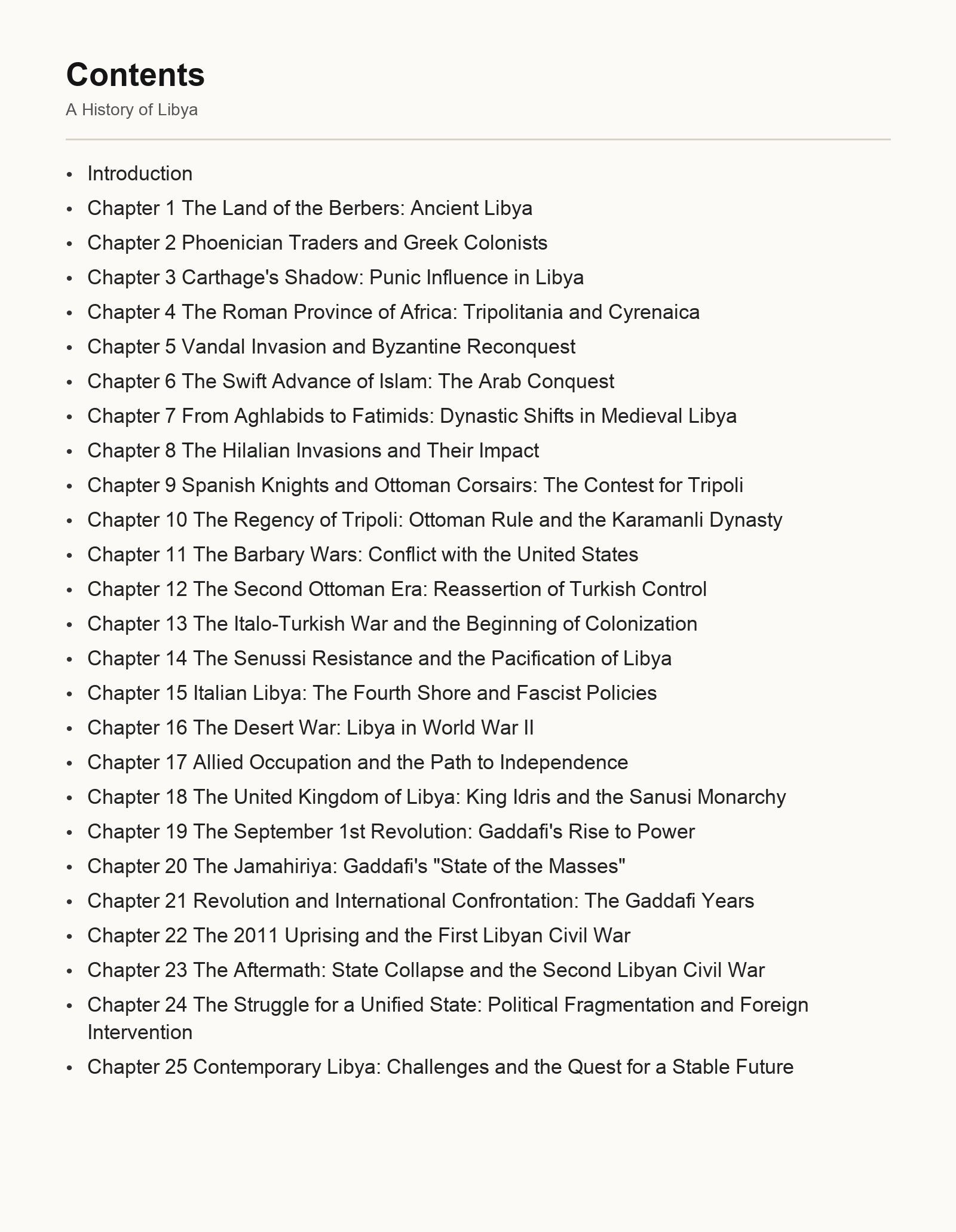
- Introduction
- Chapter 1 The Land of the Berbers: Ancient Libya.
- Chapter 2 Phoenician Traders and Greek Colonists.
- Chapter 3 Carthage's Shadow: Punic Influence in Libya.
- Chapter 4 The Roman Province of Africa: Tripolitania and Cyrenaica.
- Chapter 5 Vandal Invasion and Byzantine Reconquest.
- Chapter 6 The Swift Advance of Islam: The Arab Conquest.
- Chapter 7 From Aghlabids to Fatimids: Dynastic Shifts in Medieval Libya.
- Chapter 8 The Hilalian Invasions and Their Impact.
- Chapter 9 Spanish Knights and Ottoman Corsairs: The Contest for Tripoli.
- Chapter 10 The Regency of Tripoli: Ottoman Rule and the Karamanli Dynasty.
- Chapter 11 The Barbary Wars: Conflict with the United States.
- Chapter 12 The Second Ottoman Era: Reassertion of Turkish Control.
- Chapter 13 The Italo-Turkish War and the Beginning of Colonization.
- Chapter 14 The Senussi Resistance and the Pacification of Libya.
- Chapter 15 Italian Libya: The Fourth Shore and Fascist Policies.
- Chapter 16 The Desert War: Libya in World War II.
- Chapter 17 Allied Occupation and the Path to Independence.
- Chapter 18 The United Kingdom of Libya: King Idris and the Sanusi Monarchy.
- Chapter 19 The September 1st Revolution: Gaddafi's Rise to Power.
- Chapter 20 The Jamahiriya: Gaddafi's "State of the Masses".
- Chapter 21 Revolution and International Confrontation: The Gaddafi Years.
- Chapter 22 The 2011 Uprising and the First Libyan Civil War.
- Chapter 23 The Aftermath: State Collapse and the Second Libyan Civil War.
- Chapter 24 The Struggle for a Unified State: Political Fragmentation and Foreign Intervention.
- Chapter 25 Contemporary Libya: Challenges and the Quest for a Stable Future.
Author:
Published By:
Date Published:
May 29, 2026
Type:
Nonfiction
Language:
English
Also Available In:
Word Count:
51,464 words
Reading Time:
3 hours 36 minutes
Sample:
Order:
Buy the A History of Libya ebook on MixCache.com:
Buy NowThe full ebook will be available immediately to read instantly on any device.
$5 account credit for all new MixCache.com accounts, usable toward any ebook purchase!*




Ratings & Reviews
Ask Questions About This Book
Have a question about the content? Ask our AI assistant!
Start by asking a question about "A History of Libya"
Example: "Does this book mention William Shakespeare?"
Thinking...