
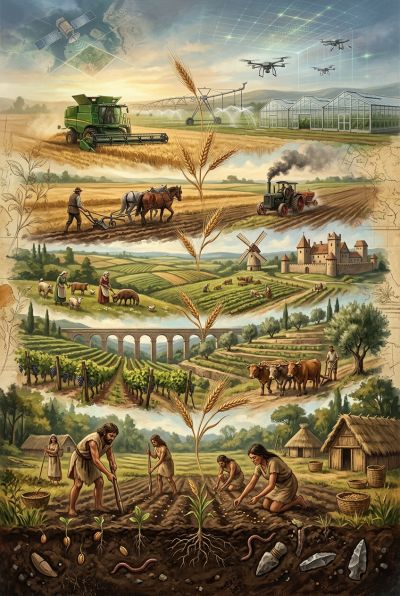
The meal on your plate is the latest chapter in a story twelve thousand years long. Leonard Patrick's A History of Agriculture follows that story from the Fertile Crescent's first saved seeds to the drone-guided combines and vertical farms of the twenty-first century, revealing a pattern of ingenious solutions that inevitably spawn new problems. The book makes a compelling case that understanding this cycle is essential for anyone who eats.
What the book is about
The book spans twenty-five chapters plus an introduction and afterword, organized chronologically but thematic in its insights. It begins with the Neolithic Revolution — the independent domestication of plants and animals in at least eleven regions worldwide — and moves through the river-valley civilizations of Mesopotamia, Egypt, and the Indus Valley. Subsequent chapters cover the Arab Agricultural Revolution, medieval feudal farming, the Columbian Exchange, the British Agricultural Revolution and Enclosure Movement, early American agriculture and the plantation economy, nineteenth-century mechanization, the scientific revolution in soil chemistry and genetics, the Green Revolution, the rise of industrial agribusiness, and the environmental consequences that followed. The final chapters confront climate change, water scarcity, biotechnology, precision agriculture, vertical farming, automation, and the challenge of feeding nearly ten billion people by 2050. A glossary defines key terms from ard to yield gap. The intended audience is broad: readers who want a single, coherent narrative linking the deep past to the pressing future of food, without assuming prior expertise in agronomy, economics, or history.
The pattern of progress and its hidden costs
A recurring motif across millennia is that every major agricultural advance solves an immediate crisis while sowing the seeds of a future one. In ancient Mesopotamia, irrigation turned desert into breadbasket but brought salinization: "Over generations, the concentration of salt in the soil steadily increased, a process known as salinization... By about 1700 BCE, the salinization was so severe that it crippled the agricultural output of the southern heartland." The British Agricultural Revolution boosted yields through enclosure and new rotations, yet "the bonds of serfdom began to dissolve" and a landless proletariat was pushed toward factory cities. The Green Revolution averted famine with high-yield wheat and rice, but "the hidden ecological and social bills were only just beginning to come due" — dead zones from fertilizer runoff, depleted aquifers, and lost crop diversity. Patrick presents this not as cynicism but as a structural feature of agricultural systems: each intensification narrows the margin for error.
Crops and techniques as global travelers
The book devotes substantial space to the movement of plants, animals, and knowledge across continents. The Arab Agricultural Revolution (Chapter 6) created a unified ecological zone from Spain to India, diffusing sugarcane, rice, citrus, cotton, and sophisticated irrigation like the qanat — "a marvel of engineering... by keeping the water underground, it dramatically reduced loss from evaporation." The Columbian Exchange (Chapter 8) was even more transformative: maize, potatoes, tomatoes, and cassava moved east, while wheat, horses, cattle, and sugarcane moved west. Patrick notes that "by the 20th century, it was estimated that about one-third of the world's total food supply came from plants that were first domesticated in the Americas." These chapters illustrate how agricultural history is inseparable from the history of empire, trade, and forced migration — the plantation complex (Chapter 12) being the brutal engine that turned New World land and Old World crops into global commodities.
The shifting definition of "improvement"
What counts as better farming has changed radically over time. For the Neolithic farmer, improvement meant selecting non-shattering rachises in wild wheat — "Human harvesters... would have disproportionately collected these mutant ears." For the Roman estate, it meant the villa rustica organized around slave gangs and screw presses. The British improvers like "Turnip" Townshend and Robert Bakewell pursued "a perfect, self-reinforcing cycle of fertility" through the Norfolk four-course rotation and systematic livestock breeding. The Green Revolution's Norman Borlaug redesigned the plant itself: semi-dwarf wheat that "could yield two, three, or even four times as much grain as the traditional tall varieties without falling over." Today, improvement means CRISPR gene editing, GPS-guided variable-rate application, and vertical farms that "can grow crops with up to ninety-five percent less water." Patrick traces this trajectory without romanticizing any era, showing how each generation's definition of progress reflects its constraints and power structures.
Soil as the silent protagonist
If the book has a central character, it is the soil — alternately revered, exploited, ignored, and now rediscovered. The ancient Egyptians depended on the Nile's annual silt deposit, "a natural fertilizer that renewed the land's fertility year after year." Liebig's chemical breakthrough reframed soil as a "bank account" of N-P-K minerals. The Haber-Bosch process broke the nitrogen bottleneck, enabling synthetic fertilizer on an industrial scale. The Green Revolution treated soil as a hydroponic medium for high-yield varieties. Industrial agriculture's monocultures and heavy machinery compacted and eroded it. The organic and regenerative movements (Chapter 18) reframe soil as "a complex, living ecosystem... the true foundation of fertility." The final chapters return to this insight: sustainable intensification requires "actively regenerate it, making it more fertile, more resilient, and a more effective sponge for holding water." The book's arc suggests that the societies which endured longest were those that treated soil as a living trust rather than an extractive resource.
Technology as both lever and lock-in
From the ard to the autonomous tractor, tools shape the social order of farming. The heavy wheeled plough "required a powerful team of draft animals — often as many as eight oxen — to pull it, reinforcing the need for peasants to pool their resources and work cooperatively." The cotton gin "revolutionized southern agriculture" and "reinvigorated and expanded the institution of slavery." The mechanical reaper allowed the Union to "maintain and even increase its grain production" during the Civil War. The Haber-Bosch process, originally for explosives, "allowed Germany to manufacture explosives throughout World War I" before becoming the basis of synthetic fertilizer. Today, precision agriculture's "prescription maps" and autonomous "swarm" robots promise per-plant management but raise new questions: "When a farmer's combine harvester is constantly streaming operational data back to the manufacturer, who owns that data?" Patrick shows that technology is never neutral; it amplifies the logic of the system it enters.
Who should read this
Readers who want a single volume that connects the domestication of emmer wheat to the ethics of cultured meat will find this book indispensable. It suits students, policy-curious citizens, gardeners, and professionals in food-adjacent fields who need historical context for today's debates about sustainability, biotechnology, and food security. Those seeking a focused monograph on a specific era or a polemical argument for one farming philosophy will be better served elsewhere. Patrick's strength is synthesis: he lets the long view speak for itself, and the pattern that emerges — innovation, consequence, adaptation — is more instructive than any manifesto.
Read “A History of Agriculture” on MixCache.com →
Please log in or create an account to leave a comment.
No comments yet. Be the first to say something.