
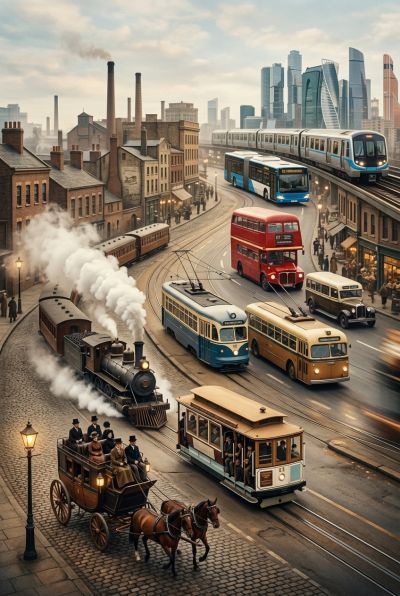
Every commute is a negotiation with history. The bus you board, the train you catch, the fare you tap — each carries the weight of two centuries of experimentation, failure, and reinvention. Julian R Halberg's A History of Public Transportation follows that lineage from the first scheduled ferry crossings to the algorithms that now predict your arrival time, showing how every technological leap reshaped not just how we travel but where we live, work, and who we become.
What the Book Is About
The book moves chronologically through 25 chapters, beginning with pre-industrial ferries and stagecoaches and ending with battery-electric buses, hydrogen fuel cells, and Mobility-as-a-Service platforms. Each chapter examines a distinct mode or era — omnibus, horsecar, cable car, electric tram, subway, elevated, interurban, motor bus, trolleybus, light rail, high-speed rail — while weaving four persistent themes: technology's uneven progress, the symbiosis of transit and urban form, the tension between private profit and public service, and the recurring struggle to make mobility equitable. Halberg writes for the general reader who wants structural understanding, not nostalgia; the tone is analytical but accessible, with enough engineering detail to explain why a grooved rail mattered or how a trolley pole works, but never so much that the narrative stalls.
The Omnibus Didn't Just Add Wheels — It Invented the Schedule
Before the omnibus, urban travel was opportunistic: you walked, hired a hackney, or waited for a wagon heading your way. The omnibus introduced the radical idea that a vehicle would leave at a published time, follow a fixed route, and accept anyone who paid the fare. Halberg traces the concept from Stanislas Baudry's 1826 Nantes bathhouse shuttle — legend says the name stuck because passengers waited near a hatter named Omnès whose sign read "Omnès Omnibus" — to George Shillibeer's 1829 London launch and the explosive spread across Paris, New York, Philadelphia, and beyond. The vehicle itself was unremarkable (a heavy, springless coach), but the organizational concept — scheduled, shared, fixed-route — became the template for every mass-transit mode that followed. As Halberg notes, "The omnibus had undeniably revolutionized urban travel. It brought scheduled, affordable mobility to the masses for the first time, breaking the constraints of the walking city and enabling unprecedented urban expansion."
Horse Power Created a Crisis Cities Couldn't Ignore
The horsecar improved on the omnibus by laying iron rails in the street, cutting rolling resistance so two horses could pull 40 passengers instead of 12. But the "horse problem" soon dwarfed the solution. By the 1880s, New York's transit horses deposited "millions of pounds of manure and tens of thousands of gallons of urine onto the streets each day." The 1872 equine influenza epizootic paralyzed North American systems for weeks, exposing the fragility of animal-dependent networks. Halberg shows how this crisis forced cities to confront the limits of biological power and accelerated the search for mechanical alternatives — cable, steam, and ultimately electricity. The horsecar era, he argues, "firmly established the concept of tracked vehicles as the preferred method for high-capacity urban movement" while simultaneously proving that muscle power could not scale.
The Streetcar's Golden Age Was Also a Financial Trap
Electric trams arrived with Sprague's 1888 Richmond system and spread with astonishing speed. By the 1920s, U.S. electric railways carried over 15 billion annual passengers — a peak never since matched. Yet the industry's business model was cracking. Franchise agreements locked fares at five cents while labor, materials, and track renewal costs climbed. Halberg describes the "transit death spiral": fare hikes drove away riders, service cuts followed, and ridership fell further. The Great Depression shattered the remaining viability; operators deferred maintenance until systems were "run into the ground." The book makes clear that the streetcar's decline began decades before the automobile's dominance, rooted in a regulatory compact that prevented price signals from matching costs — a lesson that echoes in today's subsidy debates.
Public Takeovers Didn't Solve the Money Problem — They Reframe It
When private companies collapsed in the 1950s and 1960s, cities formed public authorities: Chicago Transit Authority (1947), New York's MTA (1960s), and a wave of regional districts. Public ownership stabilized service and enabled capital renewal — the GM "New Look" bus became the visual symbol of this era. But as Halberg emphasizes, "Public ownership alone, however, rarely solved the underlying financial problem. Farebox revenues… seldom covered the full costs of operation, let alone the massive capital investment needed for modernization." The shift moved the question from "Can this turn a profit?" to "How much subsidy is the public willing to pay for mobility as a right?" That debate — over sales taxes, federal grants, farebox recovery ratios, and who counts as a beneficiary — remains the central political fight in transit policy today.
Technology Is Finally Catching Up to the Promise of Integration
The last chapters trace a quiet revolution: not in vehicles, but in information. From magnetic-stripe tickets (BART, Washington Metro) to Hong Kong's Octopus card (1997) and London's Oyster (2003), contactless payment turned fare collection into data generation. GPS-based Automatic Vehicle Location fed real-time arrival signs and smartphone apps, while GTFS standardization let third-party developers build journey planners that agencies never could. Computer-Aided Dispatch gave controllers a live map of every bus, enabling dynamic responses to bunching and delays. Halberg argues this "invisible layer of technology has become inextricably woven into the fabric of modern transit, fundamentally changing how systems operate and how riders experience their journeys." The next frontier — Mobility-as-a-Service platforms stitching transit, bike-share, ride-hail, and scooters into a single subscription — could finally make the seamless, multimodal trip as convenient as the private car.
Who Should Read This
Planners, engineers, and policy analysts will appreciate the book's structural clarity — it connects vehicle technology to land-use patterns, labor economics to fare policy, and wartime exigencies to peacetime decline. Urban history buffs will find a rich narrative of how ferries, rails, and roads wrote the physical script of modern cities. General readers curious about why their bus is late, their subway floods, or their city never built that light-rail line will get a coherent explanation without jargon. Readers seeking a celebratory tour of vintage vehicles or a polemic against cars should look elsewhere; Halberg's project is explanatory, not advocacy. The book rewards anyone willing to see public transportation not as a service they consume but as a system they inhabit.
Read “A History of Public Transportation” on MixCache.com →
Please log in or create an account to leave a comment.
No comments yet. Be the first to say something.