
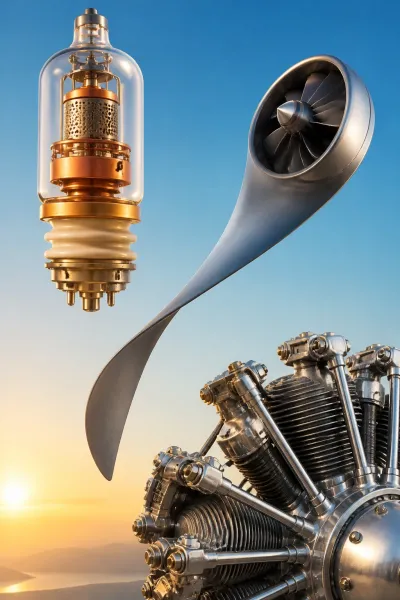
When Raytheon's founders pivoted from refrigeration to vacuum tubes in 1922, and Frederick Rentschler fired up the first Wasp engine on Christmas Eve 1925, neither could have imagined their companies would one day merge into a $74 billion aerospace and defense colossus. A History of RTX Corporation follows these two distinct industrial DNA strands across a century of wars, technological revolutions, and strategic reinventions, showing how their convergence was less inevitable than it appears in retrospect.
What the book is about
The book spans 25 chapters, organized chronologically from the "Early Seeds" of both companies through the 2020 merger and RTX's early 21st-century strategy. Jimenez structures the narrative as a dual biography that gradually braids together: Raytheon's evolution from radio tubes to radar, missiles, and electronic warfare, and UTC's arc from Pratt & Whitney engines through Sikorsky helicopters, the Otis and Carrier acquisitions, and the eventual spin-off of those commercial businesses to focus purely on aerospace. The intended reader is someone who wants a single-volume institutional history — investors, engineers, business-history buffs, or policy analysts — comfortable with technical detail but not requiring an engineering degree. Each chapter tackles a theme (wartime innovation, the Space Race, globalization, digital transformation, sustainability, M&A, culture, regulation, philanthropy, cybersecurity, future technologies) while advancing the timeline, so the book works as both a linear narrative and a reference for specific eras or topics.
From magnetrons to microwave ovens: the dual-use thread
One of the book's most revealing through-lines is how military R&D repeatedly seeded civilian markets. Chapter Three details how Raytheon's magnetron production for WWII radar led directly to Percy Spencer's 1945 discovery that microwaves could cook food — yielding the "Radarange" by 1947. Chapter Four shows Pratt & Whitney's wartime Double Wasp engines becoming the workhorses of early commercial aviation, then the J57 turbojet powering the Boeing 707 and DC-8 to launch the jet age. The pattern recurs: Chapter Five notes Raytheon built the Apollo Guidance Computer ("one of the first to utilize integrated circuits") and the Amplitron tube that beamed Armstrong's words home; Chapter Six traces how the Hawk and Patriot missile programs advanced solid-state electronics and phased-array radar that later migrated to air-traffic control and weather forecasting. Jimenez makes the case that this dual-use engine — defense funding de-risking core technologies, then commercial volumes driving down cost — was the hidden flywheel for both companies.
The merger that wasn't inevitable: UTC's strategic pruning
Chapter Twenty-Five reveals a crucial precondition for the 2020 merger: UTC's 2020 spin-off of Otis Elevator and Carrier Corporation. For decades, UTC's identity was the conglomerate Harry Gray built in the 1970s (Chapter Seven), pairing aerospace with building systems to smooth defense cycles. But Gray's logic eventually inverted; as Chapter Nine explains, UTC acquired Goodrich (2012) and merged it with Hamilton Sundstrand to form Collins Aerospace, doubling down on aerospace systems. By the late 2010s, the building-systems businesses were stable but low-growth, while aerospace and defense demanded massive, focused R&D. The spin-off created a "pure-play" aerospace UTC — Pratt & Whitney plus Collins Aerospace — that could merge with Raytheon as a true peer. Jimenz frames this not as destiny but as a deliberate portfolio choice: "This strategic divestiture cleared the path for a more focused aerospace and defense entity to emerge, making the combination with Raytheon an even more compelling proposition."
Software and AI as the new "nervous system"
Chapters Ten and Twenty chart a decisive shift: from hardware-centric engineering to software-defined systems. Raytheon's Patriot upgrades became "less about new hardware and more about enhanced software capabilities" (Chapter Ten), while Pratt & Whitney's FADEC engine controls evolved into predictive-maintenance platforms fed by fleet-wide telemetry. Chapter Twenty describes Collins Aerospace's "glass cockpit" maturing into AI-assisted flight decks that "optimize flight paths for fuel efficiency" and "manage complex air traffic control interactions." In commercial buildings, Otis uses machine learning to "predict demand patterns, optimize dispatching algorithms, and reduce waiting times," while Carrier's HVAC systems "dynamically adjust heating, cooling, and ventilation, optimizing indoor comfort while drastically minimizing energy usage." The book argues that RTX's 57,000 engineers and 60,000+ patents now function as much in code repositories as in machine shops, and that "open architectures allow for rapid software upgrades, ensuring the longevity and adaptability of its platforms."
Sustaining innovation through institutional discipline
Chapter Twenty-Four steps back from specific technologies to examine the meta-system that kept the pipeline full for a century. Jimenz identifies several interlocking mechanisms: R&D spending maintained "even during economic downturns"; world-class test facilities (Pratt & Whitney's engine cells, Raytheon's electronics labs) that serve as "crucibles of innovation"; a culture that treated Percy Spencer's melted candy bar as a product signal rather than a nuisance; aggressive IP protection ("tens of thousands of patents") that turned inventions into long-term moats; and deliberate cross-disciplinary teaming — aerodynamics, metallurgy, controls, software — so that "breakthroughs rarely happened in isolation." The chapter also notes the adoption of digital twins, agile hardware iteration, and sustainability mandates as newer accelerants. The takeaway: innovation at this scale is less about genius moments than about an operating system that funds, protects, and integrates them continuously.
Geopolitics as both catalyst and constraint
Throughout, the book shows how government policy shaped the companies' boundaries. The 1934 Air Mail Act broke up United Aircraft and Transport Corporation, creating United Aircraft Corporation (Chapter One). Cold War procurement fueled Raytheon's missile dominance and Pratt & Whitney's jet-engine leadership (Chapter Six). Post-Cold War defense consolidation drove Raytheon's acquisitions of TI Defense and Hughes (Chapter Nine). Export controls (ITAR/EAR) and the FCPA framed international strategies (Chapters Sixteen and Eighteen). Today, hypersonics and space-based threats drive RTX's R&D priorities (Chapter Twenty-Three), while net-zero aviation targets redirect propulsion research toward hydrogen and hybrid-electric demonstrators. Jimenz presents a feedback loop: the companies build capabilities the state needs; the state funds and regulates those capabilities; the resulting technologies then spin out to commercial markets, generating the scale that funds the next generation of defense tech.
Who should read this
Readers who want a single, well-structured narrative covering the full institutional arc of RTX and its predecessors will find this book efficient and thorough. It's especially useful for professionals in aerospace, defense, or industrial technology who need historical context for current program decisions, and for business-history readers who appreciate seeing M&A, R&D strategy, and geopolitics woven together rather than treated in silos. Casual readers looking for dramatic storytelling or deep technical dives into specific engineering problems may find the breadth-first approach less satisfying — the book favors scope over depth in any one episode. For its intended purpose — a credible, comprehensive corporate history that respects the complexity of a century-long convergence — it delivers.
Read “A History of RTX Corporation” on MixCache.com →
Please log in or create an account to leave a comment.
No comments yet. Be the first to say something.