
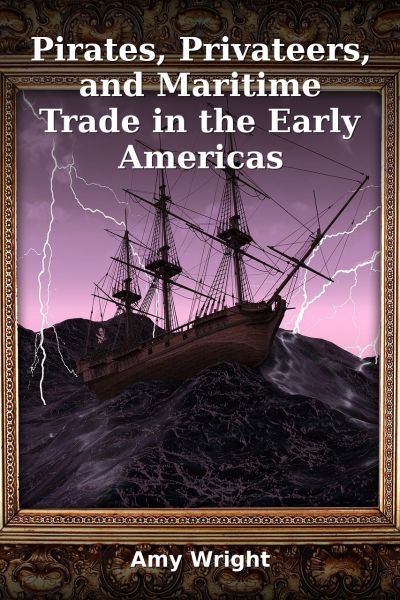
Between 1500 and 1800, the Atlantic Ocean was less a border than a marketplace where empires, merchants, and mariners negotiated risk with every voyage. Pirates, Privateers, and Maritime Trade in the Early Americas argues that the line between legal commerce and predation was never a wall but a membrane—porous, profitable, and essential to the rise of global capitalism. Wright shows that the practices forged in this era—managing risk through insurance, leveraging information networks, navigating the porous boundaries of legality—remain embedded in modern trade.
What the book is about
The book spans three centuries and twenty-five chapters, moving chronologically from the establishment of Spanish treasure convoys through the golden age of piracy to the age of Atlantic revolutions. It blends three evidence streams: maritime archaeology (wrecks, cargoes, hull modifications), port records (manifests, insurance policies, notarial contracts, customs ledgers), and narrative accounts (trial testimonies, sailors' journals, depositions, pamphlets). Wright organizes the narrative around institutional architecture—monopolies, convoys, admiralty courts, letters of marque—before expanding to the social networks that sustained trade: women as shore-based managers, Indigenous and African pilots, enslaved and free Black mariners. The intended reader is someone comfortable with academic nonfiction who wants a systems-level view of how violence, law, and commerce co-evolved. It assumes familiarity with early modern Atlantic history but explains legal and economic concepts (mercantilism, asiento, prize law, bottomry bonds) in context.
The legal edge of violence: letters of marque as commercial instruments
Chapter 3 traces how letters of marque evolved from medieval reprisal licenses into "a slip of vellum that turned theft into policy." Wright demonstrates that these commissions were less about constraining violence than about distributing its profits: sovereigns took a fifth or tenth, admiralty courts claimed fees, shipowners received shares, and crews split the remainder. The system invited evasion—captains carried multiple commissions from conflicting jurisdictions, prize crews repainted hulls and altered papers, and courts struggled to distinguish privateers from pirates. As Wright notes, "the line between privateer and pirate remained thinner than parchment." This legal ambiguity wasn't a bug; it was a feature that kept ships at sea and courts busy, turning predation into a regulated commercial instrument that sustained colonial ports from Seville to Port Royal.
Convoys as concentration mechanisms
Chapter 4 reframes the Spanish convoy system not as a defensive success but as a "bureaucratic prayer" that concentrated wealth in predictable times and places. The flotas and galeones created bottlenecks where prices spiked, ports swelled, and predators learned to read the seasonality of treasure like a tide chart. The convoy's predictability became its greatest vulnerability: it "reduced losses to isolated pirates while increasing incentives for large-scale raids against the system itself." Wright connects this to the birth of insurance markets that adjusted premiums by season and route, and to a secondary schedule of commerce where Dutch and English traders timed voyages to intercept fleet arrivals. The convoy, intended to lock wealth inside empire, became a pump drawing contraband through its own cracks.
Port cities as brokers of ambiguity
Chapters 7, 8, and 20–21 reveal how ports functioned as "translators as much as transshipment points, turning foreign things into familiar prices and smuggling into schedule." Seville's Casa de Contratación tried to make the Indies legible; Cádiz inherited its contradictions and refined them; Cartagena, Havana, and Veracruz operated as "laboratories where the contradictions of Atlantic commerce were tested under pressure." Customs officials, often underpaid office-holders who had purchased their posts, developed "a finely tuned sense of when to inspect and when to pass." Notaries became "artisans of euphemism," recording cargoes as "good of the land" or "merchandise of general use" when specificity would raise questions. This wasn't corruption so much as a negotiated system where legality was a variable cost rather than a fixed rule.
The slave ship economy as a factory of possibility and ruin
Chapter 9 positions the slave ship as "a floating factory of possibility and ruin, a machine that compressed distance, law, and human suffering into a single hold." Wright follows the money: mortality as an actuarial problem, insurance policies listing "insurrections" alongside "perils of the sea," credit cycles binding planters to merchants. The trade fostered "a culture of hardness" that lingered in ports long after ships unloaded. Crucially, she shows how the slave trade was intertwined with other illicit exchanges—ships carrying captives also carried gold, ivory, dyewoods—and how abolitionist pressure pushed merchants to innovate new routes and papers. The financial instruments pioneered here (bills of exchange, marine insurance, bottomry bonds) became "the plumbing of global capitalism."
Indigenous and African maritime knowledge as essential infrastructure
Chapter 17 dismantles the notion that European mariners mastered the Atlantic alone. Taíno, Kalinago, and Arawak canoe networks linked the Greater and Lesser Antilles; West African coastal economies operated sophisticated riverine trade; maroon communities used maritime mobility to resist imperial control. Pilots who knew hidden channels and seasonal winds could "name his price, and often received payment in silver, guns, or promises of safe harbor." This expertise was so indispensable that Spanish law technically prohibited non-Europeans from commanding vessels, yet colonial courts routinely made exceptions. Wright argues that "the Atlantic economy, with all its violence and exploitation, could not have functioned without the contributions of people who had learned to read the sea long before European maps claimed to chart it."
Who should read this
Readers who want a structural understanding of how Atlantic capitalism emerged from the interplay of law, violence, and commerce will find this book rewarding. It's especially valuable for those interested in maritime law, insurance history, or the material culture of seafaring—archaeology appears throughout as a corrective to paper archives. The density of detail and institutional focus means it's not a narrative-driven popular history; readers looking for swashbuckling biographies of famous pirates should look elsewhere. For scholars and serious generalists, Wright delivers a framework that connects seventeenth-century prize courts to modern risk management, showing that the gray market never disappeared—it was absorbed into the operating system of global trade.
Read “Pirates, Privateers, and Maritime Trade in the Early Americas” on MixCache.com →
Please log in or create an account to leave a comment.
No comments yet. Be the first to say something.