
Browse by Category
Fiction
- Action & Adventure
- African American
- Anthologies
- Children's Fiction
- Classics
- Comics & Graphic Novels
- Coming of Age
- Contemporary
- Cultural & Regional
- Drama
- Erotica
- Fantasy
- General
- Historical Fiction
- Horror
- Humor & Satire
- Literary Fiction
- Mystery, Thriller & Suspense
- Poetry
- Religious & Inspirational
- Romance
- Science Fiction
- Short Stories
- War & Military
- Westerns
- Women's Fiction
- Young Adult
Non-Fiction
- Antiques & Collectibles
- Arts & Photography
- Biographies & Memoirs
- Business & Money
- Children's Non-Fiction
-
Computers & Technology
- Artificial Intelligence
- Computer Science
- Cybersecurity & Cryptography
- Data Science & Analytics
- Databases & Big Data
- Game Development & Design
- General
- Hardware & DIY
- Mobile App Development
- Networking & Cloud Computing
- Operating Systems
- Programming
- Robotics
- Software
- Software Engineering
- User Experience (UX) & Design
- Web Development & Design
- Cooking, Food & Wine
- Crafts, Hobbies & Home
- Education & Teaching
- Engineering
- General
- Health, Fitness & Dieting
-
History
- African History
- African History - North Africa
- African History - Sub-Saharan Africa
- American History
- American History - 20th Century
- American History - Civil War
- American History - Colonial Period
- Ancient History
- Asian History
- Asian History - China
- Asian History - India
- Asian History - Japan
- Asian History - Southeast Asia
- European History
- European History - Ancient Greece
- European History - Ancient Rome
- European History - Medieval
- European History - Modern
- European History - Renaissance
- General
- Middle Eastern History
- Military History
- Military History - Aviation
- Military History - Naval
- Social & Cultural History
- World History
- Humor & Entertainment
- Industrial Technology
- Language Learning
- Law
- LGBTQ+ Non-Fiction
- Literary Criticism
- Medical Books
- Parenting & Relationships
- Philosophy
- Politics & Social Sciences
- Reference
- Religion & Spirituality
-
Science & Math
- Agricultural Sciences
- Astronomy & Space Science
- Behavioral Sciences
- Biological Sciences
- Botany & Plant Science
- Chemistry
- Earth Sciences
- Engineering - Chemical
- Engineering - Civil
- Engineering - Electrical
- Engineering - Mechanical
- Environment
- General
- Geology
- Mathematics
- Nature & Ecology
- Oceanography
- Paleontology
- Physics
- Statistics
- Self-Help
- Sports & Outdoors
- Study Aids
- Sustainability & Green Living
- Textbooks
- Transportation
- Travel
- True Crime
- Urban Planning & Development
- Veterinary Medicine
- Writing & Publishing
Jump to Section
MixCache.com Total Access
Unlimited reading and audiobooks for every book published by MixCache.com.
Included titles carry the MTA badge.
Learn more →
Pirates, Privateers, and Maritime Trade in the Early Americas
MTA
Seafaring raiders, imperial commerce, and the development of Atlantic economies in the 16th–18th centuries
About this book:
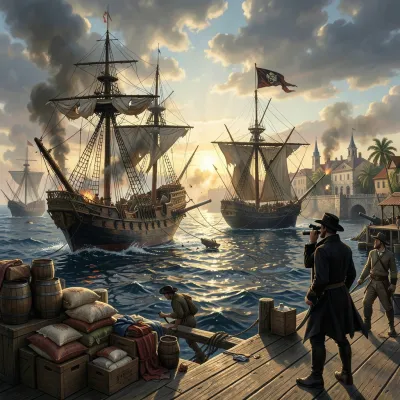
"Pirates, Privateers, and Maritime Trade in the Early Americas" examines the evolution of Atlantic economies from 1500 to 1800, arguing that maritime violence and illicit exchange were foundational to the development of global capitalism. The book details how the rigid mercantilist monopolies of European empires—particularly Spain's silver fleets and convoy systems—unintentionally created lucrative gray markets. By analyzing the legal distinctions between state-sanctioned privateering and criminal piracy, the text shows how "letters of marque" and admiralty courts transformed predation into a regulated commercial instrument that sustained colonial ports from Seville to Port Royal.
The narrative explores the vital roles played by specific maritime hubs, such as Nassau, Havana, and Curacao, which functioned as brokers for both legal and contraband goods. It highlights the diverse social networks required to sustain these economies, foregrounding the contributions of women as shore-based managers, the specialized skills of Indigenous and African pilots, and the brutal "factory of possibility" represented by the slave ship economy. Through the lens of maritime archaeology, the book connects the material evidence of shipwrecks—such as mismatched armaments and cosmopolitan cargoes—to the paperwork of insurance and credit that linked shipboard risk to European capital.
As the era of Atlantic revolutions emerged, the book illustrates how traditional piratical tactics were repurposed for political resistance and how neutral ports became essential pressure valves for empires under strain. Ultimately, the work argues that the legacies of this era did not vanish with the age of sail but were absorbed into the institutional memory of modern trade. The practices of managing risk, leveraging information, and navigating the porous boundaries between legality and expediency remain embedded in the structures of contemporary international commerce and maritime law.
What You'll Find Inside:
- Pirates, privateers, smugglers, and legitimate traders operated in interconnected networks where legal categories were fluid and often depended on paperwork, port of entry, and perspective rather than clear behavioral differences.
- The Spanish convoy system designed to protect treasure fleets created predictable targets that paradoxically stimulated illicit trade, insurance innovations, and naval tactical adaptations throughout the Atlantic world.
- Port cities functioned as crucial brokers where legal and illegal trade coexisted, with officials often tolerating or participating in gray market activities that kept imperial economies functioning despite formal restrictions.
- Maritime archaeology combined with port records and personal accounts reveals how ships' cargoes, armament, and routes frequently deviated from official manifests, demonstrating the pervasive nature of smuggling, contraband, and illicit exchange.
- Women, Indigenous pilots, and African seafarers formed essential shore-based and maritime networks that facilitated trade, provided critical knowledge, and sustained Atlantic commerce through credit provision, information sharing, and household economies that operated alongside formal institutions.
Who's It For:
This book is primarily intended for students and scholars of Atlantic history, maritime history, and early modern economic history. It will be particularly valuable for researchers studying piracy, privateering, smuggling, and the development of capitalism, insurance markets, and financial institutions in the 16th-18th centuries. Graduate students and advanced undergraduates in history, economics, or related fields focusing on colonialism, imperial competition, and the role of marginalized groups (women, Indigenous peoples, Africans) in historical economies will find the multidisciplinary approach combining archaeology, port records, and narrative accounts especially instructive.
Table of Contents:
- Introduction
- Chapter 1 Charting the Atlantic World, 1500–1800
- Chapter 2 Empire, Mercantilism, and the Law of the Sea
- Chapter 3 Letters of Marque: The Legal Edge of Violence
- Chapter 4 Spanish Treasure, Convoys, and the Birth of Opportunity
- Chapter 5 Buccaneers of the Spanish Main: From Tortuga to Port Royal
- Chapter 6 Dutch and French Freebooters in an Iberian Ocean
- Chapter 7 Port Cities as Brokers: Seville, Cádiz, and the Caribbean Gateways
- Chapter 8 Smugglers, Factors, and the Gray Market
- Chapter 9 The Slave Ship Economy and Maritime Coercion
- Chapter 10 New England and the North Atlantic Illicit Trade
- Chapter 11 Logwood, Silver, and the Contraband Frontiers
- Chapter 12 The West India Companies and Chartered Violence
- Chapter 13 War, Peace, and the Piracy Cycle, 1650–1715
- Chapter 14 The Golden Age in Context: Nassau, New Providence, and Beyond
- Chapter 15 Admiralty Courts, Insurance, and Prize Taking
- Chapter 16 Women, Households, and Shore-Based Networks
- Chapter 17 Indigenous Seafaring, Pilots, and Coastal Knowledge
- Chapter 18 Technologies of Pursuit: Hulls, Rigging, and Small Arms
- Chapter 19 Wrecks and Evidence: Maritime Archaeology of Piracy
- Chapter 20 Cartagena, Havana, Veracruz: Defenses and Vulnerabilities
- Chapter 21 Spanish America’s Internal Markets and External Leakages
- Chapter 22 Faith, Reputation, and the Culture of the Sea
- Chapter 23 After Utrecht: Privateers, Asientos, and New Empires
- Chapter 24 Revolutions, Neutral Ports, and the End of an Era
- Chapter 25 Legacies of Illicit Exchange in Atlantic Capitalism
Author:
Published By:
Date Published:
May 5, 2026
Type:
Nonfiction
Language:
English
Word Count:
65,877 words
Reading Time:
4 hours 37 minutes
Sample:
MixCache.com Total Access
Get unlimited access to this book + all books published by MixCache.com for $11.99/month
Subscribe to MTAOr purchase this book individually below
Order:
Buy the Pirates, Privateers, and Maritime Trade in the Early Americas ebook on MixCache.com:
Buy Now
Full ebook will be available immediately
- read online or download as a PDF file.
$5 account credit for all new MixCache.com accounts, usable toward any ebook purchase!*






Ratings & Reviews
Ask Questions About This Book
Have a question about the content? Ask our AI assistant!
Start by asking a question about "Pirates, Privateers, and Maritime Trade in the Early Americas"
Example: "Does this book mention William Shakespeare?"
Thinking...