
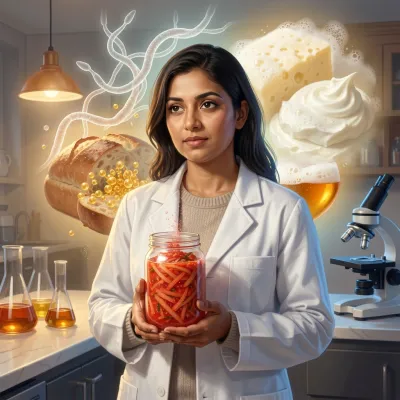
Fermentation often feels like kitchen magic — cabbage turns tangy, milk thickens into yogurt, grape juice becomes wine — but Anthony Stone's The Science of Fermented Foods replaces wonder with understanding without diminishing the marvel. The book maps the invisible collaborations between bacteria, yeasts, and molds that have shaped human diets for millennia, showing how each transformation rests on reproducible biochemistry rather than luck. For anyone who has ever watched a jar bubble and wondered exactly who is doing what, this volume offers a clear, systematic answer.
What the book is about
Stone structures the work as a progressive curriculum, moving from first principles to cutting-edge applications across 25 chapters. The opening sections define fermentation as a "microbial symphony" and introduce the primary actors — lactic acid bacteria, yeasts, acetic acid bacteria, and molds — before walking through the core biochemical pathways: glycolysis, homolactic and heterolactic fermentation, alcoholic fermentation, acetic acid fermentation, and less common routes like alkaline and propionic acid fermentations. Chapters 8–13 cover the enabling machinery: enzymes, flavor formation, nutritional enhancement, preservation mechanisms, starter cultures, and environmental controls (temperature, pH, oxygen). The middle third surveys major food categories — vegetables, dairy, grains, legumes and soy, beverages, meat and fish — detailing the microbial ecology and sensory development of each. Later chapters address scaling from kitchen to factory, gut microbiome interactions, emerging trends such as plant-based alternatives and waste valorization, and the creative dimension of blending science with experimentation. The tone remains accessible but uncompromising: Stone writes for "anyone with a curious mind and an appetite for knowledge — whether you are a home cook eager to master the art of sourdough, a seasoned food professional seeking a deeper understanding of your craft, a health enthusiast interested in the benefits of fermented foods, or simply fascinated by the unseen world that shapes our sustenance."
The microbial symphony as organizing metaphor
Stone returns repeatedly to the orchestra analogy introduced in Chapter 1: "In the world of fermented foods, the various microbes act as these different sections, playing their parts in a 'microbial symphony.' Lactic acid bacteria might be the violins, producing the tangy notes in yogurt, while yeasts could be the trumpets, providing the effervescence in bread or beer. Molds might offer the deeper, richer tones, as seen in aged cheeses." This metaphor does more than decorate; it structures how the book presents microbial succession. In sauerkraut, for instance, Leuconostoc mesenteroides (a heterofermenter) opens the piece, producing lactic acid, acetic acid, and carbon dioxide, before Lactobacillus plantarum and L. brevis take over as acidity rises. In kefir, a "symbiotic culture of bacteria and yeast" (SCOBY) functions as a standing ensemble where "the byproducts of one organism's metabolism become the food source for another." The image helps readers grasp why defined starters yield consistency while spontaneous ferments offer variability — each is a different approach to conducting the same players.
Biochemistry as the backstage crew
Chapters 3 through 7 make the case that you cannot predict or troubleshoot fermentation without grasping the underlying energy metabolism. Stone walks through glycolysis as "the first universal step in breaking down glucose" and explains how the fate of pyruvate — whether it becomes lactate, ethanol, acetaldehyde, or something else — depends on the microbe's enzymatic toolkit and the redox balance of the cell. He distinguishes homolactic fermenters ("almost 100% of the glucose is converted into lactic acid") from heterolactic ones that also yield ethanol and CO2, and shows why that difference matters for texture and flavor: the carbon dioxide from heterolactic bacteria "can also contribute to the characteristic effervescence found in some fermented beverages and the desirable gas pockets in certain fermented foods." The acetic acid chapter clarifies why vinegar production is a two-stage relay — yeast makes ethanol, then obligate aerobic Acetobacter oxidize it — and why oxygen management is the switch between alcohol and vinegar. Even niche pathways get their due: propionic acid fermentation creates the eyes and nutty flavor of Swiss cheese via the Wood-Werkman cycle, while Bacillus subtilis var. natto drives an alkaline fermentation that releases ammonia and poly-gamma-glutamic acid, yielding natto's signature slime and pungency.
Category deep dives reveal pattern and variation
The food-specific chapters (14–19) demonstrate how the same biochemical toolkit produces wildly different results depending on substrate, salt, temperature, and microbial cast. In vegetables, salt draws out brine to create anaerobiosis and selects for halotolerant lactic acid bacteria; Stone notes that "the ideal salt concentration varies by recipe and vegetable, but typically ranges from 1.5% to 3% of the total weight of vegetables and water." Dairy ferments hinge on the symbiotic pair Streptococcus thermophilus and Lactobacillus delbrueckii subsp. bulgaricus, whose cross-feeding — formic acid and peptides — accelerates acidification and curd formation. Grain ferments showcase the prerequisite step of saccharification: malted barley's amylases or koji mold's enzymatic arsenal must unlock starch before yeast can ferment. Legume chapters contrast tempeh's Rhizopus mycelial binding, miso's koji-driven enzymatic predigestion followed by salt-tolerant bacteria and yeasts, and natto's alkaline Bacillus fermentation. Meat and fish ferments add curing agents — salt, nitrites — and often rely on coagulase-negative staphylococci for nitrate reduction, catalase activity, and flavor development alongside lactic acid bacteria. Each chapter closes with a "Key Microbial Contributions" summary that reinforces the pattern: substrate dictates which microbial specialists get invited, and environmental controls determine which stay.
Safety by design: hurdles, not hopes
Chapters 20, 21, and 13 reframe safety as an engineering problem rather than a gamble. Stone introduces the hurdle concept: "food safety is achieved by combining several inhibitory factors — multiple 'hurdles' — that individually might not be sufficient but collectively prevent the growth of pathogens and spoilage organisms." The primary hurdles are low pH (target <4.6 to block Clostridium botulinum), reduced water activity via salt or drying, alcohol, oxygen exclusion for anaerobic ferments, competitive exclusion by vigorous starters, and temperature control. He is explicit about sensory red flags: "Putrid, sulfuric (rotten egg), rancid, ammonia-like, strong solventy, or distinctly unpleasant smells are clear indicators of spoilage," while fuzzy surface molds on vegetable ferments usually signal oxygen exposure and warrant discarding. The chapter on spoilage versus desired fermentation draws a sharp line: "Desired fermentation is a carefully orchestrated microbial process, steered by specific microorganisms under controlled conditions to create products that are safe, palatable, and often enhanced in flavor and nutrition. Spoilage is simply fermentation gone rogue." This framework gives readers a diagnostic checklist — measure pH, verify anaerobiosis, confirm starter vigor — rather than relying on hope.
From kitchen to bioreactor and beyond
The final quarter of the book lifts the lens from individual jars to systems-level thinking. Chapter 22 details the engineering leap to industrial scale: heat removal via cooling jackets, mixing to prevent gradients, sterile air sparging for aerobic processes, and automated pH, dissolved-oxygen, and temperature feedback loops. Downstream steps — centrifugation, pasteurization, aseptic filling — determine whether live cultures reach the consumer. Chapter 23 connects fermented foods to the gut microbiome, distinguishing probiotic delivery (live microbes that "transiently survive the harsh acidic environment") from postbiotic contributions (SCFAs, bioactive peptides, vitamins, enzymes) that persist even after pasteurization. Chapter 24 surveys emerging trends: precision fermentation of animal proteins in microbes, non-Saccharomyces yeasts for novel beverage profiles, waste valorization (brewery spent grain, whey, fruit pomace), AI-driven process optimization, and the prospect of microbiome-personalized ferments. The closing chapter frames fermentation as "a dynamic interplay between microbial biochemistry and human ingenuity," where scientific literacy enables creative risk-taking — adjusting proofing temperature to shift acetic versus lactic balance, blending koji principles with new grains, or embracing spontaneous diversity for flavor nuance. Stone positions the fermenter as both scientist and artist: "The tools are scientific, but the vision is artistic, and the resulting creations are nothing short of culinary magic."
Who should read this
Home fermenters who want to move beyond recipe-following into informed experimentation will find the biochemical explanations and environmental control chapters immediately applicable. Culinary professionals and food-science students gain a consolidated reference that links microbial taxonomy to sensory outcomes across every major fermented category. Health-focused readers receive a nuanced, evidence-based discussion of probiotic, postbiotic, and prebiotic mechanisms without hype. Readers seeking a light narrative or purely historical survey may find the density of metabolic pathways and process parameters heavier than expected; this is a working textbook as much as a popular science book. For its intended audience — curious practitioners willing to engage with the science — The Science of Fermented Foods delivers a thorough, well-organized foundation that turns microbial mystery into a set of adjustable levers.
Read “The Science of Fermented Foods” on MixCache.com →
Please log in or create an account to leave a comment.
No comments yet. Be the first to say something.