
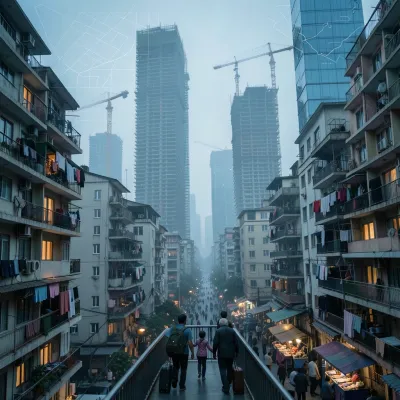
The alley is so narrow that two people cannot walk abreast. On either side, six-story brick towers lean toward each other, their balconies nearly kissing, their windows close enough for neighbors to pass a phone charger or a plate of dumplings without stepping outside. This is a handshake building, the signature architecture of China's urban villages, where the distance between private lives has been compressed to arm's length.
Islands in the Urban Sea
The phenomenon began when China's megacities exploded outward in the 1990s and 2000s, swallowing surrounding farmland. Rather than immediately requisitioning every village in their path, local governments often drew new administrative boundaries around existing rural settlements, allowing the original residents to keep their collective land rights. Overnight, farming hamlets became islands of rural jurisdiction floating in a sea of urban development. The villagers found themselves sitting on suddenly precious real estate, surrounded by factories, highways, and millions of incoming migrant workers desperate for cheap shelter.
The economic logic was ruthless and immediate. With no access to formal credit or urban construction permits, farmers began adding floors to their own homes, then building new structures in their courtyards, maximizing every square meter of their land. A single-story courtyard house became a six-story rental block. Alleyways that once accommodated ox carts shrank to drainage channels. The result was a hyper-dense, self-built cityscape that defied every planning code — structures bolted together without engineers, plumbing improvised from blue plastic pipe, electrical wires bundled like vines along exterior walls.
The Landlord Class
By the mid-2000s, many village collectives had transformed into de facto property companies. In larger villages, the rental income funded community centers, pensions for elders, and even dividend payments to registered members. Individual households with prime frontage on wider lanes became mini-tycoons, managing dozens of units through WeChat groups. The landlords were not absentee investors; they lived upstairs from their tenants, sharing stairwells and water tanks, negotiating rent in the same dialect they used to haggle over vegetables.
For the migrants — factory hands, delivery riders, construction crews, nannies — these villages offered the only viable foothold. A room in a handshake building cost a fraction of formal housing, required no deposit, and came with a month-to-month flexibility that matched precarious work. The trade-offs were visible: windows that opened onto a neighbor's kitchen, bathrooms shared by four families, the constant hum of extractor fans and mahjong tiles. But the location was unbeatable — walking distance to industrial parks, subway stations, wholesale markets. The village was not a slum in the traditional sense; it was a machine for keeping the city's labor costs low and its service economy running.
Life at Arm's Length
Inside the handshake zones, a distinct urban culture evolved. Ground floors became commercial arteries: Sichuan hot-pot stalls, phone-repair booths, unlicensed clinics, mahjong parlors, remittance counters. Hometown associations from Hunan, Sichuan, Henan organized festivals, settled disputes, pooled money for medical emergencies. Children did homework on shared balconies while grandparents hung laundry on lines strung between buildings. The density forced a intimacy that modern apartment complexes are designed to prevent — neighbors knew each other's shift schedules, wage arrears, family dramas.
Yet the informality carried risks. Fires spread fast in the tinder-dry timber and cluttered corridors. Building collapses, though rare, made headlines. Sanitation strained under population densities that sometimes exceeded 1,000 people per hectare. The villages existed in a legal twilight: the land was collectively owned, the structures were technically illegal, the tenants had no lease protection. When a city decided to redevelop, the clearance could be swift and brutal.
The Reckoning
As land values soared, the villages became targets for "urban renewal." Developers offered compensation to village collectives, often enough to make every registered villager a millionaire on paper. But the migrant tenants — the people who actually filled the rooms — received nothing. They were simply displaced, pushing farther to the urban fringe, lengthening commutes, crowding into the next ring of handshake buildings. Some cities experimented with upgrading instead of demolition: widening fire lanes, installing proper sewage, granting limited legal status to the rental stock. These pilots showed promise but remained exceptions. The dominant model remained clearance and high-rise replacement, erasing the handshake fabric block by block.
The handshake buildings did not disappear because they failed. They disappeared because they succeeded too well at solving a problem the formal city refused to acknowledge: how to house a floating population of 200 million people without subsidizing them. The villages were the city's shadow housing policy, built by farmers, managed by villagers, inhabited by the workers who assembled the skyline. Their architecture — precarious, intimate, wildly improvisational — was a physical manifestation of a migration system that treated people as temporary inputs rather than permanent residents.
Today, in the few surviving villages, the handshake buildings still stand, their alleyways still narrow, their balconies still close enough for a shouted conversation or a passed bag of groceries. They remain a reminder that the megacity's gleaming towers rest on a foundation of informal ingenuity, and that the distance between the planned city and the lived city can be measured in outstretched arms.
This is one episode in a much longer story. For the full account of China's urban villages and informal housing, read “Cities of Change: Urbanization and Megacities in China” by Laura Allen on MixCache.com.
Please log in or create an account to leave a comment.
No comments yet. Be the first to say something.