
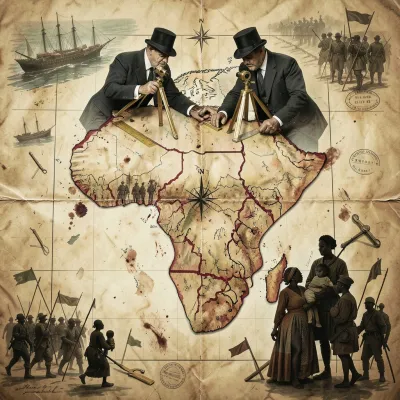
The following is an excerpt from “Scramble and Partition: European Colonialism and the Making of Modern Africa” by Alan Allen, available on MixCache.com.
Introduction
This book examines how Europe’s scramble for Africa between 1870 and 1960 produced the political geographies and social hierarchies that shape the continent to this day. It does so by holding three lenses together: diplomacy, violence, and cartography. Treaties and conferences set the terms of expansion, armies and armed columns enforced those terms on the ground, and maps translated ambition into borders that still organize economies and identities. By following these intertwined processes, we move beyond moral outrage or triumphalist myth, toward a historically grounded account of how empires were made and how their architectures endured.
In 1870, European states stood at a conjuncture of industrial might, strategic rivalry, and ideological confidence, while African polities—from centralized kingdoms to confederations and merchant towns—pursued their own projects of statecraft, trade, and reform. The “scramble” that followed was neither inevitable nor uniform. It unfolded through contingent crises, entrepreneurial adventurers, missionary networks, and calculations made in foreign ministries as much as on caravan routes and river steamers. Understanding that multiplicity is essential: Africa was not a void to be filled but a crowded political landscape into which European powers forced themselves.
Diplomacy provided the first grammar of conquest. The Berlin Conference of 1884–85 did not partition the continent by fiat, but it codified principles—especially “effective occupation”—that favored rapid flag-planting and paper claims. Bilateral treaties, protectorate proclamations, and boundary commissions multiplied. The book traces how these instruments were drafted, disputed, and enforced, and how African leaders sought to use the diplomacy of the day—petitioning, negotiating, or playing rivals off one another—to defend autonomy or win advantage. On parchment and in protocol, sovereignty was redefined in ways that narrowed the space for African authority.
Yet paperwork without power was brittle. European expansion hinged on campaigns that combined new weapons with old tactics: sieges, scorched earth, punitive expeditions, and the taking of hostages. Violence also had quotidian forms—forced labor, coercive taxation, compulsory cultivation, and the criminalization of mobility. Commercial corporations and concessionary companies blurred private interest and public authority, while humanitarian campaigns exposed abuses even as they legitimated deeper intervention. The Congo Free State crystallized these contradictions, but they were not unique to it.
Once established, colonial states sought to stabilize domination by governing through law, information, and infrastructure. Administrators reclassified peoples and spaces, freezing “custom” into codes and appointing “traditional” authorities who were answerable upward as much as downward. Censuses, ethnographies, and maps produced the subjects they claimed merely to describe. Railways, telegraphs, and ports knit hinterlands to imperial markets, while health services and agricultural research targeted productivity and control as much as welfare. The extractive state thus rested on ledger books as surely as on barracks.
Borders were the most consequential artifacts of this order. Drawn quickly and often arbitrarily, they bisected trade routes, pastoral ranges, and kin networks, while aggregating diverse communities under single administrations. Colonial frontiers hardened into international boundaries that complicated postcolonial diplomacy and internal politics. This book explores how such lines were surveyed and enforced, how people navigated, exploited, or defied them, and how partition shaped patterns of conflict and cooperation that outlived empire.
Global shocks reconfigured colonialism from within. During the First World War, African soldiers and porters fought and labored on multiple fronts, and the postwar mandate system introduced new vocabularies of oversight and development without surrendering extraction. The Great Depression exposed the fragility of commodity economies and provoked protest. The Second World War mobilized unprecedented resources and expectations, catalyzing labor movements, intellectual networks, and veterans’ organizations that demanded citizenship and self-rule. By the late 1940s and 1950s, empire faced both fiscal constraints and political insurgency.
Decolonization, however, was not a single event but a crowded field of negotiations, boycotts, strikes, and wars, refracted through Cold War geopolitics and African regional solidarities. Between 1957 and 1960, a wave of independences inaugurated sovereign governments that inherited not only flags and anthems but also administrative blueprints, commodity dependencies, and the cartographic inheritance of partition. Early postcolonial crises, from constitutional deadlocks to secessionist bids, made clear that the end of empire did not end its structures.
Methodologically, the chapters that follow braid diplomatic correspondence, military reports, company archives, missionary records, maps, and oral histories. The aim is comparative without being flattening: regional case studies—from the Congo Basin to the Maghreb, from the Sahel to East and Southern Africa—highlight diversity in the making of colonial states while tracing recurring logics of rule. Where possible, the book foregrounds African strategies and ideas, recovering choices made under constraint and visions of community that exceeded imperial categories.
Readers will find the narrative organized in arcs. The opening chapters situate the late nineteenth-century conjuncture and the diplomatic frameworks that authorized expansion. The middle sections examine conquest, corporate rule, and the construction of extractive administrations, alongside the social worlds—urban and rural, religious and secular—that colonialism reshaped. Subsequent chapters track the pressures of world wars and depression, the growth of mass politics, and the unsteady path to independence. The concluding chapters reflect on borders and institutions as enduring infrastructures, asking how the scramble’s partitions continue to shape the possibilities and dilemmas of modern Africa.
The title, Scramble and Partition, signals the book’s central contention: that European colonialism was at once a frantic race for advantage and a deliberate carving of territorial order, achieved through the fusion of diplomacy, violence, and mapmaking. Its subtitle—Diplomacy, Violence, and the Cartography of Empire, 1870–1960—marks the temporal scope and analytical frame. By tracing how arbitrary borders and extractive policies were made and maintained, the book seeks not merely to recount a past but to illuminate the institutional and spatial inheritances that still structure public life across the continent today.
Please log in or create an account to leave a comment.
No comments yet. Be the first to say something.