
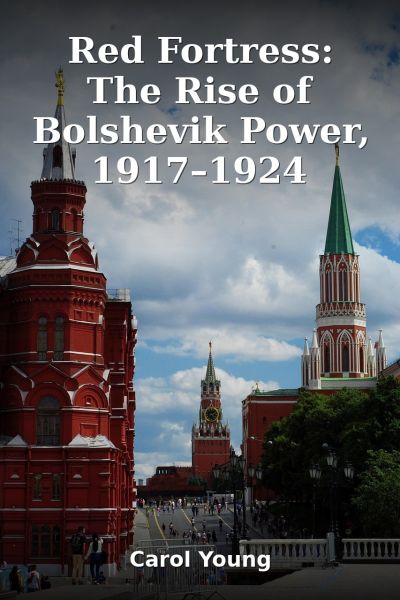
The following is an excerpt from “Red Fortress: The Rise of Bolshevik Power, 1917–1924” by Carol Young, available on MixCache.com.
Introduction
This book tells the story of how a revolutionary party, propelled by crisis and conviction, built a new kind of state in the crucible of war. Between 1917 and 1924, the Bolsheviks transformed a collapsing empire into a centralized socialist polity that would dominate the twentieth century’s geopolitics and define its debates about power, ideology, and violence. Red Fortress traces that passage from seizure to consolidation, showing how Lenin’s leadership, War Communism, and a grinding civil war forged the core institutions and habits of rule that endured long after the guns fell silent.
The narrative is concise by design and source-aware by necessity. It follows the political decision-making of the Bolshevik leadership while keeping sight of the institutional machinery that made decisions operative: Sovnarkom’s decrees, the party’s organs, the Cheka and successor bodies, the Red Army, and the local soviets that mediated power on the ground. Along the way, it draws on party minutes, decrees, correspondence, memoirs, and contemporary journalism, as well as provincial reports where they illuminate how policies were interpreted outside Petrograd and Moscow. These sources are partial and often partisan; the book treats them critically, reading against the grain and setting testimony beside practice to reconstruct what officials intended, what they could actually do, and what they felt compelled to do.
At the core of the argument lies the interaction between ideological aspiration and the pressures of survival. The Bolsheviks believed they were inaugurating a new social order, yet the choices they made between 1917 and 1921—closing the Constituent Assembly, empowering extraordinary organs of repression, requisitioning grain, militarizing labor—were not simply matters of doctrine. They were also responses to the fragility of power amid invasion, sabotage, and revolt. War Communism was both a creed and a coping strategy, and its legacies outlasted its formal repeal: even as markets reappeared under the New Economic Policy, the party’s monopoly on politics and its readiness to use coercion had become constitutive features of the regime.
Civil war made the state. The Red Army’s emergence under Trotsky professionalized coercion; the Cheka’s spread normalized emergency methods; and the party’s reach into factories, villages, and the barracks created new channels of supervision and reward. At the peripheries—from Ukraine to the Caucasus—the center’s policies met rival sovereignties and national aspirations, prompting a blend of accommodation and force that culminated in a federal union whose promise of autonomy was bounded by central control. In this contested terrain, the Bolsheviks learned the practices of rule that later generations would inherit: mobilization by decree, bargaining with local cadres, and the routine subordination of law to revolutionary expediency.
The period after 1921 did not end the revolution; it institutionalized it. NEP loosened economic strictures while tightening political discipline. The ban on factions, the rise of the Secretariat, and the routinization of cadre policy narrowed the space for internal dissent even as the leadership sought to stabilize society. The Comintern’s creation projected the revolution outward, but domestic consolidation remained paramount. Lenin’s final years, marked by illness and unfinished warnings about the apparatus, revealed a state that had grown beyond any single leader’s grasp. Structures and procedures—some improvised in crisis—had become the architecture of governance.
This is, therefore, a study of formation more than of outcomes. It stops in 1924 not because the story of Soviet power ends with Lenin’s death, but because by then the essential grammar of that power had been written. Later terrors, plans, and wars would elaborate a syntax already in place. The chapters that follow proceed chronologically with thematic pauses, anchoring major decisions in their immediate contexts while tracing how those decisions accumulated into institutions.
Finally, a caution against inevitability. Nothing in 1917 predetermined the particular state that emerged by 1924. The Bolsheviks made choices within constraints, and their opponents did too. Violence bred counterviolence; scarcity enabled command; ideology sharpened, but did not alone dictate, policy. To read these years as the roots of later authoritarianism is not to deny contingency, but to recognize how a specific blend of ideas and emergencies produced a durable system. This book aims to make that blend legible—clearly, compactly, and with due regard for the sources that allow us to see it.
Read “Red Fortress: The Rise of Bolshevik Power, 1917–1924” on MixCache.com →
Please log in or create an account to leave a comment.
No comments yet. Be the first to say something.