
Browse by Category
Fiction
- Action & Adventure
- African American
- Anthologies
- Children's Fiction
- Classics
- Comics & Graphic Novels
- Coming of Age
- Contemporary
- Cultural & Regional
- Drama
- Erotica
- Fantasy
- General
- Historical Fiction
- Horror
- Humor & Satire
- Literary Fiction
- Mystery, Thriller & Suspense
- Poetry
- Religious & Inspirational
- Romance
- Science Fiction
- Short Stories
- War & Military
- Westerns
- Women's Fiction
- Young Adult
Non-Fiction
- Antiques & Collectibles
- Arts & Photography
- Biographies & Memoirs
- Business & Money
- Children's Non-Fiction
-
Computers & Technology
- Artificial Intelligence
- Computer Science
- Cybersecurity & Cryptography
- Data Science & Analytics
- Databases & Big Data
- Game Development & Design
- General
- Hardware & DIY
- Mobile App Development
- Networking & Cloud Computing
- Operating Systems
- Programming
- Robotics
- Software
- Software Engineering
- User Experience (UX) & Design
- Web Development & Design
- Cooking, Food & Wine
- Crafts, Hobbies & Home
- Education & Teaching
- Engineering
- General
- Health, Fitness & Dieting
-
History
- African History
- African History - North Africa
- African History - Sub-Saharan Africa
- American History
- American History - 20th Century
- American History - Civil War
- American History - Colonial Period
- Ancient History
- Asian History
- Asian History - China
- Asian History - India
- Asian History - Japan
- Asian History - Southeast Asia
- European History
- European History - Ancient Greece
- European History - Ancient Rome
- European History - Medieval
- European History - Modern
- European History - Renaissance
- General
- Middle Eastern History
- Military History
- Military History - Aviation
- Military History - Naval
- Social & Cultural History
- World History
- Humor & Entertainment
- Industrial Technology
- Language Learning
- Law
- LGBTQ+ Non-Fiction
- Literary Criticism
- Medical Books
- Parenting & Relationships
- Philosophy
- Politics & Social Sciences
- Reference
- Religion & Spirituality
-
Science & Math
- Agricultural Sciences
- Astronomy & Space Science
- Behavioral Sciences
- Biological Sciences
- Botany & Plant Science
- Chemistry
- Earth Sciences
- Engineering - Chemical
- Engineering - Civil
- Engineering - Electrical
- Engineering - Mechanical
- Environment
- General
- Geology
- Mathematics
- Nature & Ecology
- Oceanography
- Paleontology
- Physics
- Statistics
- Self-Help
- Sports & Outdoors
- Study Aids
- Sustainability & Green Living
- Textbooks
- Transportation
- Travel
- True Crime
- Urban Planning & Development
- Veterinary Medicine
- Writing & Publishing
Jump to Section
MixCache.com Total Access
Unlimited reading and audiobooks for every book published by MixCache.com.
Included titles carry the MTA badge.
Learn more →
Red Fortress: The Rise of Bolshevik Power, 1917–1924
MTA
How Lenin, War Communism, and Civil War Built the Soviet State
About this book:
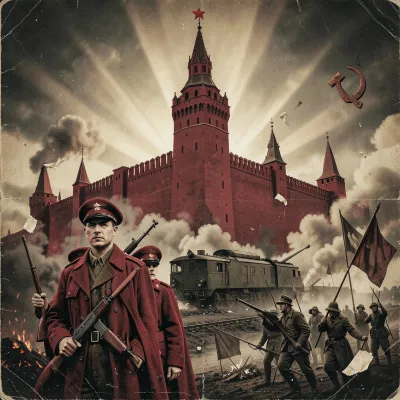
*Red Fortress: The Rise of Bolshevik Power, 1917–1924* provides a concise history of the transformation of the Russian Empire into a centralized socialist state. The book begins with the collapse of the Romanov dynasty in February 1917 and the ensuing period of "dual power" between the Provisional Government and the Petrograd Soviet. It highlights Vladimir Lenin’s pivotal return in April, where his radical "April Theses" redirected the Bolshevik Party toward a singular goal: the seizure of power in the name of the soviets. This ideological shift culminated in the October Revolution, a systematically executed coup that replaced the faltering Provisional Government with a new Bolshevik-led executive, Sovnarkom.
The narrative details how the Bolsheviks consolidated authority through strategic decrees on peace and land, which addressed the immediate grievances of a war-weary population. However, the survival of the regime necessitated a turn toward authoritarianism. The book explores the dissolution of the democratically elected Constituent Assembly and the creation of the Cheka, a secret police force that institutionalized state coercion. The crucible of the Russian Civil War further hardened the state, as Leon Trotsky forged the Red Army into a disciplined fighting force and the party implemented "War Communism," a militarized economic system of grain requisitioning and centralized control to sustain the cities and the front.
By 1921, the regime faced an existential crisis as famine and internal revolts, such as the Kronstadt uprising, signaled the limits of War Communism. In response, Lenin orchestrated a "tactical retreat" known as the New Economic Policy (NEP), which reintroduced limited market mechanisms to stabilize the economy. Simultaneously, the party tightened its political grip by banning internal factions and centralizing power within the Secretariat and Politburo. This period saw the formal founding of the USSR, establishing a federal structure that offered cultural autonomy to various nationalities while maintaining absolute political control from Moscow.
The book concludes with Lenin’s final years and the looming question of succession. As Lenin’s health declined, he warned against the growing bureaucracy and the personal ambitions of leaders like Joseph Stalin. Ultimately, the book argues that by the time of Lenin’s death in 1924, the essential "grammar" of Soviet power had been established. The Bolsheviks had successfully transitioned from a revolutionary vanguard into a permanent governing apparatus, creating a durable, one-party state built on a blend of ideological conviction, institutionalized surveillance, and the pragmatic use of force.
What You'll Find Inside:
- How Lenin's leadership and the April Theses provided the ideological roadmap for Bolshevik seizure of power, transforming revolutionary aspiration into concrete action.
- How War Communism and the Red Terror emerged as both ideological commitments and emergency responses to civil war, creating lasting institutions of repression and control.
- How the Bolsheviks built the Red Army under Trotsky, transforming a revolutionary militia into a professional fighting force that became central to state power.
- How crises like the Kronstadt and Tambov rebellions forced the New Economic Policy as a tactical retreat, revealing the limits of ideological purity in governance.
- How the Bolsheviks constructed the USSR as a federal union that maintained central control while accommodating nationalities through policies like korenizatsiia.
Who's It For:
This book is ideal for students and scholars of modern Russian history, revolutionary movements, and 20th-century political systems who want to understand how the Bolsheviks transformed from a revolutionary party into the ruling power of the Soviet state. It will particularly benefit readers interested in the interplay between ideology and pragmatism in revolutionary governance, the institutionalization of terror and party discipline, and the formation of Soviet federalism. General readers with a strong interest in the Russian Revolution and early Soviet history will also find the narrative accessible and informative.
Table of Contents:
- Introduction
- Chapter 1 Collapse and Dual Power: February–March 1917
- Chapter 2 Lenin Returns: The April Theses
- Chapter 3 The July Days and a Party on the Defensive
- Chapter 4 The Kornilov Affair and Bolshevik Momentum
- Chapter 5 October 1917: Seizing the Capital
- Chapter 6 Decrees on Peace and Land: Recasting Authority
- Chapter 7 Building Sovnarkom and the Cheka
- Chapter 8 The Constituent Assembly and One-Party Rule
- Chapter 9 Brest-Litovsk: Peace at a Price
- Chapter 10 The Red Terror and the Opening of Civil War
- Chapter 11 Trotsky and the Making of the Red Army
- Chapter 12 War Communism: Economy under Siege
- Chapter 13 Fronts and Peripheries: Ukraine, the Baltic, and the Caucasus
- Chapter 14 Nationalities and the RSFSR: Autonomy under Central Control
- Chapter 15 Church, Culture, and the Revolutionary State
- Chapter 16 Famine and Relief, 1921–1922
- Chapter 17 Kronstadt and Tambov: Revolt against the Regime
- Chapter 18 The New Economic Policy: Tactical Retreat
- Chapter 19 Party Discipline and the Ban on Factions
- Chapter 20 From Party to State: Secretariat, Politburo, and Control
- Chapter 21 The Comintern and the Promise of World Revolution
- Chapter 22 Revolutionary Legality: Law, Courts, and the Cheka to GPU
- Chapter 23 Everyday Dictatorship: Surveillance and the Local State
- Chapter 24 Founding the USSR, 1922–1924
- Chapter 25 Lenin’s Last Struggle and the Succession Question
Author:
Published By:
Date Published:
May 2, 2026
Type:
Nonfiction
Language:
English
Word Count:
62,173 words
Reading Time:
4 hours 21 minutes
Sample:
MixCache.com Total Access
Get unlimited access to this book + all books published by MixCache.com for $11.99/month
Subscribe to MTAOr purchase this book individually below
Order:
Buy the Red Fortress: The Rise of Bolshevik Power, 1917–1924 ebook on MixCache.com:
Buy Now
Full ebook will be available immediately
- read online or download as a PDF file.
$5 account credit for all new MixCache.com accounts, usable toward any ebook purchase!*



Ratings & Reviews
Ask Questions About This Book
Have a question about the content? Ask our AI assistant!
Start by asking a question about "Red Fortress: The Rise of Bolshevik Power, 1917–1924"
Example: "Does this book mention William Shakespeare?"
Thinking...