
The following is an excerpt from “Hoplites and Phalanxes: Warfare in Ancient Greece” by Kevin Brooks, available on MixCache.com.
Introduction
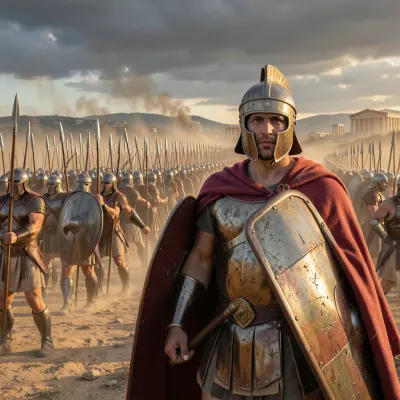
This book explores how Greek citizens, standing shoulder to shoulder in ranks of bronze and wood, turned political belonging into battlefield power. The hoplite—armed with spear and shield, armored in bronze, and fighting in close order—was not simply a military type but a social role, a civic identity performed under arms. By tracing how the phalanx worked in practice and why communities chose to fight this way, we can see warfare not as an isolated craft but as an expression of Greek politics, culture, and economy.
Our focus runs from the Persian Wars in the early fifth century BCE through the rise of Macedon in the fourth, the period when the hoplite phalanx was both emblem and instrument of the city-state. In these generations the Greek world wrestled with imperial ambition, civil strife, and experiment—on the battlefield and in the assembly. The culmination in Macedon under Philip II and Alexander did not erase the hoplite tradition so much as transform it, adapting the logic of massed infantry to new weapons, deeper formations, and coordinated arms.
Understanding the phalanx means getting close to the ground. We will examine how ranks were assembled, how depth and spacing altered shock, why shields overlapped, and what “pushing” really meant when lines collided. Terrain mattered: stony fields, low walls, and gentle slopes shaped choices as surely as courage or drill. So did time. Campaign seasons, harvest cycles, and religious calendars constrained when armies could march and how long they could stay afield. The phalanx was a tactical system, but it was also a schedule and a map.
No less important is the civic frame that made such warfare possible. Hoplites were, in most poleis, property-owning citizens who purchased their own panoply and expected a voice in public life. Decisions to declare war, levy troops, and accept terms were debated in assemblies and councils; honor was counted in trophies and casualty lists; memory was preserved in epitaphs, songs, and painted ceramics. To follow hoplite warfare is to enter a world where law, ritual, and reputation were as decisive as spearpoints.
Our evidence is varied and imperfect. Historians like Herodotus, Thucydides, and Xenophon wrote narratives that mix analysis with rhetoric. Inscriptions record decrees and honors; archaeology gives us shields, spearheads, cuirasses, and the scars of fortifications; art depicts both ideals and conventions. Throughout, this book asks how to read such sources critically: what a vase painter chose to exaggerate, what a general’s memoir elides, and how a later historian reorganizes a messy field into tidy cause and effect.
The chapters move from fundamentals to transformations. We begin with equipment, formation, and drill before turning to logistics, command, and the varied roles of light infantry and cavalry at the edges of hoplite battle. Case studies—from Marathon and Mantinea to Leuctra—anchor analysis in concrete fields and named commanders. We then consider innovations associated with Thebes and Iphicrates, the growth of mercenary service, and the rise of siegecraft, before examining Macedonian reforms: the sarissa-armed phalanx, new depths of formation, and the integration of infantry, cavalry, and missile troops.
Finally, we assess the longer legacy of Greek warfare. The hoplite ideal of the citizen-soldier shaped arguments about freedom and obligation in later republics; the Macedonian synthesis influenced Hellenistic states and confronted Rome, prompting fresh debates over flexibility and shock. Military ideas rarely vanish; they migrate. By placing tactics within the politics and society that sustained them, this book aims to show how a way of fighting helped to define a civilization—and how that civilization, in turn, reimagined the possibilities of war.
Read “Hoplites and Phalanxes: Warfare in Ancient Greece” on MixCache.com →
Please log in or create an account to leave a comment.
No comments yet. Be the first to say something.