
Browse by Category
Fiction
- Action & Adventure
- African American
- Anthologies
- Children's Fiction
- Classics
- Comics & Graphic Novels
- Coming of Age
- Contemporary
- Cultural & Regional
- Drama
- Erotica
- Fantasy
- General
- Historical Fiction
- Horror
- Humor & Satire
- Literary Fiction
- Mystery, Thriller & Suspense
- Poetry
- Religious & Inspirational
- Romance
- Science Fiction
- Short Stories
- War & Military
- Westerns
- Women's Fiction
- Young Adult
Non-Fiction
- Antiques & Collectibles
- Arts & Photography
- Biographies & Memoirs
- Business & Money
- Children's Non-Fiction
-
Computers & Technology
- Artificial Intelligence
- Computer Science
- Cybersecurity & Cryptography
- Data Science & Analytics
- Databases & Big Data
- Game Development & Design
- General
- Hardware & DIY
- Mobile App Development
- Networking & Cloud Computing
- Operating Systems
- Programming
- Robotics
- Software
- Software Engineering
- User Experience (UX) & Design
- Web Development & Design
- Cooking, Food & Wine
- Crafts, Hobbies & Home
- Education & Teaching
- Engineering
- General
- Health, Fitness & Dieting
-
History
- African History
- African History - North Africa
- African History - Sub-Saharan Africa
- American History
- American History - 20th Century
- American History - Civil War
- American History - Colonial Period
- Ancient History
- Asian History
- Asian History - China
- Asian History - India
- Asian History - Japan
- Asian History - Southeast Asia
- European History
- European History - Ancient Greece
- European History - Ancient Rome
- European History - Medieval
- European History - Modern
- European History - Renaissance
- General
- Middle Eastern History
- Military History
- Military History - Aviation
- Military History - Naval
- Social & Cultural History
- World History
- Humor & Entertainment
- Industrial Technology
- Language Learning
- Law
- LGBTQ+ Non-Fiction
- Literary Criticism
- Medical Books
- Parenting & Relationships
- Philosophy
- Politics & Social Sciences
- Reference
- Religion & Spirituality
-
Science & Math
- Agricultural Sciences
- Astronomy & Space Science
- Behavioral Sciences
- Biological Sciences
- Botany & Plant Science
- Chemistry
- Earth Sciences
- Engineering - Chemical
- Engineering - Civil
- Engineering - Electrical
- Engineering - Mechanical
- Environment
- General
- Geology
- Mathematics
- Nature & Ecology
- Oceanography
- Paleontology
- Physics
- Statistics
- Self-Help
- Sports & Outdoors
- Study Aids
- Sustainability & Green Living
- Textbooks
- Transportation
- Travel
- True Crime
- Urban Planning & Development
- Veterinary Medicine
- Writing & Publishing
Jump to Section
MixCache.com Total Access
Unlimited reading and audiobooks for every book published by MixCache.com.
Included titles carry the MTA badge.
Learn more →
Hoplites and Phalanxes: Warfare in Ancient Greece
MTA
Tactics, Politics, and Society from the Persian Wars to Macedon
About this book:
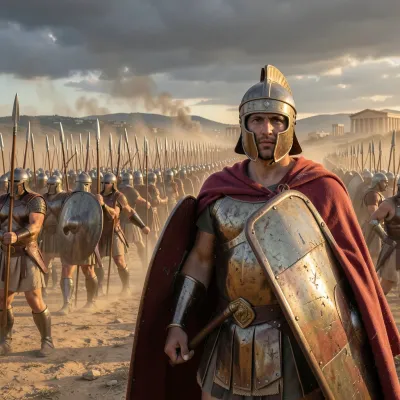
*Hoplites and Phalanxes: Warfare in Ancient Greece* provides a comprehensive analysis of the evolution of Greek military tactics, social structures, and political life from the Persian Wars to the rise of Macedon. The book establishes that the hoplite—a citizen-soldier defined by his bronze panoply and place in the phalanx—was not merely a tactical unit but a reflection of the Greek *polis*. The connection between property ownership, military service, and political rights created a unique civic identity where the shared physical risk of the battle line was inextricably linked to the democratic or oligarchic rights of the assembly.
The text meticulously details the mechanics of the phalanx, exploring equipment like the *aspas* and *dory*, and debating the nature of *othismos* (the collective shove). It traces the progression from the traditional eight-rank formation to the revolutionary tactical innovations of the fourth century. Key figures such as the Athenian Iphicrates, who professionalized light-armed peltasts, and the Theban Epaminondas, who introduced the "oblique order" and the elite Sacred Band to shatter Spartan invincibility at Leuctra, are highlighted as catalysts for the transition from citizen militias to specialized, professional forces.
The book also examines the "ecology" of Greek campaigning, emphasizing the constraints of the agricultural calendar, the logistical challenges of supply and foraging, and the vital roles played by cavalry and light troops. It argues that while the hoplite ideal remained culturally dominant, the protracted attrition of the Peloponnesian War and the increasing use of mercenaries necessitated a shift toward siegecraft, technical expertise, and combined-arms strategies that the traditional city-states struggled to manage.
The narrative culminates with the reforms of Philip II of Macedon, who synthesized these diverse developments into a professional standing army. By introducing the *sarissa* (long pike) and the modular *syntagma* formation, Philip created a military machine that superseded the traditional Greek phalanx, as evidenced by his decisive victory at Chaeronea. The book concludes with Alexander the Great’s global expansion of these tactics, marking the end of the independent city-state and the birth of a professionalized, imperial way of war that transformed the ancient world.
What You'll Find Inside:
- The hoplite phalanx as a civic institution where military service was tied to citizenship and political participation in the Greek polis
- Detailed analysis of hoplite equipment, formation mechanics, and the physics of shield-on-shield combat (othismos)
- Evolution of Greek warfare from the Persian Wars through the Peloponnesian War to Macedonian innovations under Philip II
- The growing importance of light infantry, cavalry, and combined arms tactics alongside traditional hoplite warfare
- How logistics, terrain, and professionalization transformed Greek warfare from citizen militias to standing armies
Who's It For:
This book is ideal for students and scholars of ancient Greek history, military history enthusiasts, and readers interested in the intersection of warfare, politics, and society in the classical world. It will particularly benefit those studying hoplite warfare, the evolution of military tactics, or the relationship between citizenship and military service in ancient Greece.
Table of Contents:
- Introduction
- Chapter 1 The World of the Polis
- Chapter 2 Arming the Citizen: Panoply, Training, and Cost
- Chapter 3 Spears, Shields, and the Mechanics of Shock
- Chapter 4 Making a Phalanx: Formation, Depth, and Spacing
- Chapter 5 Othismos and the Problem of Push
- Chapter 6 Discipline and Drill: From Festival to Front Line
- Chapter 7 Command, Signals, and Tactics on the March
- Chapter 8 The Ecology of Campaigning: Logistics, Foraging, and Supply
- Chapter 9 Battle Without Armor: Peltasts, Archers, and Light Troops
- Chapter 10 Horses at the Edges: Cavalry in a Hoplite World
- Chapter 11 Marathon and the Birth of Confidence
- Chapter 12 Thermopylae to Plataea: Resistance and Retaliation
- Chapter 13 The Peloponnesian War on Land
- Chapter 14 Mantinea 418: Tradition Tested
- Chapter 15 Theban Ascendancy: Leuctra and the Sacred Band
- Chapter 16 Epaminondas and the Oblique Order
- Chapter 17 Iphicrates and the New Peltast
- Chapter 18 Siegecraft and the Fall of the Open Battle
- Chapter 19 Mercenaries, Pay, and the Professional Turn
- Chapter 20 Society in Arms: Politics, Class, and Citizenship
- Chapter 21 Religion, Ritual, and the Moral World of Battle
- Chapter 22 Memory and Meaning: Poetry, Vases, and the War Story
- Chapter 23 Philip II’s Reforms: Sarissa and Syntagma
- Chapter 24 Chaeronea and the End of the City-States’ Way of War
- Chapter 25 From Macedon to the World: Alexander and the Legacy of Greek Warfare
Author:
Published By:
Date Published:
May 12, 2026
Type:
Nonfiction
Language:
English
Word Count:
68,685 words
Reading Time:
4 hours 49 minutes
Sample:
MixCache.com Total Access
Get unlimited access to this book + all books published by MixCache.com for $11.99/month
Subscribe to MTAOr purchase this book individually below
Order:
Buy the Hoplites and Phalanxes: Warfare in Ancient Greece ebook on MixCache.com:
Buy Now
Full ebook will be available immediately
- read online or download as a PDF file.
$5 account credit for all new MixCache.com accounts, usable toward any ebook purchase!*





Ratings & Reviews
Ask Questions About This Book
Have a question about the content? Ask our AI assistant!
Start by asking a question about "Hoplites and Phalanxes: Warfare in Ancient Greece"
Example: "Does this book mention William Shakespeare?"
Thinking...