
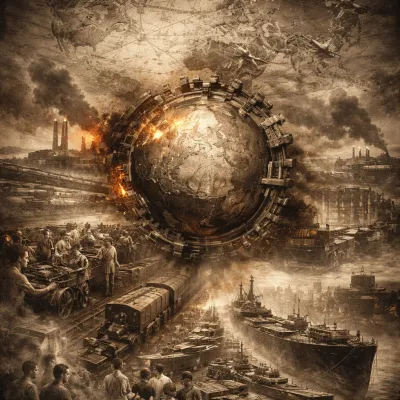
The following is an excerpt from “Global Inferno: Strategy, Technology, and Society in the Second World War” by Bobby Holmes, available on MixCache.com.
Introduction
This book examines the Second World War as a global inferno in which strategy, technology, and society were fused in unprecedented ways. Rather than treating battlefields, laboratories, and factory floors as separate arenas, it argues that they formed a single, interdependent system. Decisions taken in war cabinets reverberated through assembly lines and ration books; innovations in radar, codebreaking, and carrier aviation reshaped what commanders could conceive and attempt; and the perseverance—or collapse—of social fabrics under strain often determined whether bold plans translated into sustainable campaigns.
At the heart of this study is operational art, the connective tissue between grand strategy and tactics. Operational art orchestrates campaigns across time and space: sequencing offensives, coordinating forces across services, and aligning means with political ends. By following operational case studies—from the velocity and shock of Blitzkrieg to the austere choreography of Pacific island-hopping—the chapters show how commanders exploited or misread the technological possibilities and social constraints of their time. Operational brilliance, we will see, was fragile when it outpaced logistics, industrial capacity, or public cohesion.
Technology in this war was not a neutral toolkit but a dynamic partner in shaping options and outcomes. Air defense networks combined radar, plotting rooms, and fighter control in a system-of-systems; submarines and convoy escorts prosecuted a duel of sensors and countermeasures; and scientific breakthroughs, from mass-produced antibiotics to fission weapons, changed the calculus of risk and time. Yet no machine fought alone. Effectiveness depended on training pipelines, doctrinal learning, maintenance regimes, and the willingness of societies to accept costs—whether measured in taxes, hours on the night shift, or lives on distant beaches.
Industrial mobilization transformed national economies into engines of war. That transformation was not merely a matter of output curves; it entailed reconfiguring labor markets, redesigning production lines, and integrating finance, transportation, and procurement into resilient networks. The “arsenal democracies” and their partners leveraged scale, standardization, and lend-lease corridors to convert raw materials into combat power at a tempo the Axis could not match. At the same time, resource geographies—oil, bauxite, rubber, and food—imposed strategic imperatives and sparked campaigns whose objectives lay as much in refineries and rail junctions as in capitals.
Societies, too, were combatants. Governments policed morale with propaganda and censorship; families navigated separation, scarcity, and fear; occupied peoples faced coercion, collaboration, and resistance. Gender roles shifted under the demands of total war, drawing women into factories, farms, and code rooms while challenging—and sometimes reinforcing—hierarchies at home and in colonial domains. The human experience of war, whether in blackout cities or besieged villages, shaped the legitimacy of regimes and the durability of their war efforts.
This is a panoramic history, but it resists flattening the war into a single narrative arc. Instead, it weaves continental theaters and maritime campaigns into a comparative analysis, highlighting divergences in doctrine, political economy, and culture. The same technology could yield different results depending on how organizations learned, how commanders assessed risk, and how states balanced immediate gains against long-term sustainability. By placing these choices side by side, the book aims to clarify why some gambles succeeded, others failed, and many did both in sequence.
Finally, the chapters connect wartime systems to their legacies. The institutional habits formed under emergency—central planning, coalition standardization, scientific–military partnerships—outlived the armistices and shaped a new world order. The end of fighting did not end the interplay of strategy, technology, and society; it rechanneled it into reconstruction, decolonization, and a Cold War structured by memories and inventions of 1939–1945. Global Inferno asks readers to see the Second World War not only as catastrophe and victory but as a hinge in the history of how modern states mobilize knowledge, industry, and people for power.
Read “Global Inferno: Strategy, Technology, and Society in the Second World War” on MixCache.com →
Please log in or create an account to leave a comment.
No comments yet. Be the first to say something.