
Browse by Category
Fiction
- Action & Adventure
- African American
- Anthologies
- Children's Fiction
- Classics
- Comics & Graphic Novels
- Coming of Age
- Contemporary
- Cultural & Regional
- Drama
- Erotica
- Fantasy
- General
- Historical Fiction
- Horror
- Humor & Satire
- Literary Fiction
- Mystery, Thriller & Suspense
- Poetry
- Religious & Inspirational
- Romance
- Science Fiction
- Short Stories
- War & Military
- Westerns
- Women's Fiction
- Young Adult
Non-Fiction
- Antiques & Collectibles
- Arts & Photography
- Biographies & Memoirs
- Business & Money
- Children's Non-Fiction
-
Computers & Technology
- Artificial Intelligence
- Computer Science
- Cybersecurity & Cryptography
- Data Science & Analytics
- Databases & Big Data
- Game Development & Design
- General
- Hardware & DIY
- Mobile App Development
- Networking & Cloud Computing
- Operating Systems
- Programming
- Robotics
- Software
- Software Engineering
- User Experience (UX) & Design
- Web Development & Design
- Cooking, Food & Wine
- Crafts, Hobbies & Home
- Education & Teaching
- Engineering
- General
- Health, Fitness & Dieting
-
History
- African History
- African History - North Africa
- African History - Sub-Saharan Africa
- American History
- American History - 20th Century
- American History - Civil War
- American History - Colonial Period
- Ancient History
- Asian History
- Asian History - China
- Asian History - India
- Asian History - Japan
- Asian History - Southeast Asia
- European History
- European History - Ancient Greece
- European History - Ancient Rome
- European History - Medieval
- European History - Modern
- European History - Renaissance
- General
- Middle Eastern History
- Military History
- Military History - Aviation
- Military History - Naval
- Social & Cultural History
- World History
- Humor & Entertainment
- Industrial Technology
- Language Learning
- Law
- LGBTQ+ Non-Fiction
- Literary Criticism
- Medical Books
- Parenting & Relationships
- Philosophy
- Politics & Social Sciences
- Reference
- Religion & Spirituality
-
Science & Math
- Agricultural Sciences
- Astronomy & Space Science
- Behavioral Sciences
- Biological Sciences
- Botany & Plant Science
- Chemistry
- Earth Sciences
- Engineering - Chemical
- Engineering - Civil
- Engineering - Electrical
- Engineering - Mechanical
- Environment
- General
- Geology
- Mathematics
- Nature & Ecology
- Oceanography
- Paleontology
- Physics
- Statistics
- Self-Help
- Sports & Outdoors
- Study Aids
- Sustainability & Green Living
- Textbooks
- Transportation
- Travel
- True Crime
- Urban Planning & Development
- Veterinary Medicine
- Writing & Publishing
Jump to Section
MixCache.com Total Access
Unlimited reading and audiobooks for every book published by MixCache.com.
Included titles carry the MTA badge.
Learn more →
Global Inferno: Strategy, Technology, and Society in the Second World War
MTA
Operational art, industrial mobilization, and the social fabric of global conflict
About this book:
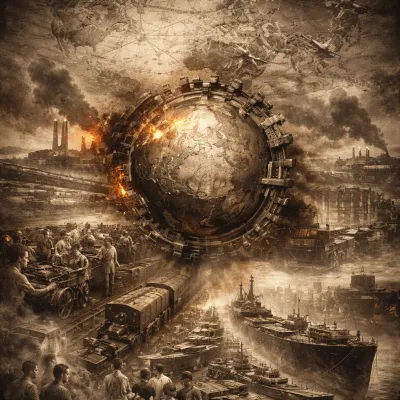
*Global Inferno* examines the Second World War as a cohesive, interdependent system where grand strategy, technological innovation, and social endurance were inextricably linked. The book moves beyond traditional battle narratives to analyze "operational art"—the vital connective tissue that synchronized industrial output and scientific breakthroughs with frontline maneuvers. By exploring theaters ranging from the mechanized velocity of the European Blitzkrieg to the logistical complexities of Pacific island-hopping, the text demonstrates that military brilliance was sustainable only when backed by resilient domestic labor markets, standardized mass production, and the successful management of the "morale economy."
The narrative highlights how the war transformed national structures, turning "arsenal democracies" and totalitarian regimes alike into total-war machines. It details the critical roles of intelligence-sharing (such as ULTRA), the systemic integration of radar and radio, and the desperate global scramble for oil and raw materials. These elements shifted the nature of conflict from a contest of soldiers to a contest of systems, where the ability to maintain supply lines and out-produce the enemy became the ultimate arbiter of victory. Simultaneously, the book addresses the social upheavals of the era, including the reconfiguration of gender roles, the exploitation of colonial manpower, and the harrowing ethical boundaries crossed by strategic bombing and occupation.
The final chapters trace the war's "endgame" and its multifaceted legacies, arguing that the collapse of the Axis powers was a result of systemic exhaustion rather than a single decisive event. The conclusion explores how the institutional habits formed during the conflict—such as centralized economic planning, international coalition-building, and military-scientific partnerships—became the foundational scaffolding for the Cold War order and the modern globalized world. Ultimately, the book presents the Second World War as a transformative "inferno" that forged the contemporary architecture of technology, statecraft, and international security.
What You'll Find Inside:
- Operational art as the vital link between grand strategy and tactics, demonstrating how commanders sequenced offensives, coordinated forces across services, and aligned means with political ends
- The dynamic integration of technology with societal factors, showing how innovations like radar, codebreaking, and carrier aviation succeeded only when combined with training, doctrine, industrial capacity, and public cohesion
- Industrial mobilization's transformation of peacetime economies into war machines, analyzing how labor markets, production lines, and resource networks were reconfigured to sustain total war
- Societies as active combatants, examining home front resilience, gender role shifts, occupation resistance, and how social fabrics determined whether military plans translated into sustainable campaigns
- The enduring legacies of WWII systems that shaped the postwar world, from central planning and scientific-military partnerships to Cold War structures forged in the crucible of total war
Who's It For:
This book is ideal for students and scholars of military history seeking a deeper understanding of World War II beyond traditional battle narratives. It will also appeal to readers interested in the history of technology, industrial mobilization, and how societies function under extreme stress, as well as professionals in defense, strategy, or international relations who need to grasp the interconnected systems that determine success in modern conflict.
Table of Contents:
- Introduction
- Chapter 1 The Architecture of Global War: From Strategy to Society
- Chapter 2 Operational Art Emerges: From the Interwar to Blitzkrieg
- Chapter 3 Breaking France: Maneuver, Morale, and Machines in 1940
- Chapter 4 The Battle of Britain: Air Defense, Radar, and Industrial Throughput
- Chapter 5 The Eastern Front: Attrition, Mobility, and the Soviet War Machine
- Chapter 6 The War at Sea I: U-Boats, Convoys, and the Battle of the Atlantic
- Chapter 7 The War at Sea II: Carriers, Logistics, and the Pacific Turn
- Chapter 8 Island-Hopping: Amphibious Warfare and Joint Command
- Chapter 9 North Africa and the Mediterranean: Logistics as Destiny
- Chapter 10 Strategic Bombing: Technology, Ethics, and Effectiveness
- Chapter 11 Intelligence and Deception: Enigma, ULTRA, and Maskirovka
- Chapter 12 Command, Control, and Communications: Radio, Radar, and Doctrine
- Chapter 13 Firepower and Mobility: Tanks, Artillery, and Combined Arms
- Chapter 14 The Air–Ground Team: Close Air Support, Air Superiority, and Airlift
- Chapter 15 Industrial Mobilization: Arsenal Democracies and Total War Economies
- Chapter 16 Labor, Gender, and the Home Front: Women, Unions, and Migration
- Chapter 17 Science at War: From Penicillin to the Atomic Bomb
- Chapter 18 Resources and the Battle for Oil: Geography, Strategy, and Sabotage
- Chapter 19 Empire and Colony: Manpower, Material, and the Politics of Service
- Chapter 20 Occupation, Resistance, and Civilian Life under Siege
- Chapter 21 Propaganda, Media, and the Morale Economy
- Chapter 22 Allies and Aid: Lend-Lease, Logistics Corridors, and Coalition Frictions
- Chapter 23 Law, Ethics, and the Boundaries of Total War
- Chapter 24 Endgame: Collapse, Surrender, and the Politics of Victory
- Chapter 25 Legacies: Reconstruction, Memory, and the Cold War Order
Author:
Published By:
Date Published:
May 7, 2026
Type:
Nonfiction
Language:
English
Word Count:
74,587 words
Reading Time:
5 hours 13 minutes
Sample:
MixCache.com Total Access
Get unlimited access to this book + all books published by MixCache.com for $11.99/month
Subscribe to MTAOr purchase this book individually below
Order:
Buy the Global Inferno: Strategy, Technology, and Society in the Second World War ebook on MixCache.com:
Buy Now
Full ebook will be available immediately
- read online or download as a PDF file.
$5 account credit for all new MixCache.com accounts, usable toward any ebook purchase!*




Ratings & Reviews
Ask Questions About This Book
Have a question about the content? Ask our AI assistant!
Start by asking a question about "Global Inferno: Strategy, Technology, and Society in the Second World War"
Example: "Does this book mention William Shakespeare?"
Thinking...