
The following is an excerpt from “A History of Algeria” by Samir Bouzid, available on MixCache.com.
Introduction
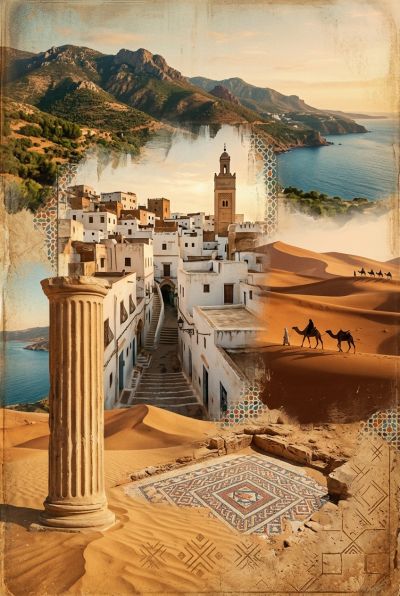
Algeria. The very name conjures a mosaic of potent, often contradictory, images. For some, it is the shimmering Mediterranean coast, the whitewashed Casbah of Algiers tumbling down to a turquoise sea, a landscape of ancient Roman ruins basking under an African sun. For others, it is the vast, silent expanse of the Sahara, a realm of shifting sands, hidden oases, and the otherworldly rock formations of the Tassili n'Ajjer, home to prehistoric art that speaks across millennia. Still others might picture the defiant resilience of its people, the searing intensity of a revolutionary struggle against colonial rule, or the vibrant, complex pulse of a modern nation navigating its place in the 21st century. None of these images are wrong, yet none of them, alone, can capture the essence of a country whose history is a story of profound depth and ceaseless transformation.
To understand Algeria is to understand a place that has, since the dawn of recorded history, been a crossroads. It is a land shaped as much by its formidable geography as by the endless procession of peoples who have arrived on its shores and traversed its deserts. Geographically, the country is a study in grand contrasts. The fertile, coastal plain known as the Tell, home to most of the population, has always been the nation's heartland, a sliver of green pressed between the Mediterranean and the mountains. This was the breadbasket of ancient Rome, a land of olives, wheat, and wine that beckoned conquerors and settlers alike. Immediately to its south rises the Atlas mountain range, a rugged spine that has served as both a refuge and a barrier, a place where rebellious tribes could defy the authority of coastal cities and where distinct cultural identities could be nurtured in isolation.
Beyond the mountains lie the High Plateaus, a semi-arid steppe that transitions into the immense furnace of the Sahara, a desert so vast it constitutes more than four-fifths of the country's total landmass. This ocean of sand and rock was never merely an empty space. It was a corridor, crisscrossed by ancient caravan routes that connected the Mediterranean world with sub-Saharan Africa, facilitating the flow of gold, salt, enslaved people, and ideas. This unique geography—a habitable coast, a defensible mountain interior, and a desert highway—decreed that Algeria would not be a self-contained entity. It was destined to be a stage upon which the great dramas of Mediterranean and African history would be played out. Its story is one of layers, of successive civilizations building upon the ruins of their predecessors, each leaving an indelible mark on the cultural, genetic, and political landscape.
The deepest layer of this story belongs to the Amazigh people, known more commonly to the outside world by the name the Romans gave them: the Berbers. They are the indigenous inhabitants of North Africa, their presence stretching back into the mists of prehistory. Their languages, cultures, and traditions form the bedrock of Algerian identity. Long before the arrival of Phoenician sailors or Roman legionaries, Amazigh kingdoms flourished. The most powerful of these, Numidia, rose to prominence as a formidable player in the epic struggle between Rome and Carthage. The tale of its kings, like Masinissa and Jugurtha, is not merely a prelude to Roman conquest but a foundational chapter in the story of Algerian statecraft and resistance, a theme that would echo down the centuries.
The arrival of Rome transformed the coastal region into a vital part of the empire. For centuries, cities like Timgad, Djémila, and Cherchell were centers of Roman power and culture, their magnificent ruins today testifying to a period of prosperity and integration into the Mediterranean world. It was during this era that Christianity took root, producing influential figures like Saint Augustine of Hippo, a towering intellect of the late Roman world whose theological writings would shape Western thought for a thousand years. Yet Roman rule, like all empires, had its limits. Its influence was felt most profoundly in the cities and the fertile plains, while in the mountains and the desert fringes, Amazigh identity remained fiercely independent, often erupting into open revolt.
The collapse of Roman authority in the 5th century ushered in a period of chaos, marked by the brief but disruptive invasion of the Germanic Vandals, followed by a partial and tenuous reconquest by the Byzantine Empire. This interlude, however, was but a preface to the most transformative event in Algeria's post-classical history: the arrival of Arab armies in the 7th century. The Arab conquest brought with it not just a new ruling elite and a new language, but a new religion, Islam, which would fundamentally and permanently reshape the region's spiritual and cultural identity. The process of conversion was gradual and complex, but Islam provided a powerful new framework for social and political organization, linking North Africa to a vibrant, expanding civilization that stretched from the Iberian Peninsula to Central Asia.
The fusion of Arab and Amazigh cultures under the banner of Islam gave rise to a series of powerful local dynasties. From the Zirids and Hammadids, who presided over a flourishing of arts and scholarship, to the great pan-Maghribi empires of the Almoravids and Almohads, who forged vast territories stretching from Spain to Libya, this was an era in which North Africa was a center of power in its own right, not merely a provincial outpost of a distant empire. The Zayyanid Kingdom of Tlemcen, in particular, stands out as a distinctly Algerian state that, for three centuries, controlled the central Maghreb, expertly navigating the complex geopolitics of the medieval Mediterranean.
By the 16th century, the geopolitical landscape had shifted once again. Facing increasing pressure from an expansionist Christian Spain, the coastal cities of Algeria turned to the rising power of the Ottoman Empire for protection. This led to the establishment of the Regency of Algiers, an Ottoman province in name but a fiercely autonomous state in practice. For three hundred years, Algiers was a formidable naval power in the Mediterranean, its corsairs a source of terror and fascination for the maritime nations of Europe. This "Barbary Coast" era, often romanticized or villainized in Western accounts, was in reality a complex period of state-sponsored privateering, diplomacy, and trade that made Algiers a wealthy and powerful city, albeit one whose economy was built on a foundation of maritime predation and a vast trade in captives.
This long chapter of Ottoman-Algerian history came to an abrupt and violent end in 1830. Under the pretext of a diplomatic insult, France launched a full-scale invasion, capturing the city of Algiers and embarking on a brutal, decades-long campaign to conquer the interior. The French colonial project in Algeria was unlike any other in their empire. It was not merely a venture of economic exploitation but one of settlement. Over the next century, hundreds of thousands of European settlers, the pieds-noirs, arrived, seizing the best agricultural land and creating a colonial society built on the political, economic, and social subjugation of the indigenous Muslim population. The French conquest was met with fierce and prolonged resistance, most famously led by the Emir Abdelkader, a brilliant military and spiritual leader who for years defied the might of the French army. His struggle, and countless other uprisings that followed, laid the groundwork for a modern Algerian nationalism.
Life under French rule was a period of profound dislocation for the Algerian people. Their society was systematically dismantled, their lands confiscated, and their identity marginalized. Yet it was also a period of unintended consequences. The very tools of the colonial state—modern education, a centralized administration, and new forms of political organization—were eventually turned against it. Through the early 20th century, and particularly in the aftermath of the two World Wars in which countless Algerians fought and died for France, a new nationalist consciousness began to stir. The brutal massacre of Algerian civilians by French forces in Sétif and Guelma in 1945 shattered any remaining illusions of liberty, equality, and fraternity within the colonial system, setting the stage for an armed struggle.
The Algerian War of Independence, which began on November 1, 1954, was one of the longest, bloodiest, and most iconic decolonization conflicts of the 20th century. It was a brutal war of attrition, characterized by the guerrilla tactics of the National Liberation Front (FLN) and the ruthless counter-insurgency methods of the French army, including the widespread use of torture. The conflict ripped French society apart and brought the Fourth Republic to its knees, ultimately leading to Charles de Gaulle's return to power. After nearly eight years of savage fighting and immense human suffering, the Evian Accords were signed, granting Algeria its independence in 1962.
The joy of liberation was soon tempered by the immense challenges of nation-building. The new Algerian state, under its first leaders Ahmed Ben Bella and Houari Boumédiène, embarked on an ambitious program of state-led industrialization and socialist reform. The FLN, once a broad-based liberation movement, solidified its grip on power, transforming Algeria into a single-party state. For decades, the country rode the highs and lows of global oil prices, its political stability and social contract underwritten by hydrocarbon revenues. This system, however, bred corruption, stifled political dissent, and created a growing disconnect between the ruling elite and a young, rapidly growing population.
By the late 1980s, economic crisis and social unrest forced the regime to open up the political system. This democratic experiment was short-lived. The stunning electoral success of the Islamic Salvation Front (FIS) in 1991 prompted a military coup, plunging the country into a devastating civil war. The "Black Decade" of the 1990s was a period of unimaginable violence, a multifaceted conflict between the state's security forces and various Islamist insurgent groups that left an estimated 200,000 people dead and scarred the national psyche for a generation.
The end of the civil war saw the rise of Abdelaziz Bouteflika, who would go on to dominate Algerian politics for two decades. His presidency was marked by a national reconciliation program aimed at healing the wounds of the civil war, coupled with high oil prices that funded massive public spending projects. But this stability came at the cost of political stagnation and endemic corruption. The system grew sclerotic, a gerontocracy seemingly frozen in time. The dam finally broke in 2019. When the aging and infirm Bouteflika announced his intention to run for a fifth term, millions of Algerians poured into the streets in a massive, peaceful protest movement known as the Hirak. This unprecedented popular uprising demanded a radical overhaul of the entire political system, a "second independence," and a new chapter in the nation's history.
This book aims to narrate this long, complex, and often turbulent story. It is a history marked by violence and conquest, but also by extraordinary resilience, cultural brilliance, and an unyielding struggle for identity and independence. From the Numidian horsemen who challenged Rome to the modern-day protesters of the Hirak, the story of Algeria is the story of a people forged in the crucible of a Mediterranean and African crossroads, a nation perpetually reinventing itself while striving to remain true to its ancient roots. It is a history that is not merely Algerian, but one that is essential to understanding the broader narrative of North Africa, the Mediterranean world, and the enduring legacies of empire and liberation.
Read “A History of Algeria” on MixCache.com →
Please log in or create an account to leave a comment.
No comments yet. Be the first to say something.