
Browse by Category
Fiction
- Action & Adventure
- African American
- Anthologies
- Children's Fiction
- Classics
- Comics & Graphic Novels
- Coming of Age
- Contemporary
- Cultural & Regional
- Drama
- Erotica
- Fantasy
- General
- Historical Fiction
- Horror
- Humor & Satire
- Literary Fiction
- Mystery, Thriller & Suspense
- Poetry
- Religious & Inspirational
- Romance
- Science Fiction
- Short Stories
- War & Military
- Westerns
- Women's Fiction
- Young Adult
Non-Fiction
- Antiques & Collectibles
- Arts & Photography
- Biographies & Memoirs
- Business & Money
- Children's Non-Fiction
-
Computers & Technology
- Artificial Intelligence
- Computer Science
- Cybersecurity & Cryptography
- Data Science & Analytics
- Databases & Big Data
- Game Development & Design
- General
- Hardware & DIY
- Mobile App Development
- Networking & Cloud Computing
- Operating Systems
- Programming
- Robotics
- Software
- Software Engineering
- User Experience (UX) & Design
- Web Development & Design
- Cooking, Food & Wine
- Crafts, Hobbies & Home
- Education & Teaching
- Engineering
- General
- Health, Fitness & Dieting
-
History
- African History
- African History - North Africa
- African History - Sub-Saharan Africa
- American History
- American History - 20th Century
- American History - Civil War
- American History - Colonial Period
- Ancient History
- Asian History
- Asian History - China
- Asian History - India
- Asian History - Japan
- Asian History - Southeast Asia
- European History
- European History - Ancient Greece
- European History - Ancient Rome
- European History - Medieval
- European History - Modern
- European History - Renaissance
- General
- Middle Eastern History
- Military History
- Military History - Aviation
- Military History - Naval
- Social & Cultural History
- World History
- Humor & Entertainment
- Industrial Technology
- Language Learning
- Law
- LGBTQ+ Non-Fiction
- Literary Criticism
- Medical Books
- Parenting & Relationships
- Philosophy
- Politics & Social Sciences
- Reference
- Religion & Spirituality
-
Science & Math
- Agricultural Sciences
- Astronomy & Space Science
- Behavioral Sciences
- Biological Sciences
- Botany & Plant Science
- Chemistry
- Earth Sciences
- Engineering - Chemical
- Engineering - Civil
- Engineering - Electrical
- Engineering - Mechanical
- Environment
- General
- Geology
- Mathematics
- Nature & Ecology
- Oceanography
- Paleontology
- Physics
- Statistics
- Self-Help
- Sports & Outdoors
- Study Aids
- Sustainability & Green Living
- Textbooks
- Transportation
- Travel
- True Crime
- Urban Planning & Development
- Veterinary Medicine
- Writing & Publishing
Jump to Section
MixCache.com Total Access
Unlimited reading and audiobooks for every book published by MixCache.com.
Included titles carry the MTA badge.
Learn more →A History of Algeria
About this book:
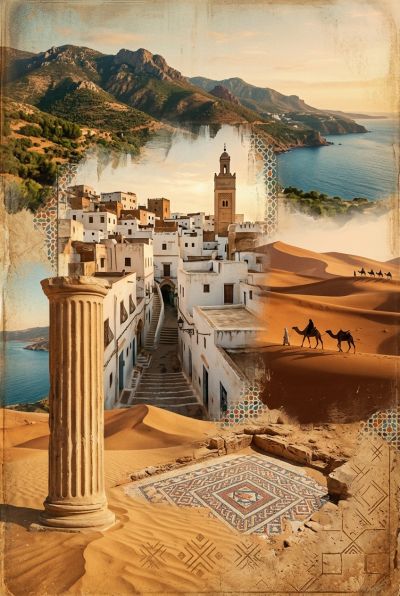
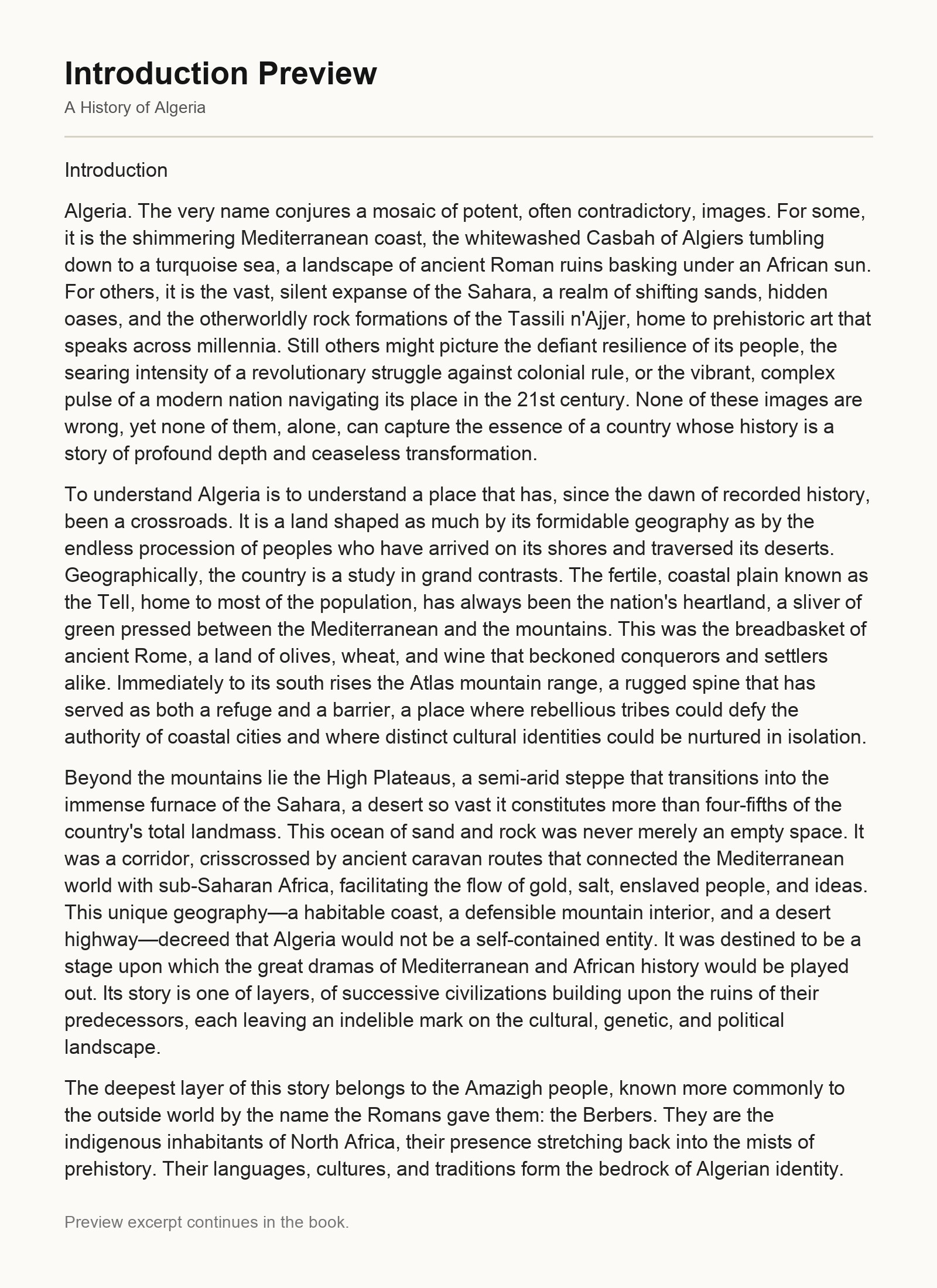
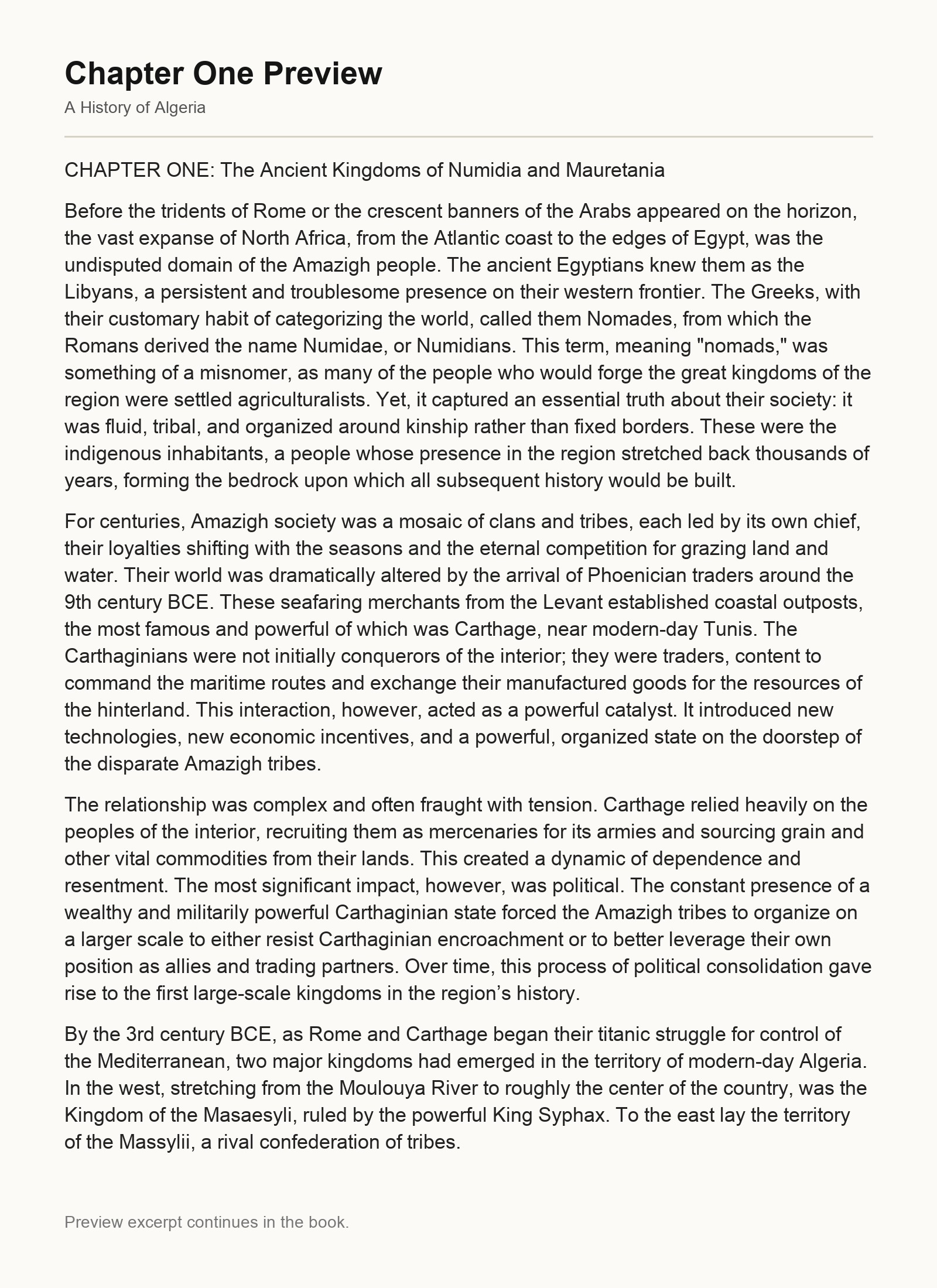
A History of Algeria offers readers a sweeping journey through the many layers that have shaped one of North Africa’s most pivotal nations. Beginning with the indigenous Amazigh societies and the powerful kingdoms of Numidia and Mauretania, the book traces how geography and trade made the region a crossroads for Phoenicians, Romans, Vandals, and Byzantines. Readers will gain insight into the rise of early Christian centers, the legacy of figures like Saint Augustine, and the gradual transformation of local cultures under successive waves of conquest and conversion.
The narrative continues with the Arab conquest and the spread of Islam, showing how a new religious and linguistic framework fused with Berber identity to produce influential dynasties such as the Zirids, Hammadids, and later the Almoravid and Almohad empires. Chapters detail the intellectual and artistic flourishing of medieval Algeria, the strategic importance of trans‑Saharan trade, and the political fragmentation that followed the Hilalian migrations, setting the stage for the Ottoman Regency of Algiers and its renowned Barbary corsairs who dominated Mediterranean maritime affairs for three centuries.
French colonial rule is examined in depth, from the brutal 1830 invasion and the long resistance of Emir Abdelkader to the systematic land seizures, settler society, and the discriminatory Code de l’Indigénat that governed daily life for indigenous Algerians. The book explains how World Wars I and II intensified nationalist sentiment, how the Sétif and Guelma massacres of 1945 shattered hopes for reform, and how the ensuing war of independence unfolded through the FLN’s guerrilla campaign, the Battle of Algiers, and the eventual Evian Accords that ended 132 years of French domination.
Post‑independence Algeria is explored through the tumultuous early years of Ben Bella and Boumédiène, the socialist industrialization fueled by oil wealth, the rise of political Islam, the devastating civil war of the 1990s, and the uneasy reconciliation under Bouteflika. Readers will experience the birth of the Hirak movement in 2019, a peaceful mass uprising that challenged a stagnant regime, and the subsequent political and economic challenges facing contemporary Algeria, including hydrocarbon dependence, regional rivalries, and the quest for genuine democratic renewal. By the end, the reader will have a comprehensive understanding of how Algeria’s ancient roots, colonial scars, and relentless struggle for self‑determination continue to shape its present and future.
What You'll Find Inside:
- Comprehensive chronological coverage of Algeria's history from ancient Berber kingdoms through Roman, Vandal, Byzantine, Arab, and Ottoman periods to French colonization and independence struggle
- Detailed analysis of the Algerian War of Independence (1954-1962) including the rise of the FLN, urban guerrilla tactics in the Battle of Algiers, and independence through the Evian Accords
- Examination of post-independence governance including Ben Bella's charismatic leadership, Boumédiène's socialist industrialization, the single-party state, and the rise of political Islam challenging the FLN regime
- In-depth look at the 'Black Decade' civil war (1991-2002) following the military cancellation of elections that would have brought the Islamic Salvation Front to power, resulting in approximately 200,000 deaths
- Analysis of contemporary Algeria including Bouteflika's two-decade rule, the 2019 Hirak protest movement demanding systemic change, and current challenges of economic dependence on hydrocarbons and political legitimacy
Who's It For:
This comprehensive history is ideal for university students and scholars of North African studies, post-colonial history, and Middle Eastern politics. It will particularly benefit researchers focusing on decolonization movements, nationalist struggles, and the complex interplay between religion, identity, and state formation in Algeria. General readers seeking to understand Algeria's role in Mediterranean and African history, as well as policy makers and analysts working on contemporary North African affairs, will find valuable historical context for current events.
Table of Contents:
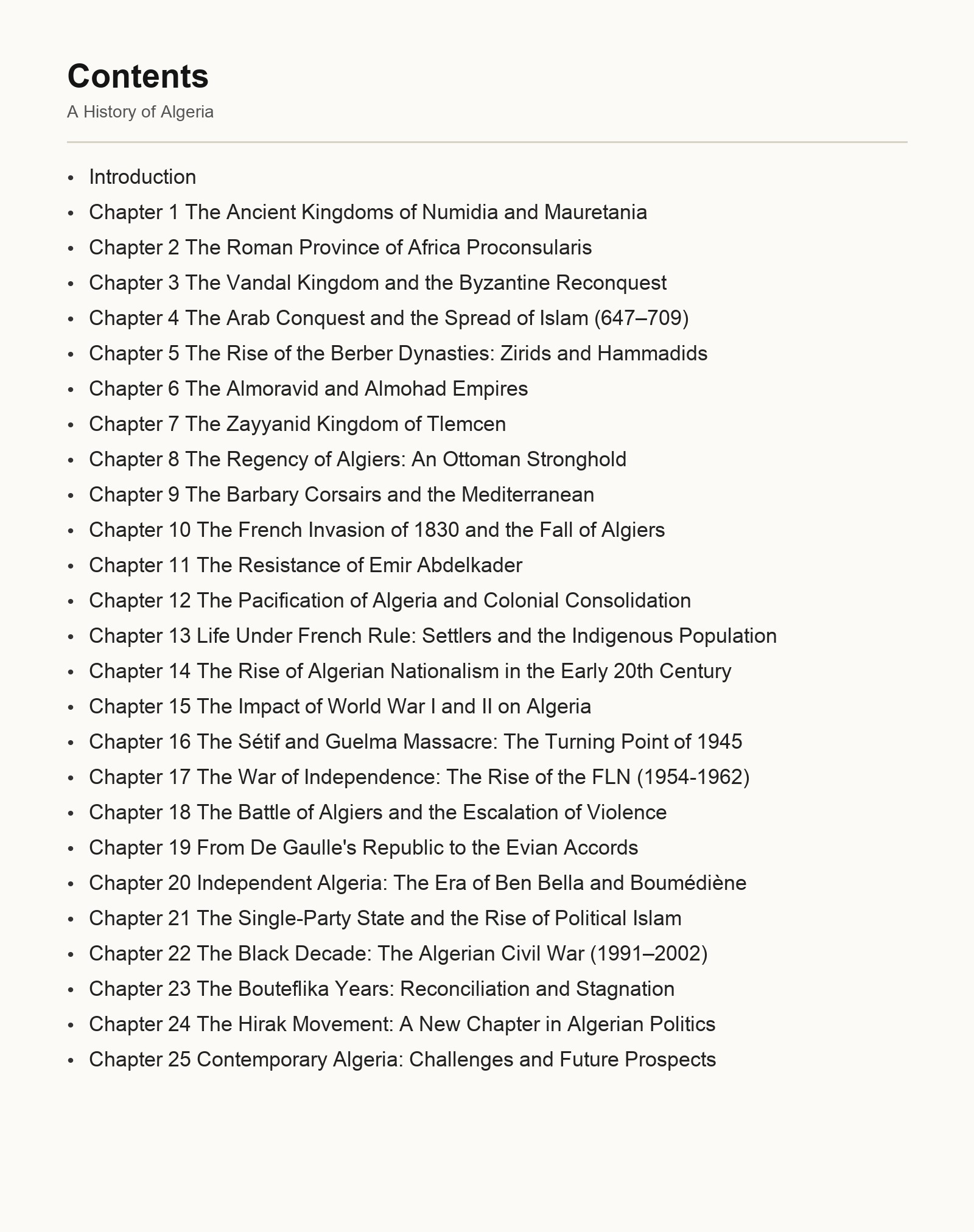
- Introduction
- Chapter 1 The Ancient Kingdoms of Numidia and Mauretania
- Chapter 2 The Roman Province of Africa Proconsularis
- Chapter 3 The Vandal Kingdom and the Byzantine Reconquest
- Chapter 4 The Arab Conquest and the Spread of Islam (647–709)
- Chapter 5 The Rise of the Berber Dynasties: Zirids and Hammadids
- Chapter 6 The Almoravid and Almohad Empires
- Chapter 7 The Zayyanid Kingdom of Tlemcen
- Chapter 8 The Regency of Algiers: An Ottoman Stronghold
- Chapter 9 The Barbary Corsairs and the Mediterranean
- Chapter 10 The French Invasion of 1830 and the Fall of Algiers
- Chapter 11 The Resistance of Emir Abdelkader
- Chapter 12 The Pacification of Algeria and Colonial Consolidation
- Chapter 13 Life Under French Rule: Settlers and the Indigenous Population
- Chapter 14 The Rise of Algerian Nationalism in the Early 20th Century
- Chapter 15 The Impact of World War I and II on Algeria
- Chapter 16 The Sétif and Guelma Massacre: The Turning Point of 1945
- Chapter 17 The War of Independence: The Rise of the FLN (1954-1962)
- Chapter 18 The Battle of Algiers and the Escalation of Violence
- Chapter 19 From De Gaulle's Republic to the Evian Accords
- Chapter 20 Independent Algeria: The Era of Ben Bella and Boumédiène
- Chapter 21 The Single-Party State and the Rise of Political Islam
- Chapter 22 The Black Decade: The Algerian Civil War (1991–2002)
- Chapter 23 The Bouteflika Years: Reconciliation and Stagnation
- Chapter 24 The Hirak Movement: A New Chapter in Algerian Politics
- Chapter 25 Contemporary Algeria: Challenges and Future Prospects
Author:
Published By:
Date Published:
May 21, 2026
Type:
Nonfiction
Language:
English
Also Available In:
Word Count:
50,561 words
Reading Time:
3 hours 32 minutes
Sample:
Order:
Buy the A History of Algeria ebook on MixCache.com:
Buy NowThe full ebook will be available immediately to read instantly on any device.
$5 account credit for all new MixCache.com accounts, usable toward any ebook purchase!*





Ratings & Reviews
Ask Questions About This Book
Have a question about the content? Ask our AI assistant!
Start by asking a question about "A History of Algeria"
Example: "Does this book mention William Shakespeare?"
Thinking...